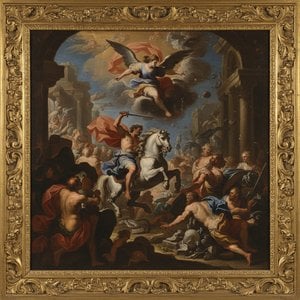
A Divine Encounter in Oil: The Essence of Poussin’s Masterpiece
In the quiet, hallowed atmosphere of Nicolas Poussin’s The Institution of the Eucharist, time seems to suspend itself, inviting the viewer into a moment of profound spiritual gravity. Completed in 1640, this monumental work serves as a cornerstone of the French Baroque, yet it eschews the frantic energy often associated with the era in favor of a serene, intellectual clarity. As one gazes upon the canvas, the scene unfolds not merely as a historical recount of the Last Supper, but as an eternal ritual. Pous sin captures the precise instant where the earthly meets the divine, orchestrating a composition that feels both monumental and intimately personal. For the discerning collector or interior designer, this piece offers more than just visual beauty; it provides a focal point of contemplative depth, capable of anchoring a room with its solemnity and grace.
The technical mastery on display is a testament to Poussin’s unique position as a bridge between the sensuality of the Venetian school and the rigorous logic of Neoclassicism. Through a masterful command of chiaroscuro, the artist utilizes light not just to illuminate, but to sculpt. The flickering glow from unseen candles breathes life into the figures, casting dramatic shadows that lend a sculptural solidity to the disciples. This interplay of light and dark creates a sense of three-dimensional presence, making the figures feel as though they occupy the same physical space as the observer. The pyramidal composition, with Christ positioned at the apex, directs the eye upward in a silent prayer, ensuring that the viewer’s gaze is perpetually drawn toward the spiritual heart of the narrative.
Symbolism and the Architecture of Faith
Beyond its aesthetic brilliance, the painting is a complex tapestry of theological symbolism and historical resonance. Painted during the height of the Counter-Reformation, every element within the frame serves to reaffirm the sanctity of the Eucharist. The meticulous arrangement of objects—the books, the vessels, and the subtle placement of light—reflects the humanist ideals of the age, blending Christian doctrine with the structured logic of classical antiquity. Poussin’s ability to weave these intellectual threads into a cohesive visual narrative allows the painting to function as both an object of devotion and a triumph of academic precision.
For those seeking to integrate such a masterpiece into a curated space, The Institution of the Eucharist offers an unparalleled emotional impact. It possesses a quiet authority that commands respect without overwhelming its surroundings. Whether placed in a library, a formal study, or a grand hall, a high-quality reproduction of this work brings with it an aura of timelessness and intellectual rigor. It is a piece that does not merely decorate a wall; it transforms an environment into a sanctuary of thought and reflection, celebrating the enduring power of classical beauty and the profound mysteries of the human spirit.
Gyakran Ismételt Kérdések
Mit ábrázol a „The eucharist”, Poussin alkotása?
A „The eucharist”, Poussin alkotása alkotás témái közé tartozik a last supper, eucharist, classical art, religious scene, baroque painting, roman triclinium, light and shadow. Ezek együtt foglalják össze a mű tárgyát.
Milyen viszonyban állnak egymáshoz a "The eucharist" színei?
A „The eucharist”, Poussin alkotása színei Strong Color Unity harmóniát mutatnak bemutatni. A harmónia azt írja le, hogyan kapcsolódnak egymáshoz a színek.
Melyik helyiségbe illik jól a "The eucharist" reprodukciója az otthonunkban?
A „The eucharist”, Poussin alkotása ajánlott egy Living Room számára. Ez a javaslat a mű témáján, színein és hangulatán alapul.



 Előnézet
 Kézzel festett másolat vásárlása
 Megosztás
 Megosztás
 Részletek
 Útmutató

 Letöltés
 Hasonló darabok
 X-ray felvétel
 Diavetítés
 Statisztika

 Tovább olvasom






































 Az üvegkeretes opció csak 110 cm alatti méretben érhető el