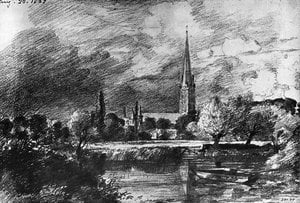
John Constable’s *Harnham Gate, Salisbury*: A Window into Rural Harmony
John Constable’s *Harnham Gate, Salisbury*, painted between 1820 and 1821, isn't merely a depiction of an English landscape; it’s a profound evocation of a world steeped in tranquility, a moment captured with an almost palpable sense of peace. This painting transcends the simple act of recording a scene; instead, Constable invites us to step into a timeless realm where the rhythms of rural life intertwine seamlessly with the grandeur of nature and the enduring presence of faith. The work speaks volumes about the Romantic movement’s fascination with the sublime beauty of the English countryside and Constable's unique ability to translate that experience onto canvas.
The scene itself is deceptively simple: a weathered stone gate, the *Harnham Gate*, stands as a threshold between the bustling city of Salisbury and the quiet expanse of the surrounding Wiltshire landscape. The gate’s arched entrance frames a view dominated by the imposing silhouette of Salisbury Cathedral, its spire piercing the sky – a symbol not just of architectural achievement but also of spiritual authority and historical continuity. Constable masterfully uses this vertical element to anchor the composition, providing a sense of scale and perspective that draws the eye into the distance.
A Masterclass in Romantic Technique
Constable’s technique is nothing short of revolutionary for his time. He eschews the smooth, polished surfaces favored by earlier landscape painters, opting instead for a distinctive “broken brushstroke.” This isn't about meticulous detail; rather, it’s about capturing the *feeling* of light and atmosphere. He builds up layers of thin, translucent paint – often using palette knives alongside brushes – creating a textured surface that seems to shimmer with reflected light. The colors are muted yet vibrant, dominated by earthy greens, browns, and greys, punctuated by the cool blues and purples of the overcast sky. This deliberate lack of sharp edges contributes significantly to the painting’s sense of depth and immediacy.
Notice particularly how Constable renders the foliage – not as individual leaves but as masses of color and texture. He employs a technique known as *sfumato*, blurring the outlines and creating an atmospheric haze that softens the forms and suggests movement in the breeze. The light, constantly shifting and changing, is captured with remarkable sensitivity, lending the scene a sense of fleeting beauty.
Symbolism and the English Landscape
The choice of *Harnham Gate* as the focal point carries significant symbolic weight. As a medieval gateway, it represents a transition – a passage between the urban world and the rural countryside, between civilization and nature. Constable’s inclusion of figures—a solitary pedestrian and two horses—adds a human element to this scene, suggesting a harmonious coexistence with the landscape. These aren't heroic or dramatic figures; they are ordinary individuals going about their daily lives, reinforcing Constable’s commitment to portraying beauty in the commonplace.
Furthermore, the painting is deeply rooted in the context of Salisbury and its history. The city was then a significant ecclesiastical center, and the cathedral held immense spiritual importance. Constable's patron, John Fisher, Bishop of Salisbury during this period, frequently visited the area, inspiring many of his landscapes. The spire’s prominence serves as a constant reminder of this connection between faith, tradition, and the enduring spirit of the region.
An Enduring Legacy: A Connection to Place
*Harnham Gate, Salisbury* continues to resonate with viewers today because it speaks to a universal longing for connection with nature and a simpler way of life. Constable’s ability to infuse his landscapes with such palpable emotion is what sets him apart. He wasn't simply painting what he saw; he was painting how it *felt* to be there, to experience the sights, sounds, and smells of the English countryside. A reproduction of this masterpiece brings not just an image into your home but a sense of peace, tranquility, and a connection to a rich artistic heritage – a reminder that beauty can be found in the most unassuming corners of our world.



 Előnézet
 Váltás nyomtatványra
 Megosztás
 Megosztás
 Részletek
 Útmutató

 Letöltés
 Hasonló darabok
 X-ray felvétel
 Diavetítés
 Statisztika

 Tovább olvasom






































 Az üvegkeretes opció csak 110 cm alatti méretben érhető el