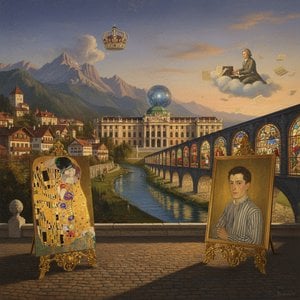
Gustav Klimt – A Symphony of Gold and Mystery: “Die Musik”
Gustav Klimt’s “Die Musik” (1895), housed within the Bavarian State Painting Collections in Munich, isn't merely a painting; it’s an immersive experience, a visual poem meticulously crafted in the shimmering language of Art Nouveau. This captivating work transcends simple representation, offering a profound meditation on art itself, the ephemeral nature of time, and the delicate balance between harmony and chaos. Klimt, a pivotal figure within Vienna’s Secession movement – a group dedicated to challenging artistic conventions – masterfully employed his signature style—a potent blend of opulent decoration, layered symbolism, and an undeniable, alluring sensuality—to create a piece that continues to resonate with viewers over a century later. “Die Musik” isn't about depicting a literal scene; it’s about capturing the *feeling* of music, its creation, and its profound impact on the human spirit.
At first glance, the painting presents a seemingly straightforward tableau: a woman seated at a grand piano, her hands poised over the keys. However, Klimt's genius lies in transforming this commonplace scene into something far more complex and layered. The background isn’t merely a backdrop; it’s an intricate tapestry woven with symbolic elements designed to provoke contemplation. A prominent clock, frozen at a specific moment – perhaps representing the fleeting nature of time itself – dominates the composition, while a vase overflowing with vibrant flowers symbolizes elegance, refinement, and the transient beauty of life. A subtle skull, a recurring motif in Klimt’s oeuvre, serves as a poignant reminder of mortality, grounding the scene in an awareness of transience and urging us to appreciate the present moment. Two figures are subtly integrated into the composition: one standing partially obscured to the left of the woman, adding an element of mystery and intrigue, and another appearing further back on the right side, suggesting a narrative that extends beyond the immediate depiction.
The Art Nouveau Influence and Klimt’s Unique Vision
“Die Music” is deeply rooted in the principles of Art Nouveau – also known as Jugendstil in Germany. This movement celebrated beauty, nature, and craftsmanship, rejecting the rigid academic styles of the past. Klimt's masterful application of gold leaf—a technique he perfected during his travels to Italy—elevates the painting to an almost ethereal level. The shimmering gold not only adds visual richness but also symbolizes eternity, divinity, and the transformative power of art itself. This lavish use of gold was revolutionary for its time, challenging traditional notions of painting and pushing the boundaries of artistic expression. Klimt didn’t simply *use* gold; he integrated it seamlessly into the fabric of the composition, creating a sense of luminous depth and otherworldly beauty.
Beyond its aesthetic qualities, “Die Music” is rich in symbolic meaning. The woman at the piano is often interpreted as representing harmony and beauty—the very essence of music itself. Her posture, her focused gaze, and her connection to the instrument all contribute to this interpretation. Klimt’s deliberate choice of a female subject reflects the prevalent fascination with femininity during the late 19th century, but also subtly challenges conventional gender roles by portraying a woman as an active creator—a musician shaping sound and emotion. The painting can be viewed as a meditation on the creative process, the power of art to transcend time and mortality, and the enduring allure of beauty and harmony. It’s a testament to Klimt's ability to imbue a seemingly simple scene with profound emotional depth and intellectual complexity.
Historical Context and Artistic Legacy
Created in 1895, “Die Music” emerged during a period of significant artistic ferment in Vienna. The Secession movement was challenging the conservative establishment and exploring new forms of expression. Klimt’s work reflects this spirit of innovation, pushing the boundaries of traditional painting techniques and incorporating elements of symbolism and eroticism. The painting's influence can be seen in the works of subsequent artists, particularly those associated with the Symbolist and Expressionist movements. It remains a powerful example of Art Nouveau’s decorative intensity and its ability to evoke complex emotions through carefully chosen symbols and colors.
Further resources for exploring this masterpiece include the original artwork details available at WahooArt.com, a detailed WikiArt analysis at WikiArt, and an image available on Wikimedia Commons: Wikimedia Commons. These resources offer valuable insights into the painting’s creation, historical context, and artistic significance.
Size: Unknown
Date: Unknown
Artist Information
Artist: Gustav Klimt
Birth Year: 1862
Death Year: 1918
Birth City: Baumgarten
Birth Country: Austria
Biography:
Early Life and Artistic Beginnings
Gustav Klimt, born July 14, 1862, in Baumgarten near Vienna, emerged from a family touched by both artistic inclination and financial hardship. His father, Ernst Klimt, was a gold engraver, a profession that would subtly yet profoundly influence the young Gustav’s aesthetic sensibilities—the allure of gold leaf, the meticulous detail, the sheer opulence. The family's struggles meant frequent moves within Vienna, a transient upbringing that perhaps fostered in Klimt a keen observation of his surroundings and a sensitivity to human experience. Even as a child, his drawing skills were remarkable, nurtured by his father’s profession and an innate talent that quickly became apparent. In 1876, he entered the Vienna Kunstgewerbeschule (School of Applied Arts), embarking on formal training in architectural painting under Ferdinand Laufberger. This provided him with a solid technical foundation, but also exposed him to the prevailin



 Előnézet
 Váltás nyomtatványra
 Megosztás
 Megosztás
 Részletek
 Útmutató

 Letöltés
 Hasonló darabok
 X-ray felvétel
 Diavetítés
 Statisztika

 Tovább olvasom






































 Az üvegkeretes opció csak 110 cm alatti méretben érhető el