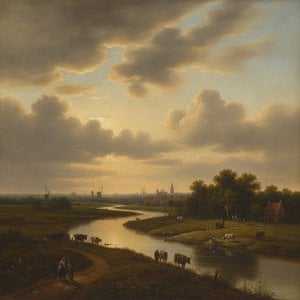
George Gray: A Painter of Light and Landscape
George Robert Gray (1808-1872) emerged from the bustling intellectual landscape of Victorian England as a remarkably observant and deeply personal artist, primarily known for his exquisite fruit still lifes and evocative portraits. While often categorized within the broader tradition of British painting, Gray’s work possesses a unique sensibility—a quiet intensity combined with an almost scientific precision in rendering light and form. His legacy rests not only on the beauty of his paintings but also on his significant contribution to the field of entomology, a pursuit that profoundly shaped his artistic eye.
Born in Little Chelsea, London, into a family steeped in intellectual pursuits—his father was a pharmacologist and botanist, Samuel Frederick Gray—George’s early life fostered an appreciation for detail and observation. He received a solid education at Merchant Taylor's School, but his restless spirit and keen interest in the natural world led him away from formal academic training. Instead, he apprenticed himself to the renowned portrait painter Thomas Busby, gaining invaluable experience in capturing likeness and atmosphere. However, Gray’s true passion lay not solely in replicating reality but in understanding its underlying structure—a trait that would become central to his artistic practice.
Gray's career truly took flight when he joined the British Museum as Assistant Keeper of the Zoology Branch in 1831. This role provided him with unparalleled access to a vast collection of specimens and, crucially, the opportunity to study them meticulously. His work on insects—particularly Lepidoptera (butterflies and moths)—became legendary, culminating in his monumental publication, *Genera of Birds* (1844-49), illustrated by David William Mitchell and Joseph Wolf. This ambitious undertaking, encompassing over 46,000 references, cemented Gray’s reputation as a leading entomologist and demonstrated his extraordinary ability to synthesize information and translate it into visual form. The detailed illustrations, rendered with remarkable accuracy, reveal the same meticulous attention to detail that would later characterize his paintings.
The Art of Still Life
While Gray's entomological work is undeniably significant, it was in the realm of still life painting that he truly achieved lasting recognition. His fruit arrangements—apples, pears, grapes, and plums—are not merely depictions of objects; they are carefully constructed meditations on light, color, texture, and decay. He eschewed the overly sentimental or decorative approaches favored by some of his contemporaries, instead opting for a rigorously analytical approach. Gray would often spend days observing a single fruit, studying its form from every angle, noting the subtle shifts in color as it ripened or began to spoil.
His technique was characterized by a remarkable control of brushwork and glazing—thin layers of paint applied over time to build up depth and luminosity. He employed a limited palette of muted tones—ochres, browns, greens, and blues—to create a sense of atmospheric perspective and evoke the feeling of light filtering through a window. The shadows are particularly masterful, conveying not just darkness but also the texture and volume of the fruit itself. Gray’s still lifes possess an almost photographic quality, yet they are far from cold or sterile; they radiate with warmth and vitality.
Influences and Style
Gray's artistic style can be traced back to a confluence of influences. He was deeply affected by the works of Dutch Masters like Rembrandt and Jan van Eyck, particularly their mastery of light and shadow. The meticulous detail and atmospheric perspective evident in his paintings recall the Northern Renaissance tradition. However, Gray’s work also demonstrates an awareness of contemporary trends, including the influence of Pre-Raphaelite painters such as William Holman Hunt and John Everett Millais, who shared his interest in naturalism and symbolism.
Furthermore, Gray's scientific training undoubtedly shaped his artistic approach. His ability to dissect objects into their constituent parts—a skill honed through years of studying insects—translated into a remarkable understanding of form and structure. This analytical sensibility is evident in the precise rendering of fruit surfaces, the subtle gradations of color, and the careful arrangement of elements within each composition.
Legacy and Recognition
Despite his considerable talent and dedication, Gray’s work received relatively little recognition during his lifetime. He primarily exhibited at smaller galleries and private collections, and his paintings were largely overlooked by the major art institutions of London. However, in recent decades, Gray's oeuvre has experienced a significant revival, thanks to the efforts of dedicated collectors and scholars who have championed his unique vision. His paintings are now widely admired for their technical brilliance, emotional depth, and quiet beauty.
Gray’s influence extends beyond the realm of painting. He was also a passionate advocate for scientific education and a generous benefactor to various charitable organizations. His life exemplifies a rare combination of intellectual curiosity, artistic talent, and human compassion—a legacy that continues to inspire artists and scholars today. His work remains a testament to the power of observation, the beauty of simplicity, and the enduring appeal of light and landscape.



 Előnézet
 Váltás nyomtatványra
 Megosztás
 Megosztás
 Részletek
 Útmutató

 Letöltés
 Hasonló darabok
 X-ray felvétel
 Diavetítés
 Statisztika

 Tovább olvasom






































 Az üvegkeretes opció csak 110 cm alatti méretben érhető el