Megtekintés AR előnézet Kézzel festett másolat rendelése Áttérés digitális képre Küldés
Részletek Útmutató Kedvencekhez ad Letöltés Hasonló darabok X-ray felvétel Diavetítés Statisztika

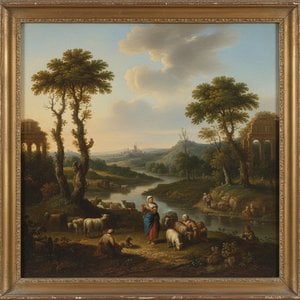
Imaginary Landscape

Explore Francisque Millet's 'Imaginary Landscape,' a serene Belgian Baroque masterpiece inspired by Poussin and Dughet, depicting figures strolling amidst mountains and classical architecture.

Francisque Millet (1642-1679): Flemish-French Baroque painter of serene Italianate landscapes & figures, influenced by Poussin. Discover his legacy & artworks!

Giclée / Műnyomat

Múzeumi minőségű giclée vagy vászonnyomat, gyors gyártással és rugalmas finomítási lehetőségekkel. ( Kézzel festett másolat rendelése Áttérés digitális képre)

Corner sample of the P118B picture frame: formázott polisztirol, 5 cm wide and 3 cm thick
P118B Ft10
Corner sample of the P118H picture frame: formázott polisztirol, 5 cm wide and 3 cm thick
P118H Ft10
Corner sample of the P118W picture frame: formázott polisztirol, 5 cm wide and 3 cm thick
P118W Ft10
Corner sample of the P438Z picture frame: formázott polisztirol, 5.5 cm wide and 3.5 cm thick
P438Z Ft10
Corner sample of the P508JH picture frame: formázott polisztirol, 7 cm wide and 3.5 cm thick
P508JH Ft12
Corner sample of the P508YH picture frame: formázott polisztirol, 7 cm wide and 3.5 cm thick
P508YH Ft12
Corner sample of the P805H picture frame: formázott polisztirol, 5 cm wide and 3.5 cm thick
P805H Ft10
Corner sample of the P805Z picture frame: formázott polisztirol, 5 cm wide and 3.5 cm thick
P805Z Ft10
Corner sample of the P919BZ picture frame: formázott polisztirol, 7 cm wide and 3.5 cm thick
P919BZ Ft10
Corner sample of the P919G picture frame: formázott polisztirol, 7 cm wide and 3.5 cm thick
P919G Ft10
Corner sample of the P919XJ picture frame: formázott polisztirol, 7 cm wide and 3.5 cm thick
P919XJ Ft10
Corner sample of the P959ZH picture frame: formázott polisztirol, 5 cm wide and 3 cm thick
P959ZH Ft10
Corner sample of the P968JZ picture frame: formázott polisztirol, 6 cm wide and 4 cm thick
P968JZ Ft12
Corner sample of the W106C picture frame: tömörfa, 5 cm wide and 3 cm thick
W106C Ft8
Corner sample of the W218G picture frame: tömörfa, 5 cm wide and 3 cm thick
W218G Ft10
Corner sample of the W218JH picture frame: tömörfa, 5 cm wide and 3 cm thick
W218JH Ft8
Corner sample of the W218Y picture frame: tömörfa, 5 cm wide and 3 cm thick
W218Y Ft10
Corner sample of the W307PJ picture frame: tömörfa, 6 cm wide and 3 cm thick
W307PJ Ft10
Corner sample of the W316G picture frame: tömörfa, 6 cm wide and 3 cm thick
W316G Ft10
Corner sample of the W316PJ picture frame: tömörfa, 6 cm wide and 3 cm thick
W316PJ Ft8
Corner sample of the W316Y picture frame: tömörfa, 6 cm wide and 3 cm thick
W316Y Ft10
Corner sample of the W398PJ picture frame: tömörfa, 5 cm wide and 3 cm thick
W398PJ Ft8
Corner sample of the W4111J picture frame: tömörfa, 6.5 cm wide and 3.5 cm thick
W4111J Ft10
Corner sample of the W500HY picture frame: tömörfa, 7 cm wide and 5 cm thick
W500HY Ft15
Corner sample of the W500JH picture frame: tömörfa, 7 cm wide and 5 cm thick
W500JH Ft15
Corner sample of the W692G picture frame: tömörfa, 8 cm wide and 4 cm thick
W692G Ft12
Corner sample of the W849H picture frame: tömörfa, 5 cm wide and 3 cm thick
W849H Ft8
Corner sample of the W940BG picture frame: tömörfa, 7.5 cm wide and 4.5 cm thick
W940BG Ft15
Corner sample of the W953PJ picture frame: tömörfa, 6 cm wide and 3.5 cm thick
W953PJ Ft8

Standard méret
egyedi méretű
CM
INCH

Válasszon előre meghatározott méreteink közül, amelyek megfelelnek a műalkotás eredeti arányainak.

szélesség
magasság

Írja be a keretének vagy a falának megfelelő szélességet és magasságot. A nyomatot csak le lehet vágni, soha nem tehető nagyobbá, mint az eredeti kép, így egy eltérő alakú méretnél a kép egy része elveszik. Mielőtt bármit kinyatintanánk, küldünk egy digitális próbamodellt jóváhagyásra. Az oldalon látható kép nem tartalmazza a valós levágást — ezt csak a próbamodell mutatja meg.

Világszerte történő kiszállítás területére mindössze 2 hét alatt, a szokásos 4-5 hét helyett. (26 október)

Ingyenes globális expressz szállítás
Prémium minőségű len vászon
Teljes körű szállítási biztosítás
Vámvisszatérítési Garancia
Hiteles színarányosság garancia
100 napos visszaküldési lehetőség (csak hibás termékek esetén)
100% pénzvisszatérítési garancia
Több darab vásárlásakor kedvezmény

Összesített ár

Ft 21829

Imaginary Landscape

Giclée / Műnyomat

Reprodukció mérete

-

Összesített ár

Ft 21829

Gyors információk

  • Artist: Francisque Millet
  • Influences:
    • Nicolas Poussin
    • Gaspard Dughet
  • Medium: Oil on Canvas
  • Year: 1660
  • Notable elements or techniques: Detailed depiction of classical architecture and vegetation.

Művészeti kvíz

Minden kérdésre csak egy helyes válasz létezik.

Kérdés 1:
What artistic style is Francisque Millet’s ‘Imaginary Landscape’ primarily influenced by?
Kérdés 2:
Who served as Francisque Millet's mentor during his artistic training?
Kérdés 3:
What prominent artist’s brother-in-law did Laurentius Frank collaborate with, influencing Millet's artistic vision?
Kérdés 4:
The painting depicts a scene inspired by what geographical location?
Kérdés 5:
What is notable about Francisque Millet’s ability as described by Abraham Genoels?

A Serene Vision of Antiquity: Exploring Francisque Millet’s Imaginary Landscape

Francisque Millet's "Imaginary Landscape," painted in 1660, stands as a testament to the enduring influence of Italianate landscape painting during Louis XIV’s reign. More than just a depiction of scenery, it embodies a profound philosophical statement about humanity’s relationship with nature and its yearning for idealized beauty—a sentiment deeply rooted in the artistic currents sweeping across Europe at the time.
  • Subject Matter: The canvas portrays a tranquil valley bathed in soft sunlight, dominated by a majestic oak tree – a symbol of strength and longevity – beneath which two figures stroll leisurely. A distant bridge adds depth to the composition, hinting at connection and aspiration.
  • Style & Influences: Millet’s style is unmistakably indebted to Nicolas Poussin and Gaspard Dughet, masters of Italianate landscape whose works championed a harmonious blend of observation and imagination. Like his predecessors, Millet sought not merely to represent the external world but to convey an inner state of contemplation and spiritual elevation.
  • Technique: Executed in oil paint on canvas, Millet employed meticulous brushwork—characteristic of the Flemish tradition—to achieve remarkable tonal gradations and textural nuances. The artist skillfully captured the dappled light filtering through the foliage, creating a palpable sense of atmosphere that transports the viewer to a timeless realm of pastoral serenity.
The painting’s historical context is crucial to understanding its significance. Louis XIV's court embraced classical ideals as a means of asserting royal authority and glorifying France’s grandeur. Millet’s landscape reflects this preoccupation with antiquity, presenting a vision of paradise—a carefully constructed illusion designed to inspire awe and reaffirm faith in divine order. The oak tree itself is laden with symbolism; it represents resilience, nobility, and the enduring presence of God's grace – concepts central to Jansenist theology, which profoundly shaped intellectual life during Millet’s era.
  • Symbolism: Beyond its visual beauty, “Imaginary Landscape” speaks volumes about humanist concerns. The figures embody human dignity and tranquility, suggesting a harmonious coexistence with the natural world—a counterpoint to the anxieties of the turbulent political landscape of Louis XIV's France.
Ultimately, Millet’s masterpiece resonates with an emotional depth that transcends its formal conventions. It invites contemplation on themes of beauty, faith, and human aspiration. Its luminous palette and masterful brushwork evoke a feeling of profound peace—a reminder that even amidst worldly concerns, glimpses of idealized perfection can be found in the simplest of landscapes. Reproductions of “Imaginary Landscape” continue to captivate collectors and inspire interior designers seeking to infuse their spaces with an aura of timeless elegance and spiritual serenity.

Kérdések és válaszok

A „Imaginary Landscape” 1660-es dátuma Francisque Millet pályájának mely szakaszára tekintthető?

A 1660 évszám a "Imaginary Landscape" alkotást Francisque Millet fejlődésének Mature Period szakaszába helyezi.

„Imaginary Landscape”, Francisque Millet alkotása festmény, rajz vagy grafika?

A katalógusban a „Imaginary Landscape”, Francisque Millet alkotása a WallArt kategóriába tartozik. Ez a besorolás segít hasonló művek megtalálásában.

Milyen domináns alapszín jellemzi „Imaginary Landscape”, Francisque Millet alkotása alkotást?

A Amber to Saffron árnyalat áthatárolja a „Imaginary Landscape”, Francisque Millet alkotása alkotást.


A művész életrajza

Francisque Millet: Life and Legacy

Early Life and Training

  • Born in Antwerp, Belgium in 1642, Francisque Millet (also known as Jean-François Milée) was the son of a French ivory worker who had settled in the region.
  • He began his artistic training with Laurentius Frank, a cousin of Abraham Genoels.
  • Remarkable Talent: Genoels noted Millet’s extraordinary ability to copy artworks quickly and accurately from memory, without needing to constantly refer to the original.
  • At the age of eighteen, he married his master's daughter, solidifying his position within the artistic community.

Artistic Development and Influences

  • Italianate Landscapes: Millet specialized in Italianate landscapes populated with figures, a style heavily influenced by Nicolas Poussin and his brother-in-law, Gaspard Dughet.
  • His work often depicted serene scenes inspired by the Roman countryside, featuring classical architecture, lush vegetation, and pastoral figures.
  • Travels and Exposure: He traveled extensively throughout France, England, and Holland, gaining exposure to different artistic styles and patrons. However, he was known for spending beyond his means.

Major Works and Style

  • Millet produced a substantial body of work including landscapes with religious themes like “Landscape with Christ and His Disciples” as well as mythological scenes such as "Mercury and Battus".
  • Characteristic Features: His paintings are characterized by their balanced compositions, atmospheric perspective, and meticulous attention to detail.
  • He skillfully integrated figures into his landscapes, creating harmonious and visually appealing scenes.
  • Examples of notable works include “Imaginary Landscape”, “Italian Scene With A Shrine” and "Classical Landscape".

Later Life and Death

  • Millet’s life was tragically cut short in 1679 at the age of 36.
  • Sudden Illness: He succumbed to a sudden high fever that led to insanity, and he died shortly thereafter.
  • He was buried in the St Nicolas-des-Champs church in Paris.

Family Legacy and Historical Significance

  • Jean-François Millet II: His son, also named Jean François Millet (1666–1723), followed in his father’s footsteps and became a member of the Academy of Painting in 1709.
  • The younger Millet consulted artists like Watteau to enhance the figures within his landscapes.
  • Influence on Later Artists: While overshadowed by later artists with the same name, Francisque Millet’s work paved the way for subsequent generations of landscape painters.
  • Mark Twain even drew inspiration from Millet's life (and the confusion surrounding his name) to write the farcical play “Is He Dead?”.
  • Millet’s contribution lies in his skillful execution of Italianate landscapes and his ability to blend classical influences with Baroque sensibilities.
Francisque Millet

Francisque Millet

1642 - 1679 , Belgium

Rövid információk

  • Name: Francisque Millet
  • Movement: Baroque
  • Birth Date: 1642-04-27
  • Death Date: 1679-06-03
  • Influenced:
    • Jean-François Millet II
    • Jean Coustel
  • Birth Place: Antwerp, Belgium
  • Nationality: Flemish-French
  • Date Of Birth: 1642
  • Date Of Death: 1679
  • Influenced By: Nicolas Poussin, Gaspard Dughet
  • Notable Works:
    • Landscape with Christ and His Disciples
    • Imaginary Landscape
    • Mountain Landscape With Lightning
  • Place Of Birth: Antwerp, Belgium