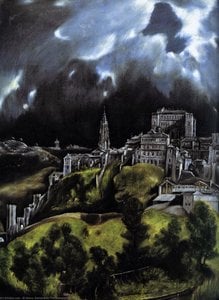
The Soul of a City – Unveiling El Greco’s “A View of Toledo”
El Greco’s “A View of Toledo,” painted in 1597 and now residing within the Metropolitan Museum of Art, isn't merely a depiction of a Spanish city; it’s an immersion into a profound psychological landscape. This oil on canvas transcends the boundaries of simple observation, becoming instead a visceral expression of spiritual tension and impending drama. Born Domenikos Theotokopoulos in Crete, El Greco’s artistic journey was marked by a unique synthesis of Byzantine tradition, Italian Mannerism, and Venetian Renaissance influences – a confluence that culminated in his intensely personal and dramatically charged style. “A View of Toledo” stands as the apex of this evolution, showcasing his mastery of elongated figures, fantastical pigmentation, and an unparalleled ability to evoke atmosphere and emotion.
The painting immediately commands attention with its overwhelming sense of foreboding. The dominant feature is a colossal hill crowned by a formidable castle, anchoring the scene within a valley bisected by two flowing rivers. These waterways aren’t serene; they surge forward with an almost violent energy, mirroring the turmoil brewing above. Scattered throughout the image are figures – not idyllic inhabitants enjoying the vista, but individuals engaged in everyday activities, seemingly oblivious to the impending storm. This deliberate juxtaposition of human activity and atmospheric drama creates a powerful sense of unease, suggesting that even amidst routine, a deeper, more unsettling reality lies beneath the surface. The artist masterfully uses perspective to draw the viewer into this dramatic scene, creating an illusion of depth and scale that amplifies the feeling of vulnerability.
A Synthesis of Artistic Influences
El Greco’s distinctive style in “A View of Toledo” is a testament to his diverse artistic training. The painting’s foundation rests firmly within the Byzantine tradition – evident in the meticulous detail, the use of rich, layered colors, and the stylized rendering of figures. Notice how the drapery flows with an almost otherworldly grace, reminiscent of Byzantine icons. However, he skillfully integrates elements of Italian Mannerism, particularly in the elongated proportions of the human forms and the dramatic lighting, alongside Venetian Renaissance influences, most notably in the vibrant use of color and atmospheric perspective. The painting’s palette is a carefully orchestrated blend of deep blues, ochres, and blacks, punctuated by flashes of white – colors that contribute significantly to the overall sense of drama and mystery. The artist's signature, “Krḗs,” a proud declaration of his Cretan origins, subtly reinforces this connection to his heritage.
Decoding the Symbolism
“A View of Toledo” is rich in symbolic meaning. The imposing castle represents authority and perhaps even divine judgment, while the turbulent rivers can be interpreted as forces of chaos or the passage of time. The figures below, engaged in their daily lives, symbolize humanity’s fleeting existence against the backdrop of eternity. Some art historians suggest that the painting reflects El Greco's own spiritual struggles – a tension between earthly concerns and a yearning for divine grace. The choice of Toledo itself is significant; the city was a major pilgrimage site during El Greco’s time, steeped in religious history and imbued with a sense of solemnity. The artist seems to be capturing not just a landscape, but the very soul of this sacred place.
Technique and Legacy
El Greco's technique is characterized by bold brushstrokes, expressive color choices, and an innovative use of light and shadow. He employed a layering technique, building up the paint in thin glazes to create luminous effects and a sense of depth. The elongated figures, a hallmark of his style, are not simply distorted; they convey a powerful emotional intensity. “A View of Toledo” is considered one of El Greco’s most important landscapes, demonstrating his ability to transform a simple depiction of a city into a profound meditation on faith, mortality, and the human condition. It stands as a testament to his unique artistic vision – a legacy that continues to inspire artists and captivate viewers centuries later. Reproductions of this masterpiece offer a remarkable opportunity to experience the power and beauty of El Greco’s art in your own home.



 Előnézet
 Váltás nyomtatványra
 Megosztás
 Megosztás
 Részletek
 Útmutató

 Letöltés
 Hasonló darabok
 X-ray felvétel
 Diavetítés
 Statisztika


 Tovább olvasom






































 Az üvegkeretes opció csak 110 cm alatti méretben érhető el