Előnézet AR előnézet Váltás nyomtatványra Kézzel festett másolat vásárlása Megosztás
Részletek Útmutató Kedvencekhez ad Letöltés Hasonló darabok X-ray felvétel Diavetítés Statisztika

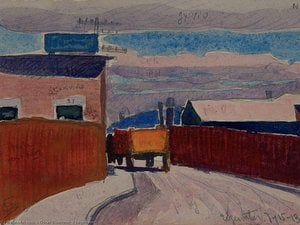
Freight Car at Truro

Edward Hopper’s ‘Freight Car at Truro,’ a masterful Social Realism painting from 1931 captures the poignant solitude of rural America. Its stark lighting and minimalist composition evoke a profound sense of quiet contemplation, inviting viewers to explore this iconic piece.

Edward Hopper: amerikai realizmus mestere, a magány és az urbán élet évtizedeihez illő fényekkel és árnyakkal. Nighthawks, Monhegan Houses ikonikus festményei!

Vásároljon nagy felbontású, javított digitális képet, amely minőségében messze felülmúlja az online előnézetet.

Minden fájlt szakembereink a legmodernebb eszközök és precíz, kézi retusálás segítségével készítenek el aprólékosan. Gondoskodunk arról, hogy minden kép kivételes tisztasággal, pontos színhelyességgel és részletgazdag finomsággal rendelkezzen.

A végleges fájl 72 órán belül e-mailben megérkezik, professzionális, szerkesztői és nyomtatási környezetbe optimalizálva az azonnali használathoz. Ez ugyanaz a minőség, amelyben a legmeghatározóbb tervezőstúdiók, kiadók és galériák is megbízhatnak.

Digitális kép

Töltsön le nagy felbontású fájlt személyes kiállításokhoz, nyomtatáshoz és kreatív projektekhez. ( Váltás nyomtatványra Kézzel festett másolat vásárlása)

Összesen

$ 24,90

Minden digitális kép rendeléséhez tartozó extrák

Szakértői digitális kézbesítés, garantáltan

Amikor a WahooArt.com szolgáltatást választja, nem csupán egy képet kap – professzionálisan felmagasított digitális műalkotást kap, amely precizitással készült, és amelyet megelégsedési gwarancia tesz biztoslássá. Az alábbiakban automatikusan minden benne 】

shipping_icon
Gyors e-mail teslimítés

A nagy felbontású digitális képmásolatát a megrendelést követő 72 órán belül e-mailben elküldjük Önnek – azonnal használható formátumban.

canvas_icon
MI-alapú digitális képjavítás

Műve professzionális módon kerül optimalizálásra fejlett mesterséges intelligencia eszközök és manuális szerkesztés segítségével, biztosítva a maximális részletességet, tisztaságot és színpontosságot.

insurance_icon
Örök életű ingyenes újradatás

Véletlenül törölted vagy elvesztetted a fájlodat? Ne aggódj – bármikor ingyen újra megküldjük neked.

tax_icon
Nincs importköltség – soha

Élvezze műalkotásait azonnal, vám, illeték vagy szállítási költség nélkül – a digitális letöltések mindig adamentesek.

color_icon
Színpontosság garantálása

Professzionális eszközök és színkezelés segítségével garantáljuk, hogy digitális képe a lehető legpontosabban tükrözze az eredeti színeket.

return_icon
100 napos elégedettségi garancia

Ha nemມີ elégedett a digitális képével, 100 napon belül felülvizsgáljuk vagy 100% visszatérítjük az amountot – kérdés बिना.

guarantee_icon
100% Pénzvisszatérítési garancia

Nem tetszett a vásárlás? 100 napon belül teljes visszatérítést garantálunk a digitális fájl megvételétől számítva – kérdés nélkül.

discount_icon
Tömegrendelési kedvezmények

Vásároljon 3 képet, spóroljon 10%-et - Vásároljon 5-öt, spóroljon 15%-et - Vásároljon 10+ képet, spóroljon 20%-at. Kiváló kreatív projektekhez, galériákhoz és ügynökségekhez.

Rövid tények

  • Medium: Oil on canvas
  • Location: Private Collection
  • Year: 1931
  • Influences: Northern Renaissance
  • Title: Freight Car at Truro
  • Subject or theme: Urban solitude
  • Notable elements or techniques: Precise observation; Atmospheric perspective

A Symphony of Solitude: The Quiet Power of Freight Car at Truro

In the vast, sweeping landscape of American art, few images capture the heavy, cinematic silence of a moment quite like Edward Hopper’s Freight Car at Trurol. Painted in 1931, this masterpiece serves as more than just a depiction of a railway car resting on its tracks; it is a distilled essence of the American experience during the Great Depression. As the viewer's eye meets the stark, vibrant red of the train car, they are immediately transported to a rural New England setting, where the afternoon light feels diffused and heavy with memory. There is a profound stillness here, a sense that the world has paused to catch its breath, leaving us to contemplate the beauty found in isolation.

Hopper, a master of Social Realism, eschewed the idealized, romanticized landscapes of his predecessors. Instead, he turned his gaze toward the unvarnished truth of everyday life, imbuing even the most mundane subjects with deep psychological resonance. In this work, the composition is deceptively simple: a solitary freight car set against a backdrop of distant, rolling hills. Yet, within this simplicity lies a complex emotional architecture. The warmth radiating from the reds and oranges of the train creates a striking visual tension against the cool, receding blues and greens of the countryside, amplifying the sense of a singular object—and perhaps a singular soul—standing apart from the world.

Technique and the Architecture of Light

The emotional impact of this painting is inseparable from Hopper’s meticulous technical execution. He employed a sophisticated layering technique, using thin washes of oil paint to build up tonal gradations that capture the subtle, fleeting nuances of light and shadow. This painstaking approach allows the light to appear as if it is not merely hitting the surface of the canvas, but emerging from within it. The way the light grazes the metallic edges of the car and settles into the shadows of the tracks creates a tactile realism that draws the collector closer to the scene.

For the interior designer or art enthusiast, this painting offers a unique versatility. Its balanced color palette—anchored by bold primary tones but softened by earthy, natural hues—allows it to serve as a commanding focal point in a variety of settings. Whether placed in a modern, minimalist gallery space or a more traditional, cozy study, the work brings with it an atmosphere of quiet contemplation and sophisticated gravity. It does not demand attention through noise, but rather through a steady, enduring presence.

Historical Resonance and Emotional Depth

To look upon Freight Car at Truro is to witness the visual language of an era marked by economic hardship and social anxiety. Created during a period of profound displacement in American society, the painting speaks to the pervasive feeling of disconnection that characterized the early 1930s. Hopper deliberately avoids a clear narrative; there are no figures engaged in conversation, no obvious movement toward a destination. This ambiguity is intentional, inviting each viewer to project their own stories of longing and solitude onto the canvas.

The painting functions as a mirror for the human condition, exploring themes of loneliness not as a tragedy, but as a fundamental state of being. It captures that specific, electric tension found in the pauses between life's major events. For those seeking to bring a piece of art history into their homes, this reproduction offers more than just aesthetic beauty; it offers a window into the soul of 20th-century America, providing a permanent sense of peace and profound reflection within any living space.


Művész életrajza

A Solitude Observed: The Life and Art of Edward Hopper

Edward Hopper, a name inextricably linked to the quietude and subtle melancholy that permeated 20th-century American life, wasn’t simply a painter of scenes; he was a poet of light and shadow, a chronicler of modern isolation. Born in Nyack, New York, in 1882, to middle-class parents of Dutch ancestry, Hopper's early years provided a stable upbringing that nurtured his artistic inclinations. From childhood sketches meticulously dated and signed, it became evident that keen observation and an innate talent for drawing were central to his being. Though initially encouraged towards commercial illustration – a pragmatic suggestion from his parents – Hopper’s ambitions leaned toward fine art, leading him to the New York School of Art where he studied under William Merritt Chase and Robert Henri. These formative years instilled not only technical skill but also an appreciation for realism and a commitment to depicting the world as he saw it—unvarnished and honest. The writings of Ralph Waldo Emerson resonated deeply with Hopper, reinforcing his sense of individualism and acute observation – qualities that would become hallmarks of his artistic vision. Early travels to Paris exposed him to Impressionism, yet Hopper quickly diverged from its fleeting brushstrokes, forging a path uniquely his own.

Finding His Voice: Realism and the American Scene

Hopper’s artistic journey wasn't immediate or effortless. He grappled with discovering his distinctive voice, experimenting with various styles before settling into the realism that would define his career. This wasn’t mere replication of reality; it was a distillation of its essence, stripping away extraneous detail to reveal underlying emotional truths. His paintings began to focus on everyday scenes – houses, diners, offices, hotel rooms – imbued with a sense of stillness and often, loneliness. He possessed an extraordinary ability to capture the psychological states of his subjects, hinting at narratives without explicitly stating them. The precise rendering of light and shadow became crucial, not merely as descriptive elements but as emotional cues, creating atmospheres that were both captivating and unsettling. House by the Railroad (1925), an early masterpiece, exemplifies this approach—a seemingly simple composition radiating a profound sense of isolation and mystery. Hopper’s printmaking, often overlooked, ran parallel to his painting, sharing similar themes and stylistic qualities, demonstrating his mastery across mediums. He wasn't interested in grand historical narratives or allegorical symbolism; he focused on the mundane, elevating it through careful observation and emotional resonance.

Iconic Visions: Nighthawks and Beyond

While Hopper’s career unfolded gradually, certain works catapulted him to widespread recognition. Nighthawks (1942), arguably his most famous painting, became an instant icon of American culture. The late-night diner scene, bathed in stark fluorescent light, perfectly encapsulates the alienation and anonymity of modern urban life. The figures within are lost in their own thoughts, disconnected from one another despite their proximity—a poignant commentary on the human condition. Gas (1940), with its striking portrayal of a roadside gas station, showcases Hopper’s fascination with American landscapes and the burgeoning automobile culture. Other notable works like *Automat*, *Office in a Small City*, and *Summertime* each offer unique insights into the complexities of 20th-century American society. These paintings weren't merely depictions of places; they were explorations of mood, psychology, and the subtle dramas unfolding within ordinary settings. His wife, Josephine Nivison Hopper, played a vital role not only as his lifelong companion but also as a frequent model, contributing significantly to the characterization of his female figures.

Themes and Legacy: A Lasting Influence

Several recurring themes permeate Hopper’s oeuvre. Urban isolation is perhaps the most prominent—the sense of loneliness experienced by individuals even amidst crowds. He explored the American landscape, both rural and urban, often emphasizing its starkness and emptiness. His work delves into psychological realism, probing the inner lives of his subjects with a sensitivity that transcends mere representation. There’s also an undercurrent of nostalgia for a simpler past, juxtaposed with an acknowledgement of the complexities and anxieties of modern life. Hopper's influence on subsequent artists is undeniable. His unique style has inspired countless painters, including Pierre Sanford Ross, and continues to resonate with contemporary artists seeking to capture the essence of human experience. His paintings remain highly sought after by collectors and are exhibited in major museums worldwide, solidifying his place as a pivotal figure in American art history. More than just an artist, Edward Hopper was a visual philosopher, offering profound insights into the human condition through his masterful use of light, shadow, and composition.
  • His legacy lies not only in the beauty of his paintings but also in their enduring ability to provoke thought, evoke emotion, and remind us of the quiet solitude that often defines our lives.
  • Hopper’s work continues to captivate audiences because it speaks to universal themes of loneliness, isolation, and the search for meaning in a rapidly changing world.
  • His paintings have become iconic representations of American culture, often used to symbolize the anxieties and aspirations of the 20th century—and beyond.
  • Hopper’s aesthetic has profoundly influenced filmmakers (like Alfred Hitchcock) and writers, inspiring countless works that explore similar themes of alienation and psychological tension.
Edward Hopper's ability to capture the essence of modern American life with honesty, sensitivity, and a distinctive artistic vision ensures his place as one of the most important artists of the 20th century.

Edward Hopper

Edward Hopper

1931 - 1967 , Egyesült Államok

Rövid tények

  • Artistic Movement Or Style: Realista
  • Artists Or Movements Influenced By This Artist: ['Pierre Sanford Ross']
  • Artists Who Influenced This Artist:
    • William Chase
    • Robert Henri
  • Date Of Birth: 1882. július 22.
  • Date Of Death: 1967. május 15.
  • Full Name: Edward Hopper
  • Nationality: Amerikai
  • Notable Artworks:
    • Nighthawks
    • House by the Railroad
    • Gas
  • Place Of Birth: Nyack, USA