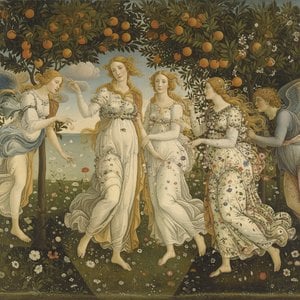
At Caffè Michelangiolo – A Snapshot of Macchiaioli Discourse
Adriano Giuseppe Cecioni’s “At Caffè Michelangiolo,” painted in 1867, offers more than just a depiction of a convivial gathering; it's a window into the intellectual ferment of late 19th-century Florence. This intimate scene, rendered with Cecioni’s signature macchiaioli style – characterized by loose brushwork and vibrant color – captures a moment of intense discussion within the famed Caffè Michelangiolo, a haunt frequented by artists and intellectuals eager to absorb European trends.
The painting's subject matter is deceptively simple: a group of men engaged in animated conversation around a table. However, Cecioni elevates this commonplace tableau through his masterful use of light and color. The warm hues of the room – ochres, reds, and browns – are applied with rapid, expressive strokes, creating a sense of immediacy and capturing the energy of the moment. Notice how the artist doesn't meticulously detail each face; instead, he focuses on conveying emotion and atmosphere through subtle shifts in tone and brushwork. This technique was central to the macchiaioli movement’s rejection of academic realism and their embrace of subjective perception.
The Macchiaioli and the Pursuit of Modernity
Cecioni's association with the macchiaioli – “the stainists” – is crucial to understanding this work. This group, emerging in the 1860s, challenged the prevailing artistic norms of the time by prioritizing direct observation and expressive color over idealized representation. They were deeply influenced by French Impressionism but sought to develop a distinctly Italian approach, often depicting contemporary life with remarkable honesty and vitality. The Caffè Michelangiolo itself became a symbol of this movement – a place where artists debated new ideas, shared banned foreign periodicals (as documented in the Italian Arts Society’s archive), and pushed the boundaries of artistic expression.
The inclusion of details like the clock and scattered books subtly reinforces the scene's intellectual context. The clock speaks to the passage of time and the urgency of the discussion, while the books suggest a scholarly environment – a space for debate and reflection. Cecioni’s careful composition draws the viewer into this world, inviting us to imagine ourselves as silent observers of this pivotal moment in Florentine art history.
Symbolism and Emotional Resonance
Beyond its historical significance, “At Caffè Michelangiolo” possesses a powerful emotional resonance. The figures are not presented as individual portraits but rather as representatives of a collective spirit – a shared passion for art, ideas, and the pursuit of modernity. Cecioni’s loose brushwork and vibrant colors evoke a sense of warmth, intimacy, and intellectual excitement. The painting's overall effect is one of inviting engagement, suggesting that the viewer too can participate in this lively exchange.
This hand-painted reproduction offers an exceptional opportunity to bring this captivating scene into your home or office. Measuring 53 x 82 cm, it’s a perfect size for adding a touch of artistic flair to any space. Created using traditional techniques and meticulously crafted by skilled artisans, this reproduction faithfully captures the essence of Cecioni's original masterpiece – a testament to his talent and the vibrant spirit of the macchiaioli movement.



 Előnézet
 Váltás nyomtatványra
 Megosztás
 Megosztás
 Részletek
 Útmutató

 Letöltés
 Hasonló darabok
 X-ray felvétel
 Diavetítés
 Statisztika


 Tovább olvasom






































 Az üvegkeretes opció csak 110 cm alatti méretben érhető el