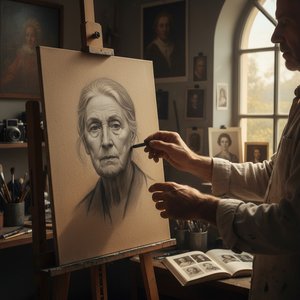
A Life Defined by Line and Stone
The trajectory of François Joseph Léo Drouyn shifts abruptly in 1826. The death of his father in Izon, Gironde, pulls a young boy away from the quietude of his childhood and thrusts him into a different world. By age eleven, he is far from the vineyards of his home, studying at the Collège Royal de Nancy. He spends eight years within those walls, eventually emerging in 1835 with a degree in letters. His family expects him to enter the wine trade, a path dictated by lineage and necessity. Instead, the boy who discovered a passion for drawing in Nancy chooses a different vocation, defying familial expectations to enter the atelier of Jean Paul Alaux in Bordeaux.
Drouyn does not settle into a single discipline. He moves through the world as an architect, an archaeologist, a draftsman, an engraver, and a painter. His hands are as comfortable with the precision of an etching needle as they are with the fluid stroke of a pen or the weight of oil on canvas. He becomes a chronicler of the Gironde, a man obsessed with the physical remnants of history and the structural integrity of the past.
The Precision of the Observer
His technical versatility allows him to capture the world through various lenses, moving from the intimate to the monumental. His work often focuses on the intersection of human construction and the passage of time. He documents the landscape and the architecture of his region with a meticulous eye, ensuring that the details of stone and shadow are preserved.
- Etching
- Lithograph (pen)
- Oil on canvas
In 1839, he presents an Autoportrait de Léo Drouyn, an oil on canvas that captures his own likeness. This period marks his emergence as a professional force, capable of translating the complexities of light and form into permanent media. His etchings, such as Intérieur de Cour, demonstrate a command over line that allows him to navigate the deep shadows of interior spaces.
Legacy in the Gironde
Drouyn’s significance lies in his dual role as a creator and a preservationist. He does not merely paint; he investigates. His work as an archaeologist and draftsman ensures that the architectural and cultural identity of the Gironde is recorded with scientific accuracy. He leaves behind a vast collection of original works that serve as a visual record of a specific era and place. His presence is felt in the archives of the Musée des Beaux Arts de Bordeaux and the libraries of Bordeaux, where his engravings and lithographs remain as physical evidence of his devotion to the history of his homeland.
Pitanja i odgovori
Gdje mogu vidjeti profil boja u radovima umjetnika Léo Drouyn?
Upotrebu boje u djelima umjetnika Léo Drouyn koja su navedena na ovaj web-mjesto moguće je proučiti na umjetnikovoj stranici Genom palete.
U kojem je povijesnom razdoblju stvarala/radio Léo Drouyn?
Léo Drouyn je stvarala u razdoblju 19th Century. To razdoblje smješta umjetnikov rad u povijesni kontekst.
Mogu li pregledati djela umjetnika Léo Drouyn prema mediju?
Djela umjetnika Léo Drouyn možete pregledavati prema mediju na njegovoj stranici Svi mediji.
Postoji li pregled svih tema koje je Léo Drouyn naslikao/la?
Stranica Atlas tema prikazuje umjetnička djela autora Léo Drouyn prema tematici.