The Life and Artistic Journey of Jacques-Albert Senave
Born in Lo-Reninge, Belgium, Jacques-Albert Senave began his artistic training under Canon Hennequin at the Augustinian abbey of his native town. His early years were marked by a balance of labor and study; while attending the Academy of Dunkirk at age fifteen, he spent his days assisting in a bakery to support himself, practicing his art in the evenings. Following the support of his teacher, M. Truit, Senave was able to study full-time in Dunkirk and later at the Academies of Saint-Omer. His talent eventually led him to Paris in 1780, where he studied at the Académie royale de peinture et de sculpture. Throughout his career, he was known for his genre scenes, history paintings, landscapes, city views, market scenes, portraits, and still lifes.
Artistic Style and Later Years
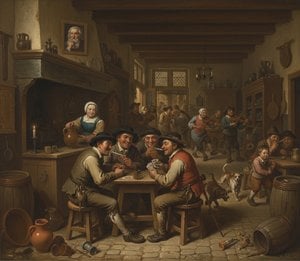
Senave's genre paintings were heavily influenced by seventeenth-century Flemish and Dutch scenes, particularly reminiscent of the tavern and festival scenes of David Teniers the Younger. He excelled in anecdotal representations of daily life and village views. His notable works include:
In his later years, Senave faced physical challenges when the right side of his body became paralyzed, forcing him to learn to draw with his left hand. He died in Paris in 1823.
Pitanja i odgovori
Gdje se mogu pronaći djela umjetnika Jacques-Albert Senave grupirana prema paleti boja?
Stranica Prema paletama boja grupirala je djela umjetnika Jacques-Albert Senave prema njihovim paletama boja.
U kojem je povijesnom razdoblju stvarala/radio Jacques-Albert Senave?
Jacques-Albert Senave je stvarala u razdoblju Early Modern. To razdoblje smješta umjetnikov rad u povijesni kontekst.
Mogu li istražiti djela umjetnika Jacques-Albert Senave prema tematici?
Atlas tema za Jacques-Albert Senave stranica je koja prikazuje umjetnička djela umjetnika prema njihovim motivima.
Mogu li pregledavati djela umjetnika Jacques-Albert Senave prema raspoloženju?
Djela umjetnika Jacques-Albert Senave možete pregledavati prema raspoloženju na njegovoj stranici Soba po raspoloženju, koja prikazuje umjetnička djela poredana prema njihovom zabilježenom raspoloženju.