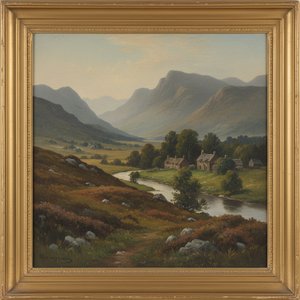
David West (1868 – 1936): A Visionary Landscape Painter Capturing the Soul of Scotland
David West was a Scottish watercolour painter who emerged as a prominent figure in the late Victorian era, leaving an indelible mark on British landscape art and establishing himself as one of the foremost artists of his time. Born in Lossiemouth, Moray, Scotland, in 1868, he possessed a remarkable talent for capturing the ethereal beauty of the Scottish Highlands and coastal regions—a skill that would define his artistic legacy. His work is characterized by meticulous observation, atmospheric perspective, and an expressive use of color, reflecting the Romantic sensibilities prevalent during his lifetime.
Early Life and Artistic Influences
James West, David’s father, was a Captain in the Royal Navy, fostering a spirit of adventure and exploration within his son from a young age. Growing up amidst the rugged landscapes of Moray instilled in David an enduring fascination with nature—a passion that would fuel his artistic endeavors throughout his life. He attended Aberdeen Grammar School before embarking on seafaring adventures alongside his father, gaining invaluable experience navigating challenging conditions and observing diverse environments. These formative years undoubtedly shaped his perception of the world and informed his artistic vision. Notably influenced by artists like Albert Pinkham Ryder and Frederic Church—luminaries of American Impressionism—West embraced innovative techniques aimed at conveying mood and emotion rather than merely replicating visual reality. He meticulously studied their methods, incorporating elements of tonalism and atmospheric perspective into his own compositions.
Career Highlights: Painting the Scottish Highlands
David West’s artistic career gained momentum in the 1890s as he began exhibiting his paintings at prestigious institutions such as the Royal Scottish Academy and The Glasgow School of Art. His landscapes—often depicting dramatic vistas of lochs, mountains, and coastal scenery—became instantly recognizable for their luminous quality and evocative portrayal of light and shadow. He achieved considerable acclaim for his depictions of Skye and Loch Lomond, capturing the grandeur of Scotland’s wilderness with unparalleled sensitivity. His paintings were praised for their ability to convey not only visual splendor but also a profound connection to the spirit of place—a hallmark of Romantic landscape painting. Furthermore, West's work was recognized by collectors and critics alike, securing his position as one of Scotland’s most celebrated artists.
Technique and Artistic Style
West’s artistic style distinguished itself through its masterful use of watercolour pigment—a medium he skillfully manipulated to achieve remarkable tonal variations and luminous effects. He employed a technique known as “atmospheric perspective,” subtly blurring distant objects to simulate the hazy airiness characteristic of mountainous landscapes. His brushstrokes were deliberate and expressive, conveying movement and texture while simultaneously capturing the subtle nuances of light and color. Unlike many artists of his era who prioritized precise detail, West prioritized conveying emotion and atmosphere—a conscious decision that aligned with the Romantic aesthetic’s emphasis on subjective experience. He meticulously blended colors to create harmonious palettes that mirrored the hues of the Scottish Highlands, resulting in paintings imbued with a palpable sense of beauty and tranquility.
Legacy and Recognition
David West's contribution to British landscape art remains significant today. His paintings continue to inspire admiration for their artistic merit and evoke memories of Scotland’s breathtaking scenery. He was elected Vice-President of The Royal Scottish Society of Painters in Watercolour in 1935, cementing his reputation as a respected figure within the artistic community. His work is housed in numerous museums and galleries across Scotland and internationally—a testament to its enduring appeal. David West's legacy extends beyond his visual creations; he embodies the spirit of Romanticism—a movement that championed imagination, emotion, and an appreciation for the sublime beauty of nature—leaving a lasting impression on subsequent generations of artists.