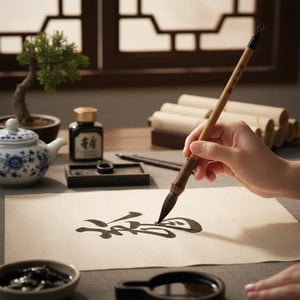
A Life of Ink and Shadow
Chen Rong lived during the Southern Song dynasty, a period when the brush moved with a particular kind of freedom. He was as much a man of politics as he was a painter, navigating the complexities of his era while finding a singular voice in the medium of ink. His work suggests a deep connection to the natural world, specifically through the lens of Daoist philosophy, where form and emptiness are often indistinguishable.
The artist is most frequently identified by his ability to render the mythical. He did not seek the rigid precision found in courtly traditions, preferring instead an expressive spontaneity. His technique relied on the brilliance of ink wash, utilizing dry-brush strokes and even the deliberate splattering of ink to suggest movement. In his hands, the dragon was not a static creature of legend but a force of nature emerging from mist and dissolving into clouds.
The Movement of the Dragon
Much of what we understand of his hand comes from specific handscrolls that have survived centuries of handling. The Nine Dragons handscroll, dated to 1244 and held in the Museum of Fine Arts, Boston, provides a window into his technical mastery. In this work, he captures various states of being: dragons appearing through fog, navigating heavy clouds, or struggling against the weight of waves. Each section uses negative space to imply that the creature is part of the atmosphere itself.
His approach to composition often mirrored the unpredictability of the elements. He utilized several distinct methods to achieve this:
- The use of ink wash brilliance to create depth within swirling mists.
- A dynamic brushwork that prioritized the suggestion of motion over anatomical accuracy.
- Dry-brush techniques to represent the rugged textures of cliffs and ancient landscapes.
Historical Presence
While some scholars debate the exact attribution of certain works, such as the Five Dragons handscroll found in the Nelson-Atkins Museum of Art or the Tokyo National Museum, his influence on the depiction of water and myth remains clear. His ability to blend the physical with the spiritual through ink allowed him to create a visual language where the dragon acts as a symbol of cosmic power. Even when later periods, such as the Ming dynasty, produced works that were once thought to be his, the standard set by his 13th-century compositions remained the benchmark for the genre.
Pitanja i odgovori
Kako mogu pratiti radove umjetnika Chen Rong kronološki?
Djela umjetnika Chen Rong možete pregledati kronološkim redoslijedom na stranici Kronologija umjetnina umjetnika.
Gdje je i kada je rođen/a Chen Rong?
Chen Rong rođen/a je u gradu Changle District 1200. godine.
Kako je karijera umjetnika Chen Rong podijeljena u razdoblja?
Karijera umjetnika Chen Rong razvija se razdoblje po razdoblje na njegovoj stranici Kronika: horizontalna vremenska linija umjetničkih djela grupiranih u poglavlja prema razdobljima stvaranja.
Pod kojim drugim imenima ili pseudonimima poznat je/poznata je Chen Rong?
Chen Rong poznat/a je i pod drugim imenima: hao Suoweng, zi Gongchu, Chen Jung, Gongchu, Suoweng.