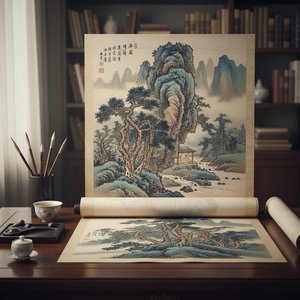
Boyun (Xiangbai): A Delicate Brushstroke in Qing Dynasty China
Boyun Xiangbai (改琦), born around 1774 in western China during the Qing dynasty, stands as a testament to the flourishing artistic landscape of his era. Though relatively obscure compared to some contemporaries, Gai Qi’s contribution to Chinese painting and poetry—particularly his masterful illustrations for Dream of the Red Chamber—cemented his place within the canon of Qing art.
- Early Life & Origins: Gai Qi hailed from Hui Muslim families in Xinjiang. This cultural heritage subtly influenced his artistic sensibilities, fostering an appreciation for Buddhist themes and aesthetics alongside traditional Chinese ideals of beauty and harmony.
- Shanghai Artistic Career: He established himself as a prominent artist based in Shanghai, actively participating in the vibrant intellectual circles of the time. His studio was frequented by fellow literati and artists who shared his passion for artistic exploration.
- Painting Style & Technique: Gai Qi’s distinctive style is characterized by “baimiao” (outline) painting—a technique that prioritizes meticulous detail within a restrained framework. This approach lends itself beautifully to capturing the subtle nuances of plant life and human figures, as evidenced in his numerous landscapes and, crucially, his illustrations for Dream of the Red Chamber.
- Dream of the Red Chamber Illustrations: Gai Qi’s fame rests largely on his contribution to Cao Xueqin's iconic novel. He undertook the monumental task of depicting the principal characters—including the renowned woman poet Zhou Qi—with breathtaking accuracy and sensitivity. The illustrations are accompanied by poems penned by Wang Qisun and Cao Zhenxiu, further enriching the narrative experience.
- Influence & Legacy: Gai Qi’s artistic lineage extends through his grandson, who continued the tradition of the “gai fei” school—a movement that championed a refined aesthetic rooted in Dream of the Red Chamber imagery. This legacy persists today, embodied by descendants of Fei Danxiu and Fei Danxu, ensuring that Gai Qi's vision continues to inspire artists and scholars alike.
His work embodies the spirit of his time—a blend of scholarly pursuits and artistic innovation—leaving an indelible mark on Chinese art history.