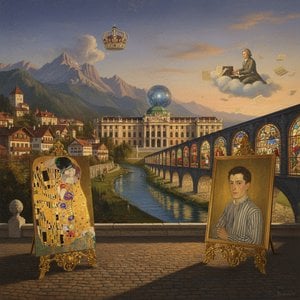
A Life in Vienna
Born in Vienna, Austria, in 1898, Anton Sebela lived a life deeply rooted in the cultural landscape of his home city. His presence in the Austrian art scene was marked by a dual commitment to both painting and graphic arts. He navigated the complexities of the early to mid-twentieth century, a period that demanded both technical precision and a distinct visual language from those working in the medium.
His career was defined by a steady, disciplined approach to his craft. Rather than seeking the spotlight of fleeting trends, Sebela focused on the fundamental elements of composition and form. His work reflects a quiet dedication to the visual arts, captured through the careful application of color and the structured arrangement of his subjects.
Artistic Focus and Technique
Sebela’s output was characterized by a focus on the natural world and the quietude of rural life. His technical skill allowed him to translate the textures of the landscape into a language of color and light. His work often centered on specific motifs that required a keen eye for detail and a sense of spatial balance.
The following elements defined his creative output:
- The use of landscape as a primary subject for exploration.
- A focus on agricultural themes and the harvest.
- The application of color to define mood and atmosphere.
- A dual mastery of both painting and graphic design.
The Harvest and Later Years
One of his notable works, Corn Dolls on the Harvest Field, dating to 1948, illustrates his ability to find meaning in the cycles of nature. This piece highlights his interest in the intersection of human labor and the natural environment. His ability to render such scenes suggests a deep familiarity with the rhythms of the countryside.
He remained active in the artistic community of Vienna until his death in 1975. His legacy is found in the quiet strength of his compositions and his contribution to the documentation of Austrian modern art. He left behind a body of work that remains a part of the historical record of his era.
Pitanja i odgovori
Mogu li pregledavati djela umjetnika Anton Sebela prema paleti boja?
Stranica Prema paletama boja grupirala je djela umjetnika Anton Sebela prema njihovim paletama boja.
Gdje mogu pronaći statistiku o djelima umjetnika Anton Sebela?
Statistike o djelima umjetnika Anton Sebela dostupne su na njegovoj stranici Statistika posjeta.
Postoji li kronološki prikaz karijere umjetnika Anton Sebela?
Karijera umjetnika Anton Sebela razvija se razdoblje po razdoblje na njegovoj stranici Kronika: horizontalna vremenska linija umjetničkih djela grupiranih u poglavlja prema razdobljima stvaranja.
Koje je boje Anton Sebela najčešće koristio/la?
Upotrebu boje u djelima umjetnika Anton Sebela koja su navedena na ovaj web-mjesto moguće je proučiti na umjetnikovoj stranici Genom palete.