A Life Forged in Glass and Gold
The story of Adrien Moreau begins not with a brush, but with the delicate, transformative craft of glassmaking. Born in Troyes, France, his early years were spent as an apprentice glassmaker, a period that undoubtedly instilled in him a profound appreciation for light, transparency, and the intricate textures that would later define his mastery of oil and watercolor. However, the pull of the Parisian art world proved irresistible. In 1863, Moreau left his apprenticeship behind to seek formal training at the École des Beaux-Arts, where he studied under the guidance of luminaries such as Léon Cogniet and Isidore Pils. This academic foundation provided him with the technical rigor necessary to ascend the ranks of the French art scene.
His emergence on the public stage was marked by his debut at the Paris Salon of 1868, an event where he was immediately recognized by critics like Joseph Uzanne as a significant talent among the greatest painters of contemporary genre. Though the ravages of the Franco-Prussian War and a devastating fire in 1871—which destroyed much of his workshop—temporarily interrupted his momentum, Moreau returned with renewed vigor. It was his 1873 work, Concert d’Amateurs dans un Atelier d’Artiste, that truly cemented his reputation, capturing the imagination of a public hungry for elegance and historical resonance.
The Elegance of an Era
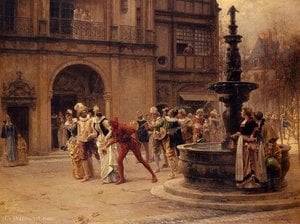
Moreau’s artistic soul resided in the intersection of history and genre painting. He possessed a singular ability to transport his viewers to the 17th and 18th centuries, populating his canvases with the refined nobility of past eras. His work is characterized by a meticulous attention to detail, where every silken gown, gallant cavalier, and opulent interior serves as a window into a lost world of aristocratic leisure. This dedication to historical accuracy earned him immense respect; he was a student of time, ensuring that the customs and costumes he depicted were true to their period.
Beyond his grander oil paintings, Moreau was a celebrated illustrator, lending his exquisite touch to the works of literary giants such as Voltaire, Victor Hugo, Alphonse Daudet, and Honoré de Balzac. Whether he was illustrating the ghostly figures in The Magic Skin or the delicate nuances of The Woman of Thirty, his illustrations possessed a narrative depth that complemented the prose of the masters. His versatility extended to landscapes as well, where he could pivot from the grandeur of courtly life to the quiet, bucolic beauty of peasant life and everyday rural scenes.
Legacy and Recognition
The accolades bestowed upon Moreau throughout his career reflect his standing in the international art community. His talent was frequently honored by the French state, earning him silver medals at the Expositions Universelles in both 1889 and 1900. In 1892, his contributions to the arts were formally recognized when he was named a Chevalier of the Légion d'honneur.
Moreau’s influence reached far beyond the borders of France, finding a particularly enthusiastic reception in North America. His ability to evoke the charm and luxury of French nobility made his work highly sought after by collectors across the Atlantic. Today, his legacy is preserved through:
- Museum Collections: His works are held in prestigious institutions in Carcassonne, Nantes, and his birthplace of Troyes.
- Literary Contributions: His role as a premier book illustrator for the most significant French authors of his time.
- Historical Documentation: His personal writings, including his book Les Moreau, which documented his family history.
Through his mastery of light, his reverence for history, and his ability to capture the grace of the human form, Adrien Moreau remains a definitive voice of 19th-century French genre painting.
Pitanja i odgovori
Gdje se djela umjetnika Adrien Moreau mogu pronaći grupirana prema ključnim riječima?
Stranica Pretraživanje po ključnim riječima umjetnika Adrien Moreau grupirana je prema ključnim riječima njegovih djela.
Gdje mogu vidjeti djela umjetnika Adrien Moreau prikazana kronološkim redom?
Postoji vremenska linija djela umjetnika Adrien Moreau: stranica Kronologija umjetnina prikazuje umjetnička djela poredana prema datumu nastanka.
Postoji li 3D virtualna obilaznost djela umjetnika Adrien Moreau?
Moguća je i virtualna posjeta: stranica 3D galerija umjetnika Adrien Moreau prikazuje njegova djela u trodimenzionalnoj galeriji.