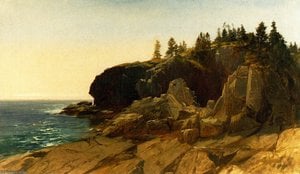
A Legacy of New England Light: The Life and Art of Aaron Draper Shattuck
In the grand tapestry of nineteenth-century American art, few threads are as intimately woven into the fabric of the New England landscape as those left by Aaron Draper Shattuck. Born in 1832 in the quiet, scenic town of Francestown, New Hampshire, Shattuck was destined for a life defined by the interplay of light and shadow. He entered a world where art was not merely a profession but a family heritage; his father, Samuel Draper Shattuck, was a respected artist who provided the foundational inspiration for his son’s creative journey. This lineage placed Aaron within a unique creative milieu, one that would eventually lead him to become a cornerstone of both the Hudson River School and the White Mountain School movements.
Unlike many of his illustrious contemporaries who sought the transformative influence of European academies, Shattuck’s artistic soul remained deeply rooted in American soil. His education was a deliberate pursuit of domestic mastery, beginning with the study of portraiture under Alexander Ransom in Boston in 1851, followed by rigorous training at the National Academy of Design in New York City. This commitment to his home landscape allowed him to develop a perspective that was profoundly intimate. While others chased the dramatic, untamed vistas of the far West, Shattuck found infinite complexity within the familiar hills and river valleys of New England, distilling the essence of the region into works that captured both its monumental grandeur and its quiet, pastoral tenderness.
Mastery of the Luminist Tradition
Shattuck’s technical prowess was characterized by a meticulous devotion to Luminism, a style defined by its emphasis on the effects of light and the creation of an atmospheric, often tranquil, sense of space. His brushwork possessed a rare duality; it was precise enough to render the delicate textures of foliage and the gentle ripples of a flowing stream, yet soft enough to evoke the humid, golden haze of a summer afternoon. In masterpieces such as Farmington River, Connecticut, one can witness his ability to command light and shadow, drawing the viewer’s eye through sun-dappled riverbanks into a soft, hazy distance that feels almost palpable.
His work often transcended mere topography to become a study of emotion and time. Through his eyes, the landscape became a vessel for nostalgia and peace. Whether depicting the rugged peaks of the White Mountains or the serene, moonlit meadows of the Berkshire foothills, Shattuck utilized light as a primary character in his compositions. His ability to capture the fleeting nature of a moment—the way moonlight rests upon a meadow or how sunlight filters through a canopy of trees—imbued his paintings with a spiritual quality that resonated deeply with the American Romantic movement.
Ascension and Historical Significance
The trajectory of Shattuck’s career was marked by rapid recognition within the most prestigious artistic circles of his era. His debut at the National Academy and Boston Athenaeum in 1854 signaled the arrival of a significant new talent, leading to his election as an Associate Academician in 1856 and eventually as a Full Academician in 1861. During the transformative years between 1856 and 1870, he resided and worked at the renowned Tenth Street Studio Building in New York City, a vibrant hub of innovation where he collaborated with fellow masters and further refined his understanding of the evolving American aesthetic.
Beyond his landscapes, Shattock’s life was intertwined with the historical currents of his time. Growing up during the American Civil War, he and his brothers utilized their creative talents to support the Northern cause, contributing to the era's propaganda efforts through their considerable imagination. This period of intense national struggle stands in poignant contrast to the enduring tranquility found within his canvases.
Today, Aaron Draper Shattuck is remembered not merely as a painter of scenery, but as a pioneer who captured the very heartbeat of New England. His legacy resides in:
- The preservation of the American pastoral: His works serve as vital historical windows into nineteenth-century life and landscape.
- Technical excellence: His mastery of light and atmospheric perspective remains a benchmark for the White Mountain School.
- A unique regional identity: By eschewing foreign training, he helped establish a distinctly American artistic voice that celebrated the beauty of the local and the known.
Pitanja i odgovori
U kojem je gradu i državi rođen/a Aaron Draper Shattuck?
Aaron Draper Shattuck rođen/a je u gradu Francestown, u državi United States of America.
Kako mogu pronaći djela umjetnika Aaron Draper Shattuck na određenu temu?
Kako biste pronašli djela umjetnika Aaron Draper Shattuck na određenu temu, koristite stranicu Prema ključnim riječima tog umjetnika, koja grupirira umjetnička djela prema ključnim riječima.
Gdje su djela umjetnika Aaron Draper Shattuck grupirana prema tehnici?
Stranica Svi mediji grupirana je prema tehnici izrade djela umjetnika Aaron Draper Shattuck.