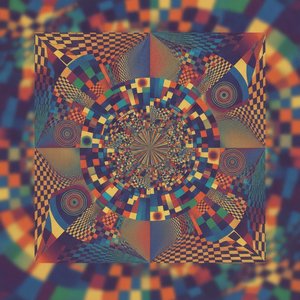
Lava: A Geometric Symphony of Color
Victor Vasarely’s “Lava” isn't merely a painting; it’s an invitation into a realm where visual perception bends and dances, embodying the very essence of Op Art – Optical Art. Born Károly Vaszary in Pécs, Croatia, in 1906, Vasarely embarked on a singular artistic journey fueled by mathematical precision and a fascination with illusion.
The artwork itself presents a mesmerizing composition dominated by concentric circles interwoven with angular shapes—primarily squares and triangles—creating an undulating surface that mimics the flow of molten lava. The palette explodes with vibrant hues: fiery reds mingle with deep blues, punctuated by splashes of emerald green, sunny yellows, regal purples, energetic oranges, and delicate pinks. These colors aren’t randomly applied; they adhere to Vasarely's meticulously crafted system based on geometric transformations—specifically rotations and reflections—designed to generate dynamic visual effects.
Vasarely’s influence extends far beyond the canvas. He championed the democratization of artistic experience, believing that art should be accessible to everyone. His groundbreaking approach challenged conventional notions of representation, prioritizing abstract forms and stimulating the viewer's subconscious mind. This piece exemplifies his commitment to exploring the boundaries of perception and transforming visual stimuli into emotionally resonant experiences.
The Bauhaus Legacy: Shaping Vasarely’s Artistic Vision
Vasarely’s formative years at Sándor Bortnyik’s Műhely – a school deeply rooted in the Bauhaus movement – profoundly shaped his artistic sensibilities. The Bauhaus ethos, prioritizing functional design and geometric abstraction, instilled in him a belief that art could serve practical purposes while simultaneously elevating aesthetic standards.
This influence is palpable in “Lava,” where Vasarely’s meticulous attention to detail reflects the Bauhaus emphasis on precision and craftsmanship. Unlike Impressionism or Expressionism, which sought to capture fleeting sensations of light and emotion, Vasarely deliberately constructed his artwork to provoke a specific response – disorientation and wonder – mirroring the Bauhaus aspiration for rational beauty.
Geometric Abstraction: Beyond Representation
“Lava” stands as a testament to Vasarely’s unwavering dedication to geometric abstraction. Rejecting traditional artistic conventions that relied on depicting recognizable subjects, he instead focused on exploring fundamental visual principles—such as repetition, symmetry, and transformation—to generate captivating optical illusions.
The resulting image isn't about what you *see*; it’s about how your eyes perceive it. Vasarely skillfully manipulates color and form to create an effect akin to a kaleidoscope or lava lamp, where patterns shift and morph as you move your gaze across the surface. This technique aligns perfectly with the Bauhaus pursuit of clarity and intellectual stimulation.
Symbolism & Emotional Resonance
While seemingly devoid of narrative content, “Lava” carries symbolic weight. The flowing curves represent dynamism and movement—a deliberate contrast to the rigid geometry underpinning the composition. The vibrant colors evoke feelings of energy, passion, and excitement – mirroring the transformative power of art itself.
Vasarely’s intention wasn't merely to create a visually stimulating artwork; he aimed to provoke contemplation and inspire awe. “Lava” serves as a reminder that beauty can reside in unexpected places—in patterns that defy conventional perception and invite us to embrace the mysteries of visual experience.
A Lasting Influence on Modern Art & Design
Victor Vasarely’s contribution to art history transcends stylistic trends. His pioneering exploration of Op Art established a new paradigm for artistic expression, influencing generations of artists and designers alike. “Lava” remains an iconic exemplar of this movement—a testament to Vasarely's genius and his unwavering belief in the transformative potential of geometric abstraction.
Pitanja i odgovori
Kolika je zasićenost i intenzitet boja u djelu "Lava" autora Viktor Vasareli?
"Lava" autora Viktor Vasareli prikazano je uz Jasna prisutnost boja zasićenost i Živopisno intenzitet.
Koja je dominantna boja djela "Lava" autora Viktor Vasareli?
"Lava" naginje prema Topli tonovi zalaska sunca tonu.
Kako mogu nabaviti print djela "Lava" autora Viktor Vasareli?
Print djela "Lava" autora Viktor Vasareli možete jednostavno naručiti na njegovoj stranici Umjetnička litografija: umjetnički otisak na pamučnom platnu ili arhivskom kanvas papiru.



 Pregledaj u realnoj veličini
 Kupi ručno oslikano djelo
 Pošalji
 Podijeli
 Detalji o umjetničkom djelu
 Vodič
Vodič

 Preuzmi umjetničko djelo
 Slični predmeti
 Rentgenska snimka
 Slide show
 Statistika
 Prikaži više






































 Opcija stakla dostupna je samo za dimenzije manje od 110 cm