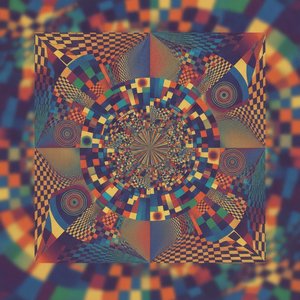
Quadrature ''X'' – A Symphony of Geometric Illusion
Victor Vasarely’s “Quadrature ”X” stands as an emblem of Op Art, a movement that revolutionized visual perception in the mid-20th century. Born Károly Vaszary in Pécs, Croatia, in 1906, Vasarely embarked on a path initially focused on medicine but swiftly pivoted towards artistic exploration after enrolling at the Podolini-Volkmann Academy in Budapest.
The painting itself is deceptively simple: four circles meticulously arranged within a square frame. Yet, this apparent austerity belies a profound complexity rooted in Vasarely’s unwavering commitment to geometric abstraction and his fascination with optical illusions. Influenced heavily by the Bauhaus movement's emphasis on functional design and reductive forms, Vasarely honed his craft at Bortnyik’s workshop, absorbing principles that would become foundational to his distinctive artistic vision.
Technique and Material Considerations
Vasarely employed a technique characterized by precise layering of colored pigments onto canvas. Unlike traditional painting methods prioritizing blending and tonal gradations, Op Art demanded an entirely different approach – one focused on creating visual effects through controlled repetition and subtle variations in color saturation. The artist meticulously applied thin washes of pigment, allowing for overlapping layers to subtly shift hues and generate mesmerizing patterns.
The canvas itself was primed with a textured surface, enhancing the illusion of depth and movement. This textural element wasn’t merely decorative; it actively contributed to the artwork's perceptual impact, guiding the viewer’s eye across the composition and amplifying the sensation of dynamism.
Historical Context: The Birth of Optical Art
“Quadrature ”X” emerged during a period marked by significant advancements in scientific understanding of perception. Researchers were beginning to unravel the mysteries of how the human brain processes visual information, revealing that our experience of reality is not passive but actively constructed.
Op Art capitalized on these discoveries, deliberately exploiting perceptual biases – such as simultaneous contrast and Gestalt principles – to generate illusions of movement, vibration, and spatial distortion. Artists like Vasarely sought to challenge conventional notions of representation, prioritizing the creation of visual experiences over literal depictions of objects or landscapes.
Symbolism and Emotional Resonance
While seemingly devoid of representational content, “Quadrature ”X” carries a powerful symbolic resonance. The square frame represents stability and order—a counterpoint to the dynamic circles that swirl within it. This juxtaposition underscores Op Art’s ambition to explore the interplay between conscious thought and subconscious perception.
More broadly, the artwork speaks to the human desire for exploration and discovery. Vasarely's geometric abstractions invite contemplation on fundamental questions about how we perceive the world around us—a timeless message conveyed through a masterful manipulation of visual illusion.
Pitanja i odgovori
Mogu li naručiti uljanu reprodukciju djela "Kvadrat X"?
"Kvadrat X" je dostupan kao ručno oslikana uljana reprodukcija na lanenom platnu. Narudžbu možete izvršiti na njegovoj Ručno oslikana reprodukcija stranici, uz mogućnost odabira veličina.
Je li "Kvadrat X" autora Viktor Vasareli u javnom vlasništvu i zašto?
"Kvadrat X" autora Viktor Vasareli je u još uvijek pod autorskim pravima. Autorska prava traju od smrti umjetnika, koja se dogodila 1997.
Koliko je poznato djelo "Kvadrat X" autora Viktor Vasareli?
"Kvadrat X" autora Viktor Vasareli ima Ikonografski razinu popularnosti. Ova klasifikacija odražava širinu prepoznatljivosti ovog djela.



 Pregledaj u stvarnoj veličini
 Naručite ručno oslikano reprodukciju
 Podijeli
 Podijeli
 Detalji
 Vodič
Vodič

 Preuzmi datoteku
 Slični predmeti
 Rentgenska snimka
 Slide show
 Statistika
 Pročitajte više






































 Opcija stakla dostupna je samo za dimenzije manje od 110 cm