The Geometry of Perception: Exploring Harmas
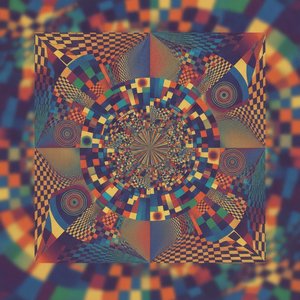
To stand before Harmas is to step directly into the mind of its creator, Victor Vasarely. This piece is not merely an arrangement of color and pattern; it is a vibrant intellectual puzzle, a visual meditation on structure itself. The eye is immediately drawn into the intricate dance between the bold red checks and the myriad small circles that populate the background. It possesses the undeniable energy characteristic of Op Art—an art movement that dared to challenge the very nature of what we perceive as solid form. Vasarely masterfully manipulates these elements, creating an optical vibration that seems to shift and breathe with every passing glance.
A Masterclass in Op-Art Technique
Technically speaking, Harmas showcases a sophisticated understanding of geometric abstraction. The composition reads almost like a meticulously crafted mosaic or a complex collage, suggesting the painstaking assembly of countless colored squares into a cohesive whole. While the overall effect is one of vibrant chaos, there is an underlying mathematical rigor. Vasarely’s signature technique involves using simple, repeating geometric units—dots, lines, and checks—to trick the viewer's perception. The scattering of those deep red dots acts as both an anchor point and a disruptive element, adding necessary depth and contrast to the otherwise patterned plane. It is this tension between order and perceived instability that gives the work its electrifying quality.
Symbolism and the Quest for Harmony
The title itself, Harmas, hints at the core philosophical underpinning of the piece: harmony or balance. In Vasarely’s hands, geometry transcends mere decoration; it becomes a vehicle for exploring universal principles. The interplay between opposing patterns—the structured grid against the scattered points—suggests that true harmony is not found in simplicity, but rather in the dynamic equilibrium achieved through contrast and complexity. It invites us to consider our own internal balances, suggesting that life’s most beautiful moments are often those where disparate elements coexist.
Historical Resonance and Emotional Impact
Created in 1964, this work sits at a fascinating juncture in art history, emerging from the intellectual ferment following the Bauhaus movement and solidifying Op Art as a global phenomenon. For the modern collector or designer, owning a reproduction of Harmas is acquiring more than just wall decor; it is acquiring a piece of conceptual art that speaks to the modernist fascination with structure and perception. Emotionally, the painting is invigorating. It demands engagement, refusing to allow the viewer to simply pass by. Instead, it compels you to slow down, to look closer, and to participate actively in the artwork’s visual dialogue.
Pitanja i odgovori
Koji je format djela "Harmas"?
Format djela "Harmas" je Square. To je korisno pri planiranju mjesta na koje će reprodukcija biti postavljena.
Koje emocije prenosi "Harmas" autora Viktor Vasareli?
Emocionalni ton zabilježen za "Harmas" autora Viktor Vasareli je Energetic. On sažima osjećaj koji ovo djelo izražava.
Odgovara li datum 1964. godine za "Harmas" kojoj fazi karijere Viktor Vasareli pripada?
Datum 1964 smješta "Harmas" u Op Art Period razvoja umjetnika Viktor Vasareli.



 Naručite ručno oslikano reprodukciju
 Podijeli
 Podijeli
 Detalji
 Vodič
Vodič

 Preuzmi datoteku
 Slični predmeti
 Slide show
 Statistika

 Pročitajte više






































 Opcija stakla dostupna je samo za dimenzije manje od 110 cm