The Penitent Magdalen: A Window into Baroque Spirituality
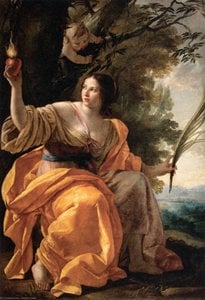
Simon Vouet’s “The Penitent Magdalen,” painted around 1630, is more than just a portrait; it's a profound meditation on faith, repentance, and the enduring power of sorrow. Executed during a pivotal moment in French art history – the transition from Mannerism to the burgeoning Baroque style – this work encapsulates Vouet’s innovative approach, blending Italian influences with a distinctly French sensibility. The painting immediately draws the viewer into a scene of quiet contemplation, dominated by the figure of Mary Magdalene, rendered with an almost sculptural quality that speaks to both her physical presence and her spiritual weight.
Vouet, having spent formative years in Rome absorbing the dramatic lighting and emotional intensity of Caravaggio’s work, brought this Italian dynamism back to France. However, he didn't simply replicate these techniques; instead, he skillfully adapted them to suit the tastes of his royal patrons. Notice how the subdued palette – dominated by rich reds, deep blues, and earthy browns – creates a sense of solemnity and introspection. The lighting is carefully controlled, highlighting Magdalene’s face and hands while casting her figure in shadow, reinforcing the theme of penance and hidden suffering.
A Study in Symbolism and Gesture
The composition itself is laden with symbolic meaning. Magdalene's posture – head bowed, hand resting on a book – immediately evokes images of prayer and devotion. The open book, often interpreted as representing scripture, suggests her ongoing journey toward redemption. Crucially, the presence of two birds—one perched on the left shoulder, the other near the upper right corner—adds layers of interpretation. Birds are frequently associated with freedom, hope, and the soul’s ascent to heaven; their inclusion here hints at Magdalene's potential for spiritual liberation through her remorse and piety.
The jar of ointment, a recurring motif in depictions of Magdalene, symbolizes her past sins—specifically, her betrayal of Christ. However, it also represents a willingness to offer amends and demonstrate genuine repentance. The careful rendering of the ointment’s texture and the subtle play of light on its surface further emphasize this duality – beauty born from sorrow.
The Painter's Technique: A Bridge Between Italy and France
Vouet’s mastery lies in his ability to seamlessly blend Italian realism with French elegance. He employs a technique known as “clai-obscure,” or chiaroscuro, which dramatically contrasts light and shadow to create depth and volume. This is particularly evident in Magdalene's face – the delicate modeling of her features, the subtle shading around her eyes, all contribute to an incredibly lifelike portrayal. Unlike the stark contrasts of Caravaggio, Vouet’s use of light is more diffused, lending a sense of grace and refinement to the scene.
Furthermore, Vouet's attention to detail—the folds of Magdalene’s dress, the texture of her hair, even the subtle imperfections in her hands—demonstrates his meticulous approach. This commitment to realism was highly valued by the French court, who sought artists capable of producing works that were both aesthetically pleasing and historically accurate.
Emotional Resonance and Lasting Legacy
"The Penitent Magdalen" is not merely a depiction of a biblical figure; it’s an exploration of human emotion—the pain of regret, the yearning for forgiveness, and the possibility of spiritual renewal. Vouet masterfully captures Magdalene's inner turmoil, inviting viewers to contemplate their own struggles with faith and redemption. The painting’s enduring appeal lies in its ability to resonate across centuries, offering a timeless meditation on the complexities of the human condition.
Reproductions of this powerful work offer an exceptional opportunity to bring this evocative scene into any space. Its rich colors, dramatic lighting, and profound symbolism create a focal point that speaks volumes about faith, sorrow, and ultimately, hope.



 Pregledaj u stvarnoj veličini
 Prebacite na print
 Pošalji
 Podijeli
 Detalji o umjetničkom djelu

 Preuzmi
 Slični predmeti
 Rentgenska snimka
 Automatska prezentacija
 Statistika


 Prikaži više