The Genesis of a Pop Visionary
Roy Fox Lichtenstein, born in the vibrant metropolis of New York City on October 27, 1923, indelibly altered the landscape of twentieth-century art. Emerging as a pivotal figure within the Pop Art movement, Lichtenstein didn’t simply reflect his era; he actively interrogated it, transforming commonplace imagery into compelling artistic statements. His upbringing in an upper-middle-class Jewish family fostered both a cultural awareness and an early artistic inclination. Childhood exposure to museums and concerts, coupled with a deep appreciation for jazz music, laid the groundwork for a creative spirit that would challenge conventional notions of fine art. Though initially drawn to realistic drawing and painting during his formative years, Lichtenstein’s formal training commenced at the Art Students League in 1939 under Reginald Marsh, followed by studies at Ohio State University – interrupted briefly by wartime service in the Army. These experiences provided a robust technical foundation that would later be brilliantly re-contextualized through the lens of mass culture and commercial aesthetics. The seeds of his signature style weren’t sown within the hallowed halls of artistic tradition but rather in the often-overlooked world of everyday imagery, particularly comic books and advertising.
Early Influences and Artistic Exploration
Lichtenstein's formative years were marked by a fascination with European art history—particularly Rembrandt and Picasso—whose mastery of chiaroscuro and expressive brushwork profoundly impacted his artistic sensibilities. He absorbed the lessons of Reginald Marsh at OSU, embracing abstraction as a means of conveying emotion and exploring innovative compositional techniques. His early drawings demonstrated an acute sensitivity to line and form, reflecting a meticulous attention to detail that would characterize his later work. Lichtenstein’s intellectual curiosity extended beyond art; he pursued scientific studies alongside his artistic endeavors, demonstrating a holistic approach to learning and creative expression. He was deeply influenced by Allan Kaprow's proto-pop aesthetic—specifically, the concept of "chance operations"—which encouraged him to experiment with unconventional materials and processes. The American Museum of Natural History served as an enduring source of inspiration, fostering his appreciation for natural forms and stimulating his imaginative vision.
The Birth of Pop Art: Comic Books and Commercial Reproduction
The pivotal moment in Lichtenstein’s artistic trajectory arrived during his tenure at Rutgers University where he encountered Allan Kaprow, whose influence reignited Lichtenstein’s interest in the burgeoning movement of Pop Art. Recognizing the potential for artistic innovation within popular culture—particularly comic books and advertising—he embarked on a radical stylistic transformation that would redefine the boundaries between “high” and “low” art. He began meticulously recreating comic strip images using techniques mimicking commercial printing processes, most notably employing Ben-Day dots – tiny colored squares that created halftone patterns—to simulate the texture of newspaper reproduction. This wasn’t merely imitation; it was a deliberate critique of mass culture and its impact on artistic expression. Lichtenstein's first major Pop painting, *Look Mickey* (1961), immediately established him as a pioneer of this new aesthetic direction. He skillfully manipulated color palettes and compositional arrangements to convey both humor and pathos—challenging traditional notions of artistic seriousness while simultaneously engaging with the visual language of popular media.
Major Achievements and Artistic Legacy
Lichtenstein’s prolific output spanned decades, encompassing paintings, prints, sculptures, murals, and commissions that cemented his position as one of the most influential artists of the second half of the twentieth century. His masterful command of technique—characterized by bold outlines, vibrant colors, and meticulous attention to detail—became synonymous with Pop Art style. He achieved international recognition through groundbreaking exhibitions at galleries and museums across Europe and North America, establishing himself as a leading voice in contemporary art discourse. Lichtenstein’s work continues to inspire graphic designers, illustrators, and visual artists worldwide—a testament to the enduring power of his artistic vision. His exploration of themes such as war, romance, and societal expectations—filtered through the lens of comic book imagery—challenged conventional artistic conventions and provoked critical reflection on cultural values.
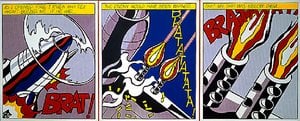
- Iconic Paintings: *Whaam!*, *Drowning Girl*, *Oh, Jeff…I Love You, Too…But…*, *Masterpiece*.
- Influence on Graphic Design: His techniques profoundly impacted the visual language of advertising and illustration.
Lichtenstein passed away on September 29, 1997, leaving behind a body of work that remains as relevant and provocative today as it was during his artistic prime—a legacy defined by innovation, intellectual rigor, and an unwavering commitment to challenging established artistic paradigms. His art serves as a powerful reminder of the transformative potential of appropriation and the enduring fascination with popular culture—a testament to the genius of Roy Fox Lichtenstein.



 Pregledaj u stvarnoj veličini
 Kupi ručno naslikanu sliku
 Pošalji
 Podijeli
 Detalji o umjetničkom djelu

 Preuzmi
 Slični predmeti
 Rentgenska snimka
 Automatska prezentacija
 Statistika

 Prikaži više






































 Opcija stakla dostupna je samo za dimenzije manje od 110 cm