Pregledaj u stvarnoj veličini Isprobaj u AR-u Naručite ručno oslikano reprodukciju Prebacite na digitalnu prodaju slika Podijeli
Detalji Vodič Dodaj u omiljene Preuzmi datoteku Slični predmeti Rentgenska snimka Slide show Statistika

Collage

René Magritte (1898-1967): Belgijski nadrealista poznat po ikoničnim djelima poput "Ljudi ljubavi", izazivanju stvarnosti i percepcije.

Djelo prikazano na ovoj stranici zaštićeno je autorskim pravima, što znači da zakonski ne možemo izraditi niti prodati identičnu reprodukciju. Ova se zaštita provodi u skladu s međunarodnim sporazumima kao što su Bernska konvencija i nacionalnim zakonima, uključujući i one koji su utvrđeni u Američki zakon o autorskom pravu – Title 17.

Ova metoda u potpunosti je usklađena s autorskim pravima jer ne uključuje kopiranje ili dupliciranje zaštićenih umjetničkih djela. Umjesto toga, riječ je o kreativnoj reinterpretaciji – novoj slici koja je dobila utjecaj na izvornik, ali nije identična njemu.

Giclée / Umjetnički otisak

Giclée tisak muzejske kvalitete ili otisak na platnu uz brzu proizvodnju i fleksibilne opcije završne obrade. ( Naručite ručno oslikano reprodukciju Prebacite na digitalnu prodaju slika)

Corner sample of the P118B picture frame: ližani polistiren, 5 cm wide and 3 cm thick
P118B €10
Corner sample of the P118H picture frame: ližani polistiren, 5 cm wide and 3 cm thick
P118H €10
Corner sample of the P118W picture frame: ližani polistiren, 5 cm wide and 3 cm thick
P118W €10
Corner sample of the P438Z picture frame: ližani polistiren, 5.5 cm wide and 3.5 cm thick
P438Z €10
Corner sample of the P508JH picture frame: ližani polistiren, 7 cm wide and 3.5 cm thick
P508JH €12
Corner sample of the P508YH picture frame: ližani polistiren, 7 cm wide and 3.5 cm thick
P508YH €12
Corner sample of the P805H picture frame: ližani polistiren, 5 cm wide and 3.5 cm thick
P805H €10
Corner sample of the P805Z picture frame: ližani polistiren, 5 cm wide and 3.5 cm thick
P805Z €10
Corner sample of the P919BZ picture frame: ližani polistiren, 7 cm wide and 3.5 cm thick
P919BZ €10
Corner sample of the P919G picture frame: ližani polistiren, 7 cm wide and 3.5 cm thick
P919G €10
Corner sample of the P919XJ picture frame: ližani polistiren, 7 cm wide and 3.5 cm thick
P919XJ €10
Corner sample of the P959ZH picture frame: ližani polistiren, 5 cm wide and 3 cm thick
P959ZH €10
Corner sample of the P968JZ picture frame: ližani polistiren, 6 cm wide and 4 cm thick
P968JZ €12
Corner sample of the W106C picture frame: masivno drvo, 5 cm wide and 3 cm thick
W106C €8
Corner sample of the W218G picture frame: masivno drvo, 5 cm wide and 3 cm thick
W218G €10
Corner sample of the W218JH picture frame: masivno drvo, 5 cm wide and 3 cm thick
W218JH €8
Corner sample of the W218Y picture frame: masivno drvo, 5 cm wide and 3 cm thick
W218Y €10
Corner sample of the W307PJ picture frame: masivno drvo, 6 cm wide and 3 cm thick
W307PJ €10
Corner sample of the W316G picture frame: masivno drvo, 6 cm wide and 3 cm thick
W316G €10
Corner sample of the W316PJ picture frame: masivno drvo, 6 cm wide and 3 cm thick
W316PJ €8
Corner sample of the W316Y picture frame: masivno drvo, 6 cm wide and 3 cm thick
W316Y €10
Corner sample of the W398PJ picture frame: masivno drvo, 5 cm wide and 3 cm thick
W398PJ €8
Corner sample of the W4111J picture frame: masivno drvo, 6.5 cm wide and 3.5 cm thick
W4111J €10
Corner sample of the W500HY picture frame: masivno drvo, 7 cm wide and 5 cm thick
W500HY €15
Corner sample of the W500JH picture frame: masivno drvo, 7 cm wide and 5 cm thick
W500JH €15
Corner sample of the W692G picture frame: masivno drvo, 8 cm wide and 4 cm thick
W692G €12
Corner sample of the W849H picture frame: masivno drvo, 5 cm wide and 3 cm thick
W849H €8
Corner sample of the W940BG picture frame: masivno drvo, 7.5 cm wide and 4.5 cm thick
W940BG €15
Corner sample of the W953PJ picture frame: masivno drvo, 6 cm wide and 3.5 cm thick
W953PJ €8

Standardne dimenzije
prilagođeno po mjeri
CM
INCH

Odaberite jednu od naših unaprijed definiranih veličina koje odgovaraju izvornim proporcijama umjetničkog djela.

širina
visina

Unesite širinu i visinu koja vam je potrebna, kako bi odgovarali vašem okviru ili zidu. Print se može samo izrezati, nikada ne može biti veći od slike, stoga veličina s drugačijim oblikom gubi dio slike. Šaljemo vam digitalni prikaz (mockup) na odobrenje prije bilo kakve štampe. Slika prikazana na ovoj stranici ne prikazuje stvarni rez — to čini samo digitalni prikaz.

Dostava širom svijeta () u roku od 2 tjedna umjesto standardnih 4/5 tjedana. (25 Listopad)

Besplatna ekspresna dostava širom svijeta
Visokokvalitetno laneno platno
Potpuno osiguranje transporta
Jamstvo povrata carine i uvoznih poreza
Jamstvo vjernosti boja
Politika povrata u roku od 100 dana (samo u slučaju nedostataka)
Jamstvo povrata 100% novca
Popust na više proizvoda

Ukupna cijena

€ 60

Collage

Giclée / Umjetnički otisak

Veličina reprodukcije

-

Ukupna cijena

€ 60

Brzi pregled

  • Subject or theme: Symbolic representation
  • Year: 1964
  • Influences: Cubism
  • Title: Collage
  • Notable elements or techniques: Juxtaposition of disparate objects

A Surreal Still Life: Exploring Magritte’s Collage

René Magritte's "Collage" stands as a deceptively simple yet profoundly unsettling exploration of perception and reality—a hallmark characteristic of Surrealist art. Painted around 1962, this artwork embodies the core tenets of Surrealism, championed by André Breton and his circle, who sought to liberate the subconscious mind from rational constraints. The painting presents a stark tableau: three objects arranged against a muted backdrop – a yellow hand resting on a surface, an orange ball hovering above it, and a crimson curtain draped in the background—figures that appear commonplace yet simultaneously imbued with an inexplicable tension.

Style and Technique: Precision Within Illusion

Magritte’s meticulous technique distinguishes him from many of his contemporaries who embraced spontaneous expression. Unlike Dali's melting clocks or Ernst’s biomorphic abstractions, Magritte employed a precise realism to depict these seemingly banal items. However, this careful rendering serves not to reinforce the observable world but rather to heighten its strangeness. The artist utilized oil paint on canvas with meticulous attention to detail, achieving a velvety surface texture that contrasts subtly with the flatness of the composition. This deliberate control over materiality underscores Magritte’s intention: to present familiar objects in an unfamiliar context, forcing viewers to question their assumptions about how they perceive and interpret visual information.

Historical Context: Breton's Manifesto and Beyond

“Collage” emerged during a period marked by intense intellectual ferment—the aftermath of World War II and the burgeoning influence of psychoanalysis spearheaded by Sigmund Freud. Surrealism arose as a reaction against the anxieties of postwar Europe, fueled by disillusionment with traditional artistic conventions and philosophical ideologies. Breton’s 1929 Manifesto for Surrealist Painting declared that art should be “psychic automatism in its purest form,” bypassing conscious thought and tapping into the realm of dreams and irrational impulses. Magritte embraced this ethos, mirroring Freud's exploration of unconscious desires and anxieties—a preoccupation with hidden meanings and destabilizing accepted notions of reality.

Symbolism: The Hand, The Ball, And The Curtain – Layers of Meaning

The objects within “Collage” are laden with symbolic significance. The yellow hand represents vulnerability and exposure; its upward palm suggests a yearning for connection or perhaps an attempt to grasp something elusive. Simultaneously, it embodies the artist’s own preoccupation with representation—the hand itself is depicted as a solid form despite being rendered in paint, highlighting Magritte's awareness of the illusionistic nature of art. The orange ball symbolizes optimism and aspiration, hovering above the hand like a beacon of hope amidst uncertainty. However, its position also disrupts the expected hierarchy of visual elements, mirroring the Surrealist desire to subvert conventional order. Finally, the crimson curtain serves as a barrier—a symbol of concealment and repression—yet it’s equally suggestive of protection and concealment. Its color evokes associations with blood and passion, hinting at repressed emotions and unresolved conflicts.

Emotional Impact: A Quiet Disquiet

Despite its understated aesthetic, “Collage” possesses a palpable emotional resonance. The painting doesn't provoke immediate shock or melodrama; rather, it instills a subtle sense of unease—a feeling that something is amiss beneath the surface tranquility. Magritte’s masterful manipulation of visual cues compels viewers to confront their own perceptions and assumptions about reality. Like many Surrealist artworks, “Collage” invites contemplation and encourages us to consider alternative interpretations, prompting us to question what we see and what lies beyond our conscious awareness. It remains a testament to Magritte's ability to distill profound philosophical ideas into deceptively simple visual forms—a captivating piece that continues to fascinate audiences today.

Pitanja i odgovori

Kako "Collage" uspostavlja ravnotežu između svjetla i tame?

"Collage" ima ukupnu svjetlinu od brilliant, a njezina luminancija iznosi Luminous.

U kojoj je tehnici izvedeno djelo "Collage" autora René Magritte?

Tehnika djela "Collage" autora René Magritte je Acrylic On Canvas. Reprodukcije imaju za cilj dočarati izgled ove tehnike.

Pod kojim drugim imenima ili pseudonimima poznat je/poznata je René Magritte?

René Magritte pojavljuje se pod drugim imenima René François Ghislain Magritte.


Biografija umjetnika

Early Life and the Seeds of Surrealism

René Magritte, born René François Ghislain Magritte on November 21, 1898, in Lessines, Belgium, emerged into a world that would profoundly shape his enigmatic artistic vision. His early years were marked by an unsettling event – the suicide of his mother when he was just thirteen. The image of her body being recovered from the River Sambre, with her dress obscuring her face, became a haunting motif that would subtly permeate his later work, manifesting in veiled figures and a persistent exploration of hidden realities. This early trauma instilled within him a fascination with mystery, loss, and the unsettling power of what remains unseen. While details of his childhood remain somewhat elusive, it’s clear this formative experience laid the groundwork for his lifelong questioning of perception and representation. He began drawing lessons at age ten, revealing an innate inclination towards visual expression, but initially explored Impressionism before embarking on a path that would lead him to become one of the most significant figures in Surrealist art.

Artistic Development and Influences

Magritte’s artistic journey was not immediate or straightforward. He studied at the Académie Royale des Beaux-Arts in Brussels, yet found its traditional methods stifling. His early work experimented with Futurism and Cubism, absorbing elements of these avant-garde movements but ultimately rejecting their purely formal concerns. It wasn't until encountering Giorgio de Chirico’s painting *The Song of Love* in 1922 that Magritte discovered a resonance that would irrevocably alter his artistic course. De Chirico’s dreamlike landscapes and unsettling juxtapositions unlocked within Magritte a new way of seeing – a world where the familiar could be rendered strange, and the ordinary imbued with profound mystery. This encounter sparked his commitment to Surrealism, though he often maintained a unique distance from its more overtly psychological or automatic approaches. He preferred a meticulous, almost clinical precision in his painting, using realistic techniques to depict illogical scenarios.

The Heart of Surrealism: Challenging Reality

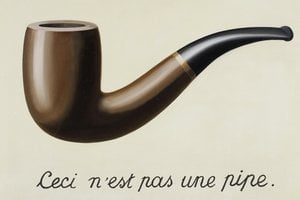
By 1926, Magritte had fully embraced the tenets of Surrealism, producing *Le Jockey Perdu (The Lost Jockey)*, widely considered his first truly surrealist work. However, his brand of Surrealism was distinct. He wasn’t interested in exploring the subconscious through free association or dream imagery in the manner of some of his contemporaries. Instead, Magritte sought to challenge viewers' perceptions of reality by presenting ordinary objects in unexpected contexts, forcing them to question their assumptions about the world around them. Iconic works like *The Treachery of Images (This is not a pipe)* (1929) brilliantly deconstructs the relationship between image and object, reminding us that a representation is never the thing itself. *Les Amants (The Lovers)* (1927-1928), with its shrouded figures, echoes the trauma of his mother’s death while simultaneously exploring themes of concealment and intimacy. *Time Transfixed* (1938) presents a locomotive bursting through a brick wall, disrupting our sense of space and time. And *The Human Condition* (1933), a canvas within a canvas, blurs the boundaries between representation and reality, prompting us to consider how we perceive and interpret the world.

Later Life, Recognition, and Enduring Legacy

Despite initial struggles for recognition, Magritte’s work gradually gained prominence, particularly in the United States with exhibitions in 1936 and later retrospective shows at the Museum of Modern Art (1965) and the Metropolitan Museum of Art (1992). He continued to refine his signature style, exploring themes of repetition, illusion, and the power of language in paintings that are both intellectually stimulating and visually arresting. Magritte died on August 15, 1967, leaving behind a body of work that continues to captivate and challenge audiences worldwide. His influence extends far beyond the realm of painting, impacting pop art, minimalist art, conceptual art, and even advertising and film. Today, his paintings are held in major museum collections around the globe, including the Musées royaux des beaux-arts de Belgique in Brussels, which houses the Magritte Museum – dedicated entirely to his work and boasting the world’s largest collection of his creations.

René Magritte

René Magritte

1898 - 1967 , Belgija

Brzi pregled

  • Artistic Movement Or Style: Surealizam
  • Artists Who Influenced This Artist: ['Giorgio de Chirico']
  • Date Of Birth: 21. studenog 1898.
  • Date Of Death: 15. kolovoza 1967.
  • Full Name: René François Ghislain Magritte
  • Nationality: Belgijanin
  • Notable Artworks:
    • Les Amants
    • The Treachery of Images
    • Time Transfixed
    • The Human Condition
  • Place Of Birth: Lessines, Belgiji
Istražite umjetnička djela organizirana prema temama, stilovima i karakteristikama.