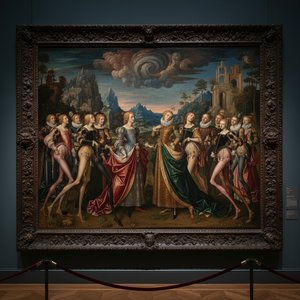
A Winter’s Tale of Humanity and Faith
In the quiet, frost-bitten landscape of 16th-century Flanders, Pieter Bruegel the Elder captures a moment that is simultaneously sacred and profoundly mundane. The Census at Bethlehem, completed in 1566, is far more than a mere biblical illustration; it is an immersive window into the rhythms of rural Brabant life during the height of the Northern Renaissance. While the painting ostensibly depicts the biblical account from the Gospel of Luke—the journey of Mary and Joseph to Bethlehem for Caesar Augustus' census—Bruegel masterfully de-centers the divine to focus on the human. Instead of a solemn, ethereal procession, we find ourselves thrust into a bustling, snow-dusted village square where the weight of imperial decree meets the simple, enduring struggles of the peasantry.
The atmosphere is palpable, thick with the biting chill of a Flemish winter. Bruegel employs a meticulous technique, utilizing fine hatching and cross-hatching to sculpt the textures of heavy woolen garments, the sturdy flanks of working horses, and the uneven, frozen earth. His palette, dominated by earthy pigments and muted tones, reflects the harsh realities of the season, yet there is a vibrant liveliness found in the small details: the movement of birds through the crisp air, the rhythmic toil of men pulling carts, and the scattered activity of villagers engaged in their daily chores. This technical precision creates a sense of depth that pulls the viewer into the scene, making the cold feel almost tangible.
Symbolism and the Social Tapestry
Beyond its surface-level narrative, the painting serves as a complex tapestry of social commentary and spiritual symbolism. Bruegel was a keen observer of the human condition, and in this work, he subtly critiques the societal hierarchies of his time. The contrast between the monumental scale of the landscape and the minute, busy lives of the figures suggests a world where individual struggles are dwaressed by larger historical and religious forces. The ruined building visible on the right serves as a poignant visual counterpoint, perhaps hinting at the fragility of human structures in the face of divine providence or the shifting political tides of the era.
For the modern collector or interior designer, this masterpiece offers an unparalleled emotional depth. It is a piece that commands attention through its sheer narrative density and atmospheric beauty. Whether viewed as a study of historical resilience or as a breathtaking landscape of winter light and shadow, The Census at Bethlehem brings a sense of timelessness and intellectual gravity to any space. It invites contemplation on the intersection of the extraordinary and the everyday, making it an exquisite choice for those who seek art that tells a story far beyond the frame.



 Pregledaj u stvarnoj veličini
 Naručite ručno oslikano reprodukciju
 Podijeli
 Podijeli
 Detalji
 Vodič
Vodič

 Preuzmi datoteku
 Slični predmeti
 Rentgenska snimka
 Slide show
 Statistika


 Pročitajte više






































 Opcija stakla dostupna je samo za dimenzije manje od 110 cm