A Dreamscape in Green: Unveiling Picasso’s ‘Sleep’
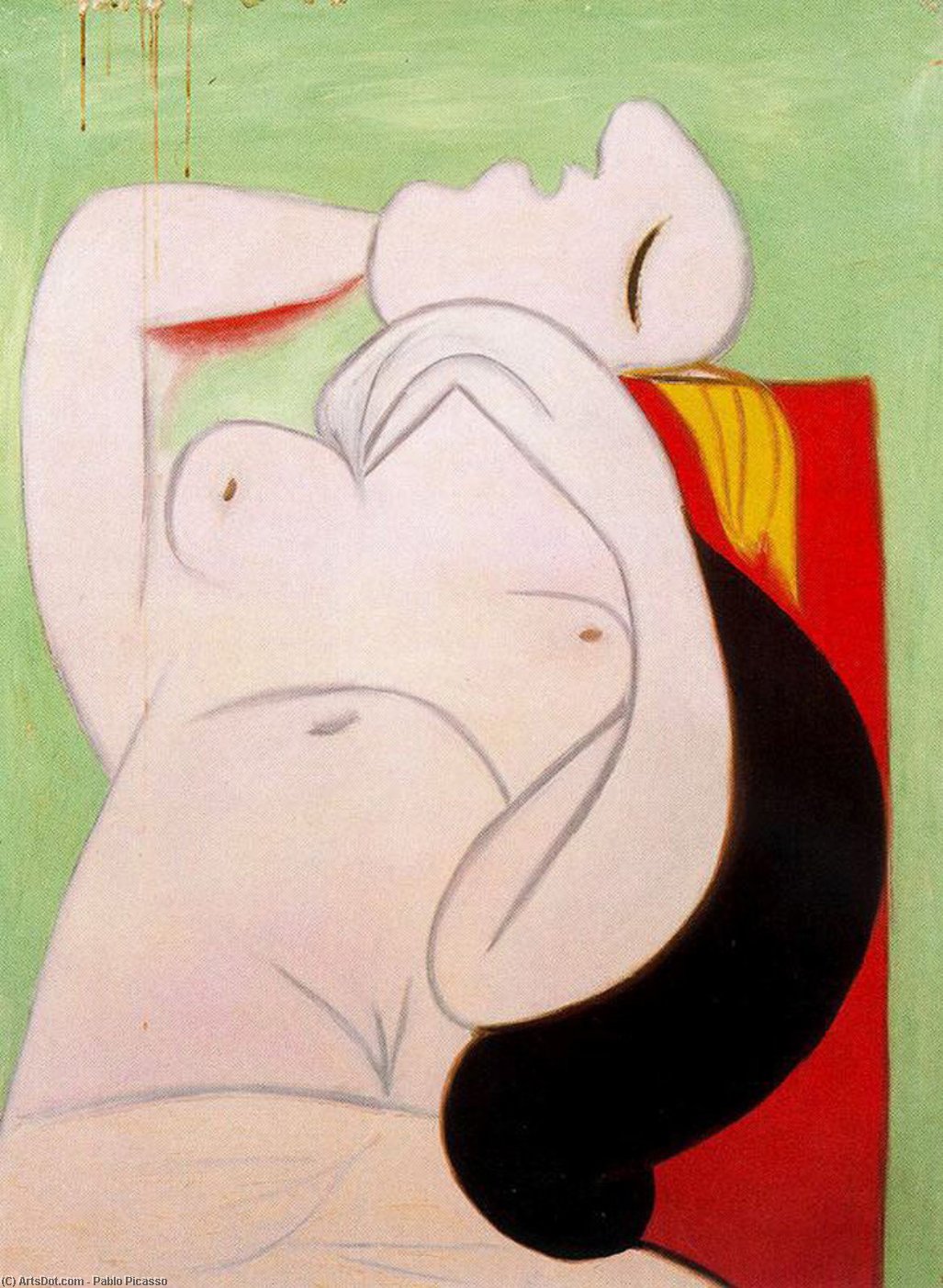
Pablo Picasso's 1932 painting, *Sleep*, is more than just a depiction of repose; it’s an invitation into the subconscious, a visual poem exploring sensuality, dreams, and the evolving artistic language of one of the 20th century’s most revolutionary figures. Measuring 130 x 97 cm and executed in oil on canvas, this work stands as a pivotal moment in Picasso's stylistic journey, bridging his Cubist foundations with the burgeoning world of Surrealism.
Subject & Composition: A Reclining Muse
The painting centers around a reclining female nude, her form elegantly elongated and simplified. She rests on her side, head cradled by her arm – a pose evoking both vulnerability and serene tranquility. The vibrant green background isn’t merely decorative; it acts as an emotional field, amplifying the dreamlike quality of the scene. Two shadowy figures subtly emerge in the background, hinting at hidden narratives or perhaps representing aspects of the dreamer's psyche. Picasso masterfully employs flowing lines and bold shapes to define the figure, creating a sense of movement even within stillness.
Style & Technique: Cubism’s Echoes in Surrealist Dreams
While undeniably influenced by Picasso’s earlier explorations into Cubism – evident in the fragmented forms and multiple perspectives subtly woven into the composition – *Sleep* distinguishes itself through a newfound fluidity. The sharp angles of his Cubist period soften, yielding to more organic curves and a dreamlike distortion of anatomy. His technique involves layering oil paint to achieve smooth transitions between colors and shapes, creating an almost luminous quality. This isn’t about precise representation; it's about capturing the *feeling* of sleep, the blurring of reality and imagination.
Historical Context & Influences: A Year of Transformation
1932 was a particularly significant year for Picasso, marked by his passionate affair with Marie-Thérèse Walter, who is widely believed to be the model for this painting and many others from that period. This personal connection infuses *Sleep* with an undeniable sensuality. The broader artistic landscape of the time – the rise of Surrealism championed by André Breton – also played a crucial role. Surrealism’s emphasis on the subconscious, dreams, and irrationality provided Picasso with fertile ground to explore new expressive possibilities beyond the intellectual rigor of Cubism. He was simultaneously exhibiting with Pierre Bonnard and Édouard Vuillard, further broadening his artistic horizons.
Symbolism & Emotional Impact: Beyond the Surface
The exposed breast is a deliberate element, not simply titillation but a symbol of vulnerability, nourishment, and perhaps even creative power. The closed eyes suggest an inward journey, a retreat into the realm of dreams. The green background can be interpreted as representing life, growth, or even envy – adding layers of psychological complexity to the scene. *Sleep* evokes a sense of peacefulness, intimacy, and mystery. It’s a painting that invites contemplation, prompting viewers to connect with their own subconscious experiences.
Legacy & Modern Relevance
*Sleep* remains a powerful testament to Picasso's artistic genius and his ability to constantly reinvent himself. It exemplifies the transition from the analytical fragmentation of Cubism towards the more emotionally charged explorations of Surrealism. The painting’s enduring appeal lies in its universal themes – love, desire, vulnerability, and the allure of the dream world. It continues to inspire artists and captivate audiences today, solidifying Picasso's place as a cornerstone of modern art.
For those seeking to experience more of Picasso’s work or explore similar Surrealist masterpieces, WahooArt.com offers exquisite handmade oil painting reproductions of ‘Sleep’ and other iconic artworks. You can find it here:
Pablo Picasso: Sleep. Further exploration into the movements that influenced Picasso, such as Cubism (
Cubism) and Surrealism (
Surrealism), will enrich your understanding of this remarkable work.



 Naručite reprodukciju
 Pošalji
 Podijeli
 Detalji

 Preuzmi
 Slični predmeti
 Rentgenska snimka
 Automatska prezentacija


 Prikaži više






































 Opcija stakla dostupna je samo za dimenzije manje od 110 cm