Ručno oslikano uljanim bojama na platnu u dimenzijama i okviru po vašem izboru, izrađeno po narudžbi od strane naših umjetnika. ( Kupi print Kupi digitalnu sliku)
Odaberite jednu od naših unaprijed definiranih veličina koje odgovaraju izvornim proporcijama umjetničkog djela.

Možete unijeti vlastite dimenzije kako bi odgovarale određenom okviru ili prostoru. Ako odabrana veličina ne odgovara proporcijama izvorne slike, izrezat ćemo umjetničko djelo ili proširiti sliku dodatnim ručno oslikanim elementima. Digitalni nacrt bit će vam poslan na odobrenje prije početka proizvodnje.
Imajte na umu da pregled na ekranu ne prikazuje stvarno izrezivanje ili proširivanje. Samo će nacrt točno prikazati konačni sastav.
Iako su dostupne prilagođene veličine, preporučujemo odabir dimenzije s preddefiniranog popisa kako bismo očuvali izvorne proporcije.
Isporuka širom svijeta () u roku od 3-4 tjedna umjesto standardnih 5 tjedana. (6 Rujan). Bez kompromisa u kvaliteti.


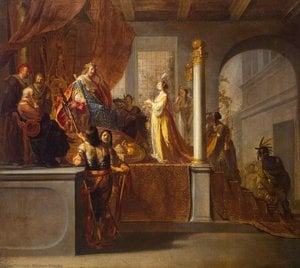
Solon before Croesus
Veličina reprodukcije

In the vibrant, bustling landscape of the Dutch Golden Age, few artists captured the dramatic tension of the Baroque era with as much meticulous care as Nicolaes Knüpfer. Born in Leipzig, Germany, in 1609, Knüpfer’s journey from a German apprentice to a celebrated figure in the Dutch artistic community is a testament to the fluid, interconnected nature of European art in the seventeenth century. His early years were defined by a rigorous pursuit of technical mastery, beginning with his training under the esteemed Emanuel Nysen. This foundational period instilled in him a profound respect for the structural elements of painting, but it was perhaps his unexpected tenure in Magdeburg that truly shaped his unique artistic DNA. While residing there, Knüpfer worked as a brushmaker, an intimate occupation that granted him an unparalleled understanding of the tools of his trade. This rare insight into the very fibers and textures of the brush allowed him to manipulate pigments with a precision that would later become his hallmark, blending the artisan's tactile knowledge with the painter's visionary spirit.
The trajectory of Knüpfer’s career reached a transformative milestone in 1630 when he relocated to Utrecht. This move placed him at the heart of a flourishing artistic hub, where he entered into a pivotal collaborative partnership with the legendary Abraham Bloemaert. Under the influence of Bloemaert’s sophisticated style, Knüpfer began to expand his repertoire beyond mere technical execution, embracing the grander, more emotive themes of biblical narratives and mythological legends. His ability to weave complex stories through flowing lines and unusual, expressive figures set him apart from his contemporaries. By 1637, his reputation was firmly established, earning him prestigious membership in the Guild of St. Luke. This period of professional maturity saw him undertaking monumental commissions that extended far beyond the borders of the Netherlands; notably, his work for the opulent Kronborg Castle in Denmark serves as a glittering reminder of his status as a premier decorative artist capable of enriching the most royal of interiors.
Knüpfer’s body of work is characterized by a remarkable versatility, allowing him to navigate seamlessly between the divine and the earthly. He possessed a singular talent for breathing life into historical and biblical figures, imbuing them with a sense of psychological depth and grandeur. In masterpieces such as Queen of Sheba before Solomon, one can witness his mastery of the Baroque aesthetic—a world of rich textures, dramatic lighting, and courtly splendor that transports the viewer to an era of ancient majesty. Yet, Knüpfer was equally adept at capturing the gritty, spirited atmosphere of everyday life. His genre paintings, such as the evocative Brothel Scene, reveal a different facet of his genius. In these works, the refined elegance of his mythological scenes gives way to exaggerated characters and expressive brushstrokes that capture the raw, often chaotic energy of an Amsterdam tavern, offering a poignant window into the societal attitudes and textures of the Dutch Golden Age.
Beyond his solo achievements, Knüpfer’s significance is deeply intertwined with the broader movement of landscape and collaborative painting. He frequently collaborated with masters such as Jan Both and Jan Baptist Weenix, skillfully integrating his intricate figures into their expansive, atmospheric landscapes. This synergy created a holistic viewing experience where human drama and natural beauty existed in perfect, dramatic harmony. His legacy is further cemented by his role as a mentor and an influence on the next generation of Dutch masters; the lineage of great painters like Jan Steen and Gabriel Metsu can trace stylistic threads back to the precision and narrative depth pioneered by Knüpfer. Through his blend of artisan craftsmanship and high-art storytelling, Nicolaes Knüpfer remains a vital figure in the history of European art, reminding us of a time when every brushstroke was an act of both devotion and discovery.

1609 - 1655 , Germany

 Pregledaj u stvarnoj veličini
 Pošalji
 Podijeli
 Detalji o umjetničkom djelu

 Preuzmi
 Slični predmeti
 Rentgenska snimka
 Automatska prezentacija
 Prikaži više




































 Opcija stakla dostupna je samo za dimenzije manje od 110 cm