


Kupite digitalnu sliku visoke rezolucije i poboljšane kvalitete, koja je znatno superiornija od online prikaza.
Svaka datoteka pedantno je pripremljena od strane naših internih stručnjaka koristeći napredne alate i vještinsku ručnu retušu. Osiguravamo da svaka slika ima iznimnu jasnoću, preciznu točnost boja i visoku razinu detalja.
Konačna datoteka dostavlja se putem e-pošte u roku od 72 sata, optimizirana za neposrednu upotrebu u profesionalnim, uredničkim i tiskarskim okruženjima. To je ista kvaliteta kojoj vjeruju vrhunski studiji dizajna, izdavači i galerije.
Preuzmite datoteku visoke rezolucije za osobnu izložbu, tisak i kreativne projekte. ( Kupi print Kupi ručno naslikanu sliku)
Odabirom WahooArt.com ne dobivate samo sliku – dobivate profesionalno unapređeno digitalno umjetničko djelo, izrađeno s najvećom preciznošću uz jamstvo zadovoljstva. Evo svega što automatski dolazi uz vašu narudžbu:

Vaša digitalna slika visoke rezolucije bit će vam poslana e-mailom u roku od 72 sata od narudžbe – spremna za neposrednu upotrebu.

Vaše umjetničko djelo profesionalno je optimizirano pomoću naprednih AI alata i ručnog uređivanja, čime se osigurava maksimalna razina detalja, oštrine i točnosti boja.

Slučajno ste obrisali ili izgubili svoju datoteku? Ne brinite – ponovno ćemo vam je poslati u bilo kojem trenutku, potpuno besplatno.

Uživajte u svojim umjetničkim djelima trenutno, bez carina, pristojbi ili troškova dostave – digitalne datoteke uvijek su oslobođene poreza.

Uz pomoć profesionalnih alata i upravljanja bojama, osiguravamo da vaša digitalna slika što vjernije odražava izvorne boje.

Ako niste zadovoljni svojom digitalnom slikom, revidirat ćemo je ili vratiti 100% iznosa u roku od 100 dana – bez suvišnih pitanja.

Niste zadovoljni? Osigurajte puni povrat novca u roku od 100 dana od primitka digitalne datoteke – bez suvišnih pitanja.

Kupite 3 slike, uštedite 10% - Kupite 5 slika, uštedite 15% - Kupite 10+ slika, uštedite 20%. Odlično za kreativne projekte, galerije i agencije.

In the golden age of Victorian landscape painting, few artists captured the ephemeral dance of light and atmosphere with as much soul as Matthew Ridley Corbet. Born on May 20, 1850, in the quiet village of South Willingham, Lincolnshire, Corbet’s origins were rooted in a world of classical scholarship and religious tradition. As the son of the Reverend Andrew Corbet, his early life was shaped by the disciplined intellect of Cheltenham College, yet his heart was destined for the vibrant, sun-drenched vistas of the Mediterranean. This tension between his structured English upbringing and his burgeoning passion for the natural world would eventually define his unique contribution to the nineteenth-century art canon.
Corbet’s formal artistic journey began within the prestigious halls of the Slade School of Art, where he studied under Alexander Davis Cooper, and later at the Royal Academy Schools under the legendary Frederic Leighton. These institutions provided him with a rigorous foundation in neoclassical technique, yet it was his departure for Italy in 1880 that truly ignited his creative spirit. In the warmth of the Italian sun, Corbet moved beyond the rigid boundaries of academic realism to embrace a more fluid, expressive way of seeing. It was during this transformative period that he formed a profound and lasting bond with the painter Giovanni Costa. This partnership became a cornerstone of his development, as together they explored the rugged beauty of Tuscany and Umbria, seeking to capture the very essence of the landscape.
The true metamorphosis of Corbet’s style occurred through his immersion in the Macchiaioli movement. Often referred to as the "splashed" painters, this group of Italian innovators sought to reject the stale conventions of academic painting in favor of direct observation and the emotive power of light. Influenced by Costa, Corbet began to master the art of the macchia—the use of distinct patches or "spots" of color to define form and atmosphere. His brushwork grew looser and more spontaneous, allowing him to render the fleeting moments of a sunset or the hazy shimmer of heat over an Italian valley with unprecedented vitality.
His canvases became windows into a world of luminous color palettes and soft, atmospheric textures. This evolution is perhaps most evident in his ability to blend Romanticism with a burgeoning Impressionistic sensibility. While his compositions often retained a sense of classical grandeur and structural integrity, the surface of his paintings pulsed with life. He did not merely paint a mountain or a field; he painted the way light clung to the stone and the way shadows stretched across the grass at dusk. This mastery of light allowed him to evoke deep emotional responses, transporting the viewer from the grey skies of England to the idyllic, sun-soaked landscapes of the Mediterranean.
Throughout his career, Corbet exhibited extensively across Europe, earning a reputation as a premier chronicler of the Italian countryside. His oeuvre contains several landmarks of Victorian landscape art that continue to captivate collectors and historians alike:
Though his life was tragically short, ending in 1902, Matthew Ridley Corbet left an indelible mark on the trajectory of landscape painting. He served as a vital bridge between the structured traditions of the Royal Academy and the experimental freedom of the modern era. By integrating the classical training of his English heritage with the revolutionary light-centric techniques of the Italian Macchiaioli, he created a body of work that remains a testament to the enduring power of nature and the transformative beauty of light.
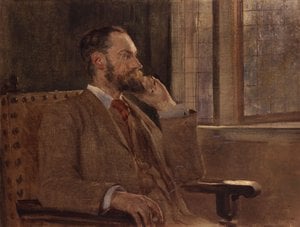
1850 - 1902

 Pregledaj u stvarnoj veličini
 Pošalji
 Podijeli
 Detalji o umjetničkom djelu

 Preuzmi
 Slični predmeti
 Rentgenska snimka
 Automatska prezentacija
 Prikaži više


