The Vibrant Pulse of Melanesian Spirit: The Life and Legacy of Mathias Kauage
In the rich, kaleidoscopic tapestry of contemporary Melanesian art, few names resonate with as much profound cultural authority as Mathias Kauage. Born in 1944 in the village of Miugu, within the Chimbu Province of Papua New Guinea, Kauage emerged not merely as a painter, but as a visual storyteller for an entire nation’s soul. His life’s work serves as a bridge between the ancient, ritualistic rhythms of his ancestors and the evolving landscape of modern global art. Though he passed away in 2003, his presence remains felt through every bold stroke and vivid pigment he left behind, capturing the very essence of Papua New Guinea’s ceremonial grandeur and its enduring spiritual vitality.
Kauage's artistic journey was ignited by a transformative encounter with the works of Timothy Akis in 1969, an event that catalyzed his transition from observer to creator. As he developed his unique visual language, he became a pioneer of the contemporary art movement in his homeland. His style is instantly recognizable for its exuberant use of color and meticulous attention to the intricate patterns that define Melanesian identity. Whether working with acrylic on canvas or exploring the graphic depths of woodcuts, Kauage possessed a rare ability to translate the intangible—the whispers of ancestral spirits and the energy of ritual dances—into tangible, breathtaking compositions. His technique often involved a masterful layering of color, creating luminous effects that mirror the atmospheric humidity and vibrant flora of the Papua New Guinean landscape.
Symbolism and the Ritual Landscape
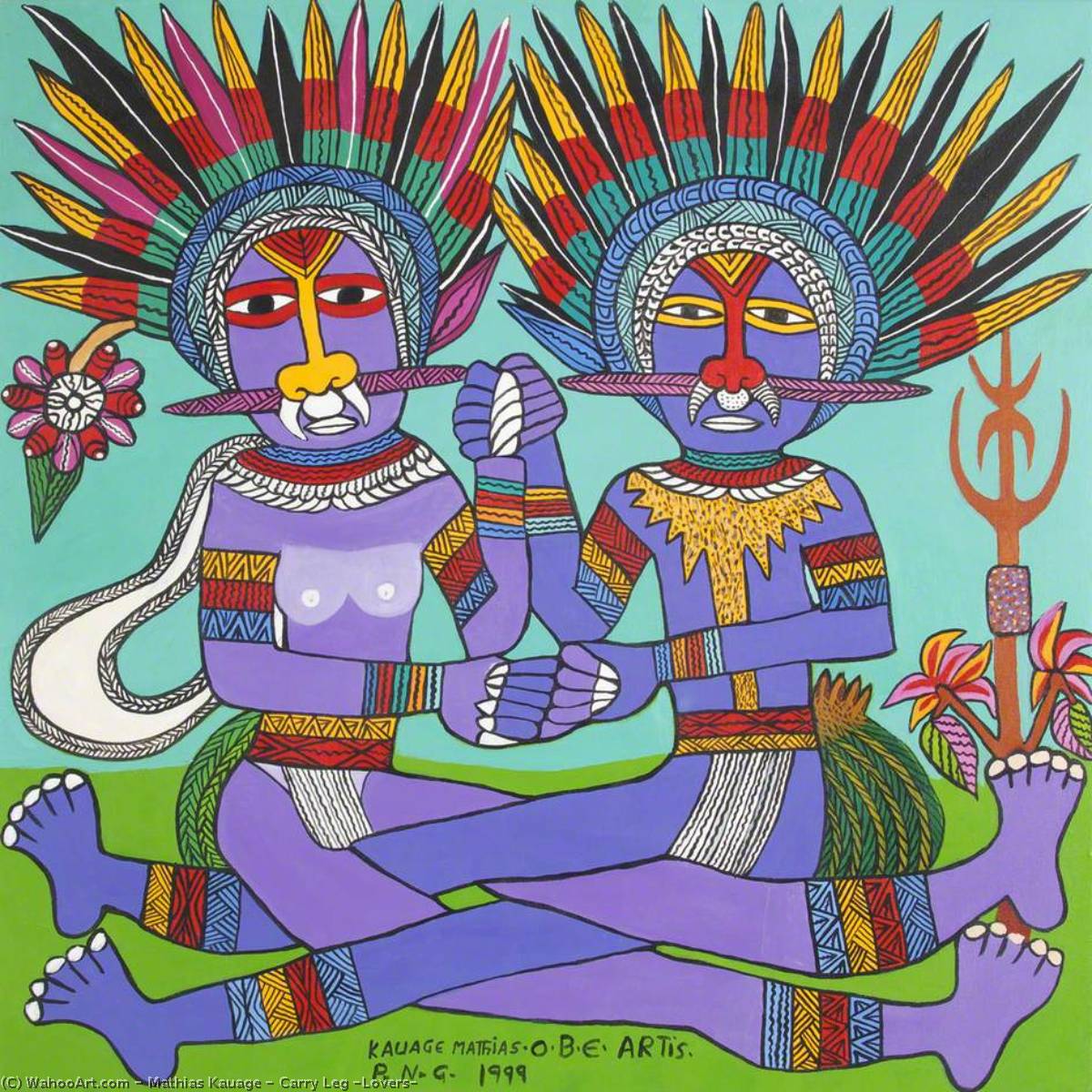
To gaze upon a Kauage masterpiece is to enter a world where the boundaries between the physical and the spiritual are perpetually blurred. His subject matter was deeply rooted in the cosmology of his people, frequently portraying scenes of warrior ceremonies, traditional dances, and the presence of ancestral deities. In works such as Mudmen, he captures the haunting beauty of ceremonial masks, while pieces like Buka War bring the tension and movement of tribal life to the forefront. Even in more intimate moments, such as his 1999 work Carry Leg (Lovers), Kauage weaves together the personal and the communal; the figures are adorned with kaleidoscopic patterns that suggest a ritualistic significance, turning a moment of human connection into a celestial encounter.
The symbolism within his paintings extends far beyond mere decoration. Every pattern, every choice of pigment, and every arrangement of figures serves as a language of status, identity, and myth. His art does not seek to provide a Western-style narrative or individual portraiture; instead, it prioritizes the collective experience. Through his eyes, we see the importance of the communal ritual, the weight of tradition, and the sacredness of the natural world. This focus on the essence of shared existence allowed his work to transcend geographical borders, speaking a universal language of human devotion and cultural pride.
Global Recognition and Lasting Significance
The impact of Mathias Kauage’s career reached far beyond the shores of Papua New Guinea. He achieved significant international acclaim, with his works finding homes in prestigious institutions such as the National Gallery of Australia and the Glasgow Museums Resource Centre. His ability to engage global audiences was further cemented through collaborations with museums like Ham House in Virginia, which helped introduce the complexities of Melanesian culture to a Western audience. In 1998, his immense contribution to the arts was formally recognized when he was awarded the Order of the British Empire (O.B.E.) by Queen Elizabeth II, a testament to his role as a cultural ambassador.
The legacy of Mathias Kauage is one of both innovation and preservation. He did not simply replicate the past; he reimagined it through a modern lens, ensuring that the traditions of Papua New Guinea remained dynamic and visible on the world stage. His influence can be seen in the ongoing dialogue between heritage and contemporary indigenous art globally. As we reflect on his life, we see an artist who successfully captured the echoes of a ritual landscape, leaving behind a vibrant, permanent record of a culture’s heartbeat.


 Pregledaj u stvarnoj veličini
 Prebacite na prodaju printova
 Podijeli
 Podijeli
 Detalji
 Vodič
Vodič

 Preuzmi datoteku
 Slični predmeti
 Rentgenska snimka
 Slide show
 Statistika


 Pročitajte više