16.0 x 24.0 cm
 Gipuzkoa Heritage Collection Centre
Giclée tisak muzejske kvalitete ili otisak na platnu uz brzu proizvodnju i fleksibilne opcije završne obrade. ( Kupi ručno naslikanu sliku Kupi digitalnu sliku)
Odaberite jednu od naših unaprijed definiranih veličina koje odgovaraju izvornim proporcijama umjetničkog djela.

Možete unijeti vlastite dimenzije kako biste umjetničko djelo prilagodili specifičnom okviru ili prostoru. Ako odabrana veličina ne odgovara proporcijama izvornog rada, izrezat ćemo dio slike ili je proširiti pomoću ogledalnog efekta ili jednobojne rubne površine. Digitalni prikaz (mockup) bit će vam poslan na odobrenje prije početka proizvodnje.
Imajte na umu da pregled na zaslonu ne odražava stvarno izrezivanje ili proširivanje. Samo će mockup točno prikazati konačnu kompoziciju.
Iako su dostupne prilagođene veličine, preporučujemo odabir dimenzije iz unaprijed definirane liste kako biste očuvali izvorne proporcije.
Dostava širom svijeta () u roku od 2 tjedna umjesto standardnih 4/5 tjedana. (7 Rujan)


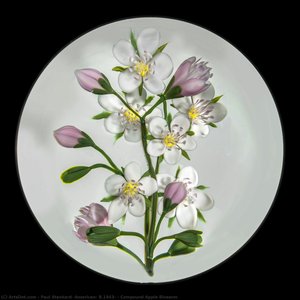
Floral centrepiece
Veličina reprodukcije

María Concepción Laca Ugaldebere, known affectionately to many as Concha Laca, was a singular figure in the realm of Spanish ceramic art, a master who possessed the rare ability to breathe life into porcelain. Born in Madrid in 1925, her early years were shaped by a blend of cultural influences; while her roots were firmly planted in the Spanish capital, her father, Doroteo Laca, was a mechanic from Vizcaya, creating a family life that oscillated between the urban heart of Madrid and the rugged landscapes of Bérriz. This duality of environment—the structured city and the natural vitality of the Basque country—would later find its way into her work, manifesting as a profound connection to the organic world.
Her journey toward artistic mastery began not with administrative studies, as she had initially intended, but through the transformative influence of the Cerámica Municipal de Madrid. Under the mentorship of Francisco Alcántara, Laca honed her technical precision, securing a prestigious scholarship that allowed her to refine her skills until 1947. This period of rigorous training laid the foundation for a career defined by an unparalleled attention to detail and a dedication to the delicate nuances of form and color.
The trajectory of Laca’s career was irrevocably changed by her long-standing association with Porcelanas Bidasoa, a period that spanned from 1952 to 1984. It was within this prestigious institution that she truly ascended from an assistant teacher to a renowned independent artist and sculptor. Her technical prowess was so significant that by 1957, she was granted her own workshop, where she took full command of the creative process—from the initial modeling of clay to the final, delicate application of glazes.
Laca’s work at Bidasoa was characterized by a remarkable versatility. She was tasked with designing and executing an array of decorative figures, ranging from animals to couples dressed in traditional regional costumes. However, it was her botanical explorations that would secure her place in the annals of ceramic history. Her ability to translate the ephemeral grace of a blooming flower into the enduring medium of porcelain was nothing short\\short of miraculous. She utilized complex techniques involving:
Beyond the technical brilliance of her craftsmanship, Laca’s work carries a deep emotional resonance. Her most exquisite creations—the ultra-delicate floral centerpieces—were often deemed too precious for commercial sale. Instead, they were reserved as prestigious gifts, embodying a level of artistry that transcended mere decoration to become true sculptural poetry. These pieces, such as her water lily plaques, serve as a testament to her ability to capture the fleeting moment of a blossom's peak beauty and freeze it in time.
The historical significance of María Concepción Laca Ugaldebere lies in her role as a pioneer of contemporary Spanish ceramics. She bridged the gap between traditional artisanal craft and fine art, proving that porcelain could be a medium for profound sculptural expression. Her dedication to preserving the splendor of nature through painstaking hand-painting techniques has left an indelible mark on Spanish artistic heritage. Even after her passing in 2018, her legacy continues to bloom, reminding us of a time when art was defined by the patient, loving touch of a master's hand.

1925 - 2018 , Spain

 Pregledaj u stvarnoj veličini
 Pošalji
 Podijeli
 Detalji o umjetničkom djelu

 Preuzmi
 Slični predmeti
 Rentgenska snimka
 Automatska prezentacija
 Prikaži više




































 Opcija stakla dostupna je samo za dimenzije manje od 110 cm