The Art of the Unexpected: Encountering Duchamp’s Trébuchet
In the quiet intersection of domesticity and disruption lies Marcel Duchamp’s Trébuchet (Trap), a work that defies the traditional boundaries of sculpture to exist as a profound philosophical inquiry. At first glance, the piece presents an unassuming silhouette: a simple wooden plank punctuated by four strategically placed metal hooks. Yet, to look upon this work is to engage with one of the most radical shifts in twentieth-century art history. This is not merely an object of wood and metal; it is a readymade, a concept that Duchamp pioneered to elevate the mundane into the realm of the monumental. The piece captures a moment where the utilitarian becomes poetic, inviting the viewer to reconsider the very objects that populate our daily lives.
The history of this particular iteration is as captivating as its form. While the conceptual seeds were sown in 1917 with an original version—a lost coat rack that famously cluttered Duchamp's studio floor—the 1964 version stands as a deliberate, reconstructed meditation on that initial impulse. Duchamp recounted how the original object, constantly obstructing his path, drove him to a state of near-madness, prompting the thought: "If it wants to stay on the floor, all right, I’m going to nail it." This act of "nailing down" the obstacle transformed a nuisance into a masterpiece, turning a functional household item into a permanent, sculptural statement that challenges our relationship with space and movement.
A Symphony of Materiality and Symbolism
Technically, the sculpture relies on a stark, minimalist aesthetic that finds beauty in its raw, industrial honesty. The choice of materials—the organic warmth of the wood contrasted against the cold, precise rigidity of the metal hooks—creates a subtle tension within the composition. There is no ornate decoration here; instead, the artistry resides in the deliberate placement and the textural dialogue between the grain of the timber and the smooth, unyielding surface of the hardware. For the collector or the interior designer, this piece offers a sophisticated architectural element that brings a sense of structured minimalism to any curated space.
Beyond its physical presence, Trébuchet is rich with layered symbolism. The title itself evokes the medieval siege engine, suggesting a calculated strategy and the sudden, forceful impact of an idea. In the lexicon of chess—an obsession that permeated much of Duchamp’s later work—a "trebuchet" refers to a pawn placed to trip an opponent. This linguistic pun is physically manifested in the sculpture; it is a piece designed to "trip up" the viewer, both mentally and, metaphorically, physically. The hooks, which might resemble the rungs of a ladder or the pegs of a coat rack, suggest themes of aspiration and upward mobility, yet their fixed, grounded nature simultaneously hints at entrapment and the constraints of modern existence.
An Essential Piece for the Modern Collector
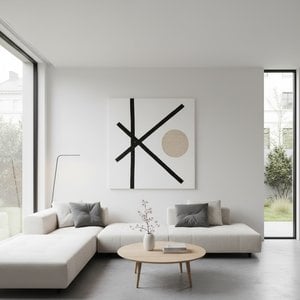
For those seeking to infuse their environment with intellectual depth and avant-garde elegance, a high-quality reproduction of Trébuchet (Trap) serves as more than just decoration; it acts as a conversation starter. It is an invitation to contemplate the thin line between art and life, between the obstacle and the masterpiece. Whether placed in a contemporary gallery setting or integrated into a sophisticated residential interior, the work commands attention through its quiet authority and historical weight.
Owning a piece that embodies the spirit of Dadaism allows one to celebrate the rebellious, transformative power of the human intellect. It is an investment in a legacy of innovation—a tribute to the artist who dared to look at a common object and see not just a tool, but a revolution. In every curve of the wood and every point of the metal, Trébuchet continues to perform its original function: it catches the eye, interrupts the mundane, and traps the wandering mind in a state of beautiful, permanent wonder.
Pitanja i odgovori
Mogu li naručiti uljanu reprodukciju djela "Trébuchet (Trap)"?
Ručno oslikane kopije djela "Trébuchet (Trap)" autora Marcel Duvšan prodaju se na stranici ovaj web-mjesto: ručno oslikana uljana reprodukcija na lanenom platnu, a mogu se naručiti putem njihove stranice Ručno oslikana reprodukcija.
Gdje i u koje svrhe se preporučuje "Trébuchet (Trap)"?
Upotreba (Poticanje razgovora) i prostor (Radni prostor) dvije su preporučene opcije za "Trébuchet (Trap)" autora Marcel Duvšan.
Na koji način "Trébuchet (Trap)" autora Marcel Duvšan povezuje Minimalist Sculpture s domovinom umjetnika?
Djelo Minimalist Sculpture pokreta "Trébuchet (Trap)" stvorio je umjetnik rođen u Francuska.



 Prebacite na prodaju printova
 Podijeli
 Podijeli
 Detalji
 Vodič
Vodič

 Preuzmi datoteku
 Slični predmeti
 Slide show
 Statistika


 Pročitajte više






































 Opcija stakla dostupna je samo za dimenzije manje od 110 cm