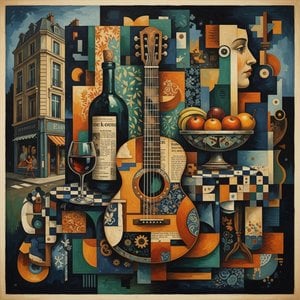
Pears and Grapes on a Table: A Geometric Symphony of Color by Juan Gris
Juan Gris’s “Pears and grapes on a table,” painted in 1913, isn't merely a still life; it is a vibrant manifesto of Synthetic Cubism. Emerging from the revolutionary artistic climate of early 20th-century Paris, this painting represents a decisive shift away from purely analytical fragmentation towards a more constructive approach to representing reality. Gris doesn’t attempt to mimic what we see; instead, he dissects and reassembles familiar objects – pears, grapes, a goblet, a table – into a dynamic interplay of geometric shapes and planes of color. The result is an exhilarating visual puzzle that challenges our conventional understanding of space, form, and perspective.
The Birth of Synthetic Cubism: Rebuilding Reality
Following the pioneering work of Picasso and Braque in Analytical Cubism, Gris championed a new direction – Synthetic Cubism. This wasn't about breaking down objects into smaller and smaller pieces; it was about building up compositions from simpler shapes and bolder colors, incorporating elements reminiscent of collage. Gris sought to *create* a new reality through the deliberate arrangement of abstract components. The asymmetrical composition isn’t arbitrary; it contributes to the painting’s inherent sense of movement and energy, drawing the eye across its surface and inviting prolonged contemplation. Notice how the newspaper fragments subtly embedded within the canvas hint at the intrusion of modern life into this carefully constructed still life – a quiet commentary on the complexities of contemporary existence.
A Palette of Emotion: Color as Structure and Form
Gris’s masterful use of color is central to understanding this work. He doesn't simply apply colors descriptively; instead, he uses them to define shapes, create spatial relationships, and evoke a particular mood. The warm tones – ochres, reds, yellows – contrast with cooler blues and greens, creating visual tension and dynamism. The sharp lines and angular forms are not merely decorative elements; they contribute to the overall sense of order and rationality that characterizes Gris’s Cubist style. Each color plane acts as a structural element, contributing to the painting's underlying geometric framework while simultaneously conveying a subtle emotional resonance.
Beyond Representation: A New Visual Language
“Pears and grapes on a table” transcends mere representation; it is an exploration of visual language itself. Gris invites us to abandon our preconceived notions of how objects should appear and instead engage with the painting as a purely formal composition. The fragmented forms, the flattened perspective, and the bold use of color all contribute to this effect. The work’s enduring appeal lies in its ability to simultaneously challenge and delight – prompting viewers to reconsider their relationship with art and the world around them. It is a testament to Gris's innovative spirit and his profound contribution to the development of modern art, offering a timeless invitation to explore the beauty of geometric abstraction.



 Pregledaj u stvarnoj veličini
 Kupi ručno naslikanu sliku
 Pošalji
 Podijeli
 Detalji o umjetničkom djelu

 Preuzmi
 Slični predmeti
 Rentgenska snimka
 Automatska prezentacija
 Statistika


 Prikaži više






































 Opcija stakla dostupna je samo za dimenzije manje od 110 cm