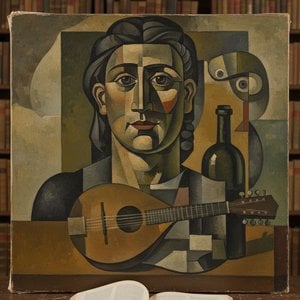
A Fragmented Portrait: Exploring Juan Gris’s “Man in the Cafe”
Juan Gris’s “Man in the Cafe,” completed in 1912, stands as a cornerstone of Analytical Cubism—a movement that irrevocably altered the landscape of European art. More than just a depiction of a Parisian café scene, it's an intellectual experiment meticulously crafted to dismantle traditional notions of perspective and representation.
- The Style: Analytical Cubism rejects illusionistic depth, favoring instead geometric forms—cylinders, cones, cubes—that overlap and intersect to create a complex spatial arrangement. This approach wasn’t merely stylistic; it reflected a profound philosophical questioning of how we perceive reality.
- Technique: Gris employed oil paint on canvas with remarkable precision, applying thin layers of pigment to achieve subtle tonal variations and highlighting the interplay between planes. The artist's meticulous attention to detail underscores his commitment to capturing not just what is seen but also how it feels—a sense of quiet contemplation amidst urban bustle.
Historical Context: Challenging Artistic Conventions
Born José Victoriano González-Pérez in Madrid, Gris’s artistic journey began with an engineering education, demonstrating a methodical mind that would later translate into his groundbreaking visual explorations. Influenced by Pablo Picasso and Georges Braque—the architects of Cubism—Gris sought to push the boundaries of artistic expression during a period marked by significant intellectual ferment.
The movement emerged in Paris around 1907, responding to the burgeoning avant-garde spirit of the era. Artists like Picasso and Braque were actively dismantling established conventions, prioritizing geometric abstraction over realistic depiction—a daring stance that challenged the prevailing aesthetic sensibilities of their time.
Symbolism Within Fragmentation
Despite its apparent simplicity, “Man in the Cafe” is laden with symbolic significance. The obscured face of the man represents anonymity and universality—suggesting that he embodies the human condition itself. The pipe and bottle serve as grounding elements, anchoring the fragmented forms within a recognizable environment.
The muted color palette—dominated by earthy tones—contributes to the painting’s melancholic mood, mirroring the contemplative gaze of the subject. Gris's deliberate use of color reinforces the emotional resonance of the scene, inviting viewers to contemplate themes of isolation and introspection.
Emotional Impact & Legacy
"Man in the Cafe" continues to captivate audiences today with its masterful blend of technique and conceptual innovation. It serves as a testament to Gris’s unwavering belief in the transformative power of art—a conviction that resonates across generations of artists and collectors alike.
Reproductions of this iconic artwork offer an opportunity to experience firsthand the profound aesthetic and intellectual legacy of Analytical Cubism, transporting viewers into the heart of a pivotal moment in artistic history. Its enduring appeal underscores the timeless beauty found within fragmented forms and contemplative observation.



 Pregledaj u stvarnoj veličini
 Naručite ručno oslikano reprodukciju
 Podijeli
 Podijeli
 Detalji
 Vodič
Vodič

 Preuzmi datoteku
 Slični predmeti
 Rentgenska snimka
 Slide show
 Statistika


 Pročitajte više






































 Opcija stakla dostupna je samo za dimenzije manje od 110 cm