


Ručno oslikano uljanim bojama na platnu u dimenzijama i okviru po vašem izboru, izrađeno po narudžbi od strane naših umjetnika. ( Kupi print Kupi digitalnu sliku)
Odaberite jednu od naših unaprijed definiranih veličina koje odgovaraju izvornim proporcijama umjetničkog djela.

Možete unijeti vlastite dimenzije kako bi odgovarale određenom okviru ili prostoru. Ako odabrana veličina ne odgovara proporcijama izvorne slike, izrezat ćemo umjetničko djelo ili proširiti sliku dodatnim ručno oslikanim elementima. Digitalni nacrt bit će vam poslan na odobrenje prije početka proizvodnje.
Imajte na umu da pregled na ekranu ne prikazuje stvarno izrezivanje ili proširivanje. Samo će nacrt točno prikazati konačni sastav.
Iako su dostupne prilagođene veličine, preporučujemo odabir dimenzije s preddefiniranog popisa kako bismo očuvali izvorne proporcije.
Isporuka širom svijeta () u roku od 3-4 tjedna umjesto standardnih 5 tjedana. (6 Rujan). Bez kompromisa u kvaliteti.


Self Portrait
Veličina reprodukcije

In the quiet corridors of American art history, few figures possess the delicate, observant grace of Joshua Charles Taylor. A master of the subtle and the small-scale, Taylor’s work does not demand attention through grand, sweeping gestures or overwhelming canvases; instead, it invites the viewer into a world of intimate precision. Born in 1917, his life was defined by an unwavering dedication to the nuances of light, shadow, and the human form. Whether capturing the theatrical elegance of a costume sketch or the serene stillness of a landscape, Taylor’s hand moved with a scholar's intellect and a poet's sensitivity, leaving behind a legacy that celebrates the beauty found in the most fleeting of moments.
Taylor’s artistic identity was forged through a rigorous academic foundation. His early training at the Milwaukee School of Art instilled in him a profound respect for anatomical accuracy and perspective—disciplines that would become the bedrock of his oeuvre. This commitment to classical excellence was further refined by his deep engagement with the Beaux Arts tradition. Drawing inspiration from masters such as Ingres and Rembrandt, Taylor sought to marry the precision of draughtsmanship with an emotional depth that transcended mere imitation. His ability to translate three-dimensional reality onto paper allowed him to explore the interplay of light and shadow, a quality that some scholars have noted imbued his work with a distinctly Hudson River School aesthetic, despite his focus on more intimate subjects.
Beyond his personal output as a painter and draftsman, Taylor’s impact on the American art landscape was profoundly shaped by his roles as a curator and administrator. His tenure at the Charles Allis Art Museum in Milwaukee, where he served as Curator of Drawings from 1946 until 1981, allowed him to champion the importance of works on paper—a medium often overlooked in favor of larger oils. In this capacity, he became a guardian of fine draughtsmanship, fostering an appreciation for the technical skill required to capture texture and movement through pencil, ink, and watercolor.
Perhaps his most significant institutional achievement came with his appointment as the director of the Smithsonian American Art Museum in 1970. In this prestigious role, Taylor transformed the institution from a mere repository into a vibrant center for rigorous scholarship. He famously eschewed the era's trend toward "blockbuster" exhibitions, choosing instead to curate deeply researched, smaller presentations that prioritized cultural context and historical nuance. This scholarly approach ensured that the museum became a place of true discovery, where the tapestry of American art could be studied with the respect it deserved.
To look upon a Taylor original is to witness a master at work in the service of observation. His repertoire was remarkably diverse, ranging from the theatrical to the pastoral:
Though he remains a relatively obscure figure to the general public, the significance of Joshua Charles Taylor lies in his role as a bridge between classical tradition and modern scholarship. He was an artist who found greatness in the minute, a curator who found truth in the detail, and a scholar who believed that the most profound stories are often told in the softest whispers of a pencil stroke.

1917 - 1981

Explore the profound artistry of graphite drawing. Discover professional techniques for mastering depth, texture, and detail through a lens of art history, from classical sketches to modern masterpieces. Elevate your understanding of the pencil medium with our expert guide.

Discover the sophisticated mastery of graphite drawing. Explore expert techniques for achieving profound depth, intricate texture, and hyper-realistic detail through the alchemy of carbon, curated for the discerning art enthusiast and professional collector.

Elevate your artistic practice with this expert guide to mastering the line. Discover advanced techniques in graphite, charcoal, and contour drawing designed for art students seeking technical precision and expressive depth in their fine art studies.
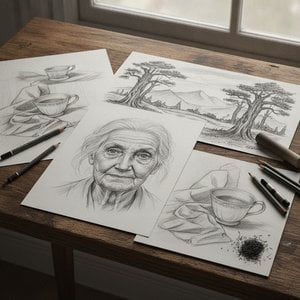
Explore the profound elegance of pencil and charcoal sketching. Discover how masters use line, shadow, and chiaroscuro to capture light and texture, bridging the gap between preparatory studies and timeless fine art masterpieces.

 Pregledaj u stvarnoj veličini
 Pošalji
 Podijeli
 Detalji o umjetničkom djelu

 Preuzmi
 Slični predmeti
 Rentgenska snimka
 Automatska prezentacija
 Prikaži više




































 Opcija stakla dostupna je samo za dimenzije manje od 110 cm


