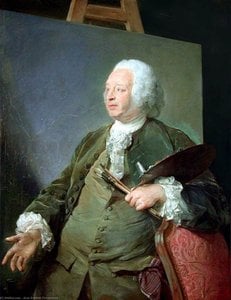
Biografija umjetnika
Jean-Baptiste Huet: A Parisian Master of Pastoral Elegance
Jean-Baptiste Huet (1745 – 1811), a name perhaps less familiar than those of his Rococo contemporaries, stands as a significant figure in 18th-century French art. Born into an artistic lineage—his uncle, Christophe Huet, was a renowned printmaker—Huet’s journey from apprentice to independent artist is a compelling tale of self-made success within the complex world of the *ancien régime*. His legacy isn't defined by grand historical narratives but rather by a quiet elegance and profound understanding of light, texture, and the subtle beauty of the natural world, particularly as reflected in his captivating wallpapers and paintings.
Early Life and Apprenticeship: A Foundation in Art
Jean-Baptiste Marie Huet’s early life was steeped in artistic tradition. His father, Nicolas Huet, also worked as a painter, and his uncle, Christophe Huet, held a prominent position as a printmaker for the royal family. This familial connection provided him with an invaluable foundation, beginning his training under Charles Dagomer, a skilled animal painter associated with the Académie de Saint-Luc in Paris. Dagomer’s influence is evident in Huet's early works, particularly his depictions of animals – a subject he would master and become synonymous with. Crucially, Huet also apprenticed with Jean-Baptiste Le Prince, a former student of François Boucher, one of the most influential artists of the Rococo period. This mentorship exposed him to the refined techniques and aesthetic sensibilities that shaped his artistic development. The early exposure to these masters instilled in him an appreciation for detail, composition, and the delicate balance between observation and imagination.
From Wallpaper Design to Artistic Recognition
Huet’s career trajectory is particularly noteworthy due to its evolution from wallpaper design to independent painting. Initially, he gained recognition as a designer of scenic vignettes for printed cotton wallpapers at the *manufacture de Jouy*, a prestigious workshop overseen by Christophe-Philippe Oberkampf. This commission provided him with an opportunity to hone his skills in composition and color, translating his artistic vision onto a large scale. However, Huet’s ambition extended beyond decorative arts; he sought recognition as a painter in his own right. He was admitted to the Académie Royale de Peinture et de Sculpture in 1769, a significant achievement that validated his artistic talent. His early Salon exhibitions showcased a growing confidence and a distinctive style characterized by a serene elegance and an intimate understanding of animal behavior.
A Master of Pastoral Scenes and Animal Studies
Huet’s paintings are primarily known for their idyllic pastoral scenes, populated with graceful animals in harmonious settings. He eschewed the dramatic grandeur favored by some of his contemporaries, instead opting for a more subtle and intimate portrayal of rural life. His compositions are often bathed in soft, diffused light, creating a sense of tranquility and serenity. His depictions of animals—dogs, sheep, goats, birds—are remarkably lifelike, capturing their individual personalities and behaviors with remarkable accuracy. He wasn’t simply illustrating animals; he was conveying a deep appreciation for their beauty and their place within the natural world. The influence of Boucher is palpable in his use of color and composition, but Huet developed a unique style that combined classical elegance with a distinctly French sensibility.
Beyond the Salon: Tapestries and Legacy
Huet’s artistic output extended beyond paintings and wallpapers. He played a crucial role in the production of tapestries for the Gobelins manufactory, designing elaborate cartoons depicting pastoral scenes and mythological subjects. These tapestries, commissioned by the French monarchy, further solidified his reputation as a versatile artist with a keen eye for detail and an understanding of decorative arts. Following the French Revolution, Huet continued to work, adapting to the changing artistic landscape. His later works often featured portraits and landscapes, reflecting the evolving tastes of the time. Jean-Baptiste Huet’s legacy endures not only through his surviving paintings and wallpapers but also as a testament to the power of self-determination in the world of art—a Parisian master who carved out a successful career through talent, dedication, and an unwavering commitment to his artistic vision. His work remains a beautiful example of Rococo elegance and a poignant reflection on the changing social and political landscape of 18th-century France.


 Pregledaj u realnoj veličini
 Pošalji
 Podijeli
 Detalji o umjetničkom djelu
 Vodič
Vodič

 Preuzmi umjetničko djelo
 Slični predmeti
 Rentgenska snimka
 Slide show
 Pitanja i odgovori
 Statistika
 Prikaži više
 Prebacite na printove





































 Opcija stakla dostupna je samo za dimenzije manje od 110 cm