A Visceral Encounter with the Uncanny
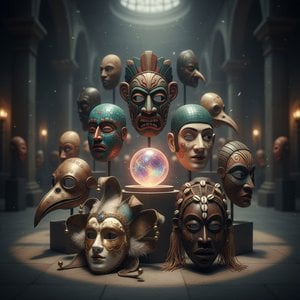
To stand before James Ensor’s "Ensor with Masks" is to step directly into a psychological labyrinth, where the boundaries between reality and artifice dissolve into a haunting tableau of human existence. Painted around 1935, this monumental work serves as a profound exploration of anxiety, capturing a moment that feels both deeply personal and universally unsettling. At the heart of the composition, Ensor places himself, yet he is far from a traditional subject; he is ensnared within a swirling, claustrophobic sea of faces. These are not mere portraits, but a collection of masks and caricatures—some grim, some vacant, others grotesque—that press against the edges of the frame, creating an atmosphere of inescapable social scrutiny. For the discerning collector or lover of fine art, this piece offers more than just visual intrigue; it provides a window into the turbulent psyche of one of Belgium's most influential masters.
The painting’s power lies in its masterful command of Expressionist technique. Ensor rejects the polished smoothness of academic realism, opting instead for a raw, tactile energy that can be felt through the very texture of the canvas. His use of thick impasto brushstrokes lends a sculptural quality to the work, where the paint itself seems to pulse with life and unease. The color palette is strategically jarring, utilizing bold, aggressive applications of reds, yellows, and deep blacks to heighten the emotional stakes. These colors do not merely decorate the scene; they act as emotional conduits, driving home the painting's central themes of tension and instability. For those looking to anchor a sophisticated interior with a piece of profound character, the dynamic interplay of light and heavy pigment in this work provides an unparalleled focal point.
The Symbolism of the Veiled Self
Beyond its striking visual surface, "Ensor with Masks" functions as a complex metaphor for the human condition and the masks we wear to navigate society. Growing up in the seaside town of Ostend, surrounded by his parents' souvenir shop filled with carnival masks and curiosities, Ensor developed a lifelong fascination with the concept of disguise. In this late masterpiece, the masks transcend their physical form to represent the various personas adopted to satisfy social conventions and conceal our true, often vulnerable, identities. The repetition of these faces creates a sense of overwhelming conformity, suggesting the difficulty of maintaining authenticity in a world of performative existence.
This profound symbolic depth makes the artwork an extraordinary choice for those who appreciate art that invites contemplation and conversation. It is a piece that demands to be lived with, offering new layers of meaning upon every viewing. Whether viewed as a precursor to Surrealism or a cornerstone of Expressionism, Ensor’s vision remains strikingly modern. Bringing a high-quality reproduction of this masterpiece into a curated space does more than decorate a wall; it introduces an intellectual and emotional gravity, inviting guests to peel back their own layers and engage with the beautiful, unsettling mystery of the human spirit.
Pitanja i odgovori
S kojim se osjećajem povezuje "Ensor with Masks"?
"Ensor with Masks" autora James Ensor prenosi Tense emocionalni ton.
Koji umjetnik se pripisuje djelu "Ensor with Masks"?
"Ensor with Masks" je djelo koje je stvorio/la James Ensor. Informacije na ovoj stranici opisuju izvornu umjetničku temu autora/ice James Ensor.
Kako se "Ensor with Masks" autora James Ensor može iskoristiti u uređenju doma?
"Ensor with Masks" autora James Ensor preporučuje se za Focal, idealno u Living Room. Namjena i prostor zajedno sugeriraju gdje reprodukcija najbolje pristaje.
Zašto je status autorskih prava za "Ensor with Masks" takav kakav jest?
Djelo "Ensor with Masks" autora James Ensor nalazi se u u javnom vlasništvu – autorska prava su istekla. Autorska prava se obračunavaju od godine smrti umjetnika, a James Ensor je preminuo/la 1949.
Gdje se predlaže izložiti "Ensor with Masks", s obzirom na njegovu paletu boja?
Earthy boje djela "Ensor with Masks" autora James Ensor savršeno se uklapaju u preporučeni prostor: Living Room.
Tko prodaje ručno oslikane kopije djela "Ensor with Masks" autora James Ensor?
Ručno oslikane kopije djela "Ensor with Masks" autora James Ensor prodaju se na stranici ovaj web-mjesto: ručno oslikana uljana reprodukcija na lanenom platnu, a mogu se naručiti putem ova stranica.
Je li "Ensor with Masks" dostupan kao umjetnička litografija?
Otisak djela "Ensor with Masks" autora James Ensor možete naručiti izravno na ova stranica: umjetnički otisak na pamučnom platnu ili arhivskom kanvas papiru.



 Pregledaj u stvarnoj veličini
 Prebacite na prodaju printova
 Podijeli
 Podijeli
 Detalji
 Vodič
Vodič

 Preuzmi datoteku
 Slični predmeti
 Rentgenska snimka
 Slide show
 Statistika

 Pročitajte više






































 Opcija stakla dostupna je samo za dimenzije manje od 110 cm