Pregledaj u stvarnoj veličini Isprobaj u AR-u Prebacite na prodaju printova Prebacite na digitalnu prodaju slika Podijeli
Detalji Vodič Dodaj u omiljene Preuzmi datoteku Slični predmeti Rentgenska snimka Slide show Statistika

Au conservatoire

James Ensor's 'Au Conservatoire' is an Expressionist masterpiece brimming with unsettling figures and satirical humor. Explore the painting’s layered symbolism, masks, and critique of Belgian society through a unique, captivating visual experience.

James Ensor bio je belgijski ekspresionista i surrealista poznat po svojim uznemirujućim djelima koje prikazuju maske, karneval i kostiju, promičući inovativnu umjetničku estetiku i izazivajući kritički pogled na društvo.

Ručno rađena uljana reprodukcija

Ručno oslikano uljanim bojama na platnu u dimenzijama i okviru po vašem izboru, izrađeno po narudžbi od strane naših umjetnika. ( Prebacite na prodaju printova Prebacite na digitalnu prodaju slika)

Corner sample of the P118B picture frame: ližani polistiren, 5 cm wide and 3 cm thick
P118B 10
Corner sample of the P118H picture frame: ližani polistiren, 5 cm wide and 3 cm thick
P118H 10
Corner sample of the P118W picture frame: ližani polistiren, 5 cm wide and 3 cm thick
P118W 10
Corner sample of the P438Z picture frame: ližani polistiren, 5.5 cm wide and 3.5 cm thick
P438Z 10
Corner sample of the P508JH picture frame: ližani polistiren, 7 cm wide and 3.5 cm thick
P508JH 12
Corner sample of the P508YH picture frame: ližani polistiren, 7 cm wide and 3.5 cm thick
P508YH 12
Corner sample of the P805H picture frame: ližani polistiren, 5 cm wide and 3.5 cm thick
P805H 10
Corner sample of the P805Z picture frame: ližani polistiren, 5 cm wide and 3.5 cm thick
P805Z 10
Corner sample of the P919BZ picture frame: ližani polistiren, 7 cm wide and 3.5 cm thick
P919BZ 10
Corner sample of the P919G picture frame: ližani polistiren, 7 cm wide and 3.5 cm thick
P919G 10
Corner sample of the P919XJ picture frame: ližani polistiren, 7 cm wide and 3.5 cm thick
P919XJ 10
Corner sample of the P959ZH picture frame: ližani polistiren, 5 cm wide and 3 cm thick
P959ZH 10
Corner sample of the P968JZ picture frame: ližani polistiren, 6 cm wide and 4 cm thick
P968JZ 12
Corner sample of the W106C picture frame: masivno drvo, 5 cm wide and 3 cm thick
W106C 8
Corner sample of the W218G picture frame: masivno drvo, 5 cm wide and 3 cm thick
W218G 10
Corner sample of the W218JH picture frame: masivno drvo, 5 cm wide and 3 cm thick
W218JH 8
Corner sample of the W218Y picture frame: masivno drvo, 5 cm wide and 3 cm thick
W218Y 10
Corner sample of the W307PJ picture frame: masivno drvo, 6 cm wide and 3 cm thick
W307PJ 10
Corner sample of the W316G picture frame: masivno drvo, 6 cm wide and 3 cm thick
W316G 10
Corner sample of the W316PJ picture frame: masivno drvo, 6 cm wide and 3 cm thick
W316PJ 8
Corner sample of the W316Y picture frame: masivno drvo, 6 cm wide and 3 cm thick
W316Y 10
Corner sample of the W398PJ picture frame: masivno drvo, 5 cm wide and 3 cm thick
W398PJ 8
Corner sample of the W4111J picture frame: masivno drvo, 6.5 cm wide and 3.5 cm thick
W4111J 10
Corner sample of the W500HY picture frame: masivno drvo, 7 cm wide and 5 cm thick
W500HY 15
Corner sample of the W500JH picture frame: masivno drvo, 7 cm wide and 5 cm thick
W500JH 15
Corner sample of the W692G picture frame: masivno drvo, 8 cm wide and 4 cm thick
W692G 12
Corner sample of the W849H picture frame: masivno drvo, 5 cm wide and 3 cm thick
W849H 8
Corner sample of the W940BG picture frame: masivno drvo, 7.5 cm wide and 4.5 cm thick
W940BG 15
Corner sample of the W953PJ picture frame: masivno drvo, 6 cm wide and 3.5 cm thick
W953PJ 8

Standardne dimenzije
prilagođeno po mjeri
CM
INCH

Odaberite jednu od naših unaprijed definiranih veličina koje odgovaraju izvornim proporcijama umjetničkog djela.

širina
visina

Unesite širinu i visinu koja vam je potrebna, kako bi odgovarali vašem okviru ili zidu. Budući da je ovo ručno oslikano djelo, umjetnik može malo proširiti rubove slike ili ih skratiti kako bi postigao željeni oblik — izbor je vaš. Prije početka slikanja poslat ćemo vam digitalni prikaz (mockup) radi potvrde. Slika prikazana na ovoj stranici ne predstavlja stvarni rezultat — samo digitalni prikaz to čini.

Primjeri onoga što se može promijeniti: Zamijenite lice fotografijom klijenta; Dodajte ljubimca (npr. zamijenite mačku psom); Uključite skrivenu poruku u pozadinu; Promijenite pejzaž ili elemente pozadine.
Nakon narudžbe, tim WahooArt.com kontaktirat će klijenta putem e-pošte radi dobivanja uputa te dostaviti probni prikaz (mockup)

Isporuka širom svijeta () u roku od 3-4 tjedna umjesto standardnih 5 tjedana. (20 Listopad). Bez kompromisa u kvaliteti.

Besplatna ekspresna dostava širom svijeta
Visokokvalitetno laneno platno
Potpuno osiguranje transporta
Jamstvo povrata carine i uvoznih poreza
Jamstvo vjernosti boja
Politika povrata u roku od 100 dana (samo u slučaju nedostataka)
Jamstvo povrata 100% novca
Popust na više proizvoda

Ukupna cijena

€ 237

Au conservatoire

Tehnika izrade

Veličina reprodukcije

-

Ukupna cijena

€ 237

Brzi pregled

  • Artistic style: Satirical, grotesque
  • Subject or theme: Conservatoire scene
  • Dimensions: 56 x 71.5 cm
  • Title: Au Conservatoire
  • Notable elements: Masks, satire, hareng-saur
  • Movement: Expressionism

Kviz o umjetnosti

Svako pitanje ima samo jedan točan odgovor.

Pitanje 1:
What artistic movement is most closely associated with James Ensor’s ‘Au Conservatoire’?
Pitanje 2:
The painting 'Au Conservatoire' primarily utilizes what color palette?
Pitanje 3:
What is the significance of the numerous objects depicted in ‘Au Conservatoire’?
Pitanje 4:
Which of the following best describes James Ensor’s style as evident in ‘Au Conservatoire’?
Pitanje 5:
The inclusion of a ‘hareng-saur’ (a type of herring) in the painting is most likely intended to convey:

A Window into the Psyche: Unpacking James Ensor’s *Au Conservatoire*

James Ensor's 1902 painting, *Au Conservatoire*, isn’t merely a depiction of a scene; it’s an unsettling plunge into the artist’s uniquely warped perception of reality. This work, housed within the Musée d'Orsay in Paris, stands as a cornerstone of Expressionism – a movement that prioritized raw emotion and subjective experience over objective representation. More than just a portrait or still life, *Au Conservatoire* is a meticulously constructed tableau designed to provoke, to challenge, and ultimately, to reveal the anxieties simmering beneath the surface of Belgian society at the turn of the 20th century.

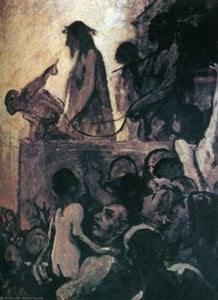
The painting immediately commands attention with its deliberate lack of harmony. A central figure, seemingly directing our gaze with a pointed stick, dominates the composition, yet his purpose remains ambiguous. Surrounding him is a chaotic collection of individuals – men in ties, a woman holding sheet music, and a scattering of objects: a bowl overflowing with what appears to be a disconcerting assortment of items, a knife and fork resting on a table, a bottle, two cell phones—each element contributing to the painting’s overall sense of unease. The use of sepia tones lends an air of timelessness, reminiscent of old photographs, yet this formality is immediately undermined by the distorted figures and jarring juxtapositions.

The Language of Distortion: Style and Technique

Ensor's masterful manipulation of form and color is central to *Au Conservatoire’s* impact. The figures are rendered with a deliberate lack of detail, their faces often obscured by masks or distorted expressions. This technique isn’t simply stylistic; it serves to strip away any semblance of conventional beauty or social decorum, exposing the underlying anxieties and tensions within the scene. Notice how the perspective is subtly skewed, creating a sense of disorientation and pulling the viewer into the painting's unsettling atmosphere. The artist employs a bold, almost frantic brushstroke, adding to the feeling of agitation and instability.

Furthermore, the inclusion of seemingly random objects – the hareng-saur (a type of herring), a canard (duck), and even a cat—functions as a deliberate disruption. These elements, presented with an almost absurd intensity, suggest a critique of bourgeois values and societal pretensions. The inscription on the back of the painting, “He.Y.HOTO.yo / Ho y Ho Ho / HAUT Y HAUT / TROP HAUT / TROP D’EAU / CONSERVATOIRE / ROYAL,” adds another layer of complexity, hinting at a satirical commentary on the rigid hierarchy and self-importance within the musical establishment.

Contextualizing the Discomfort: Expressionism and Beyond

*Au Conservatoire* is deeply rooted in the context of early 20th-century Expressionism. Artists like Egon Schiele, known for his emotionally charged portraits and unsettling imagery, and Pablo Picasso, whose exploration of form and psychology profoundly influenced the movement, were grappling with similar themes of alienation, anxiety, and the fragmentation of modern life. Ensor’s work shares a kinship with these artists, yet possesses a uniquely Belgian sensibility – a darkly humorous critique of national identity and social conventions.

The painting's influence extends beyond its immediate historical context. The use of masks, grotesque figures, and symbolic objects anticipates later developments in Surrealism and continues to resonate within contemporary art. Reproductions of *Au Conservatoire*, particularly those crafted by WahooArt.com, offer a remarkable opportunity to experience the power and complexity of this seminal work, allowing viewers to engage with Ensor’s vision on a deeper level.

To explore further, consider visiting the Musée d'Orsay in Paris or delving into James Ensor’s extensive body of work. And for a truly immersive experience, we invite you to commission a hand-painted reproduction of *Au Conservatoire* – a timeless piece that will undoubtedly become a captivating centerpiece in your collection.

Pitanja i odgovori

Iz kojeg je povijesnog razdoblja "Au conservatoire" autora James Ensor?

"Au conservatoire" pripada razdoblju Late Medieval.

Gdje se "Au conservatoire" nalazi među uobičajenim motivima umjetnika James Ensor?

Među zabilježenim temama umjetnika James Ensor – wagnerianism, satire, masks, belgian society, carnival, critique, social commentary, absurd – djelo "Au conservatoire" donosi vlastiti fokus na carnival, masks, belgium, wagnérism, satire, figures, sepia.

Gdje i u koje svrhe se preporučuje "Au conservatoire"?

"Au conservatoire" se preporučuje za Statement, a idealan prostor za nju je Living Room.


Biografija umjetnika

James Ensor (1860-1949): A Pioneer of Expressionism & Surrealism

James Sidney Edouard Ensor, Baron Ensor (Ostend, 13 April 1860 – 19 November 1949) was a Belgian painter and printmaker who stands as one of the most influential figures in the development of Expressionism and Surrealism. Born into an English father and Belgian mother—a duality that profoundly shaped his artistic worldview—Ensor defied convention from the outset, rejecting academic formalism for a bold exploration of psychological depth and grotesque imagery.

Early Influences & Artistic Training

His formative years were marked by exposure to the vibrant atmosphere of Ostend’s seaside resort town, where his parents operated a souvenir shop brimming with curiosities—a veritable cabinet of wonders that ignited his imagination. From 1876 until 1880 he studied at the Académie Royale des Beaux-Arts in Brussels, alongside fellow students like Fernand Khnopff and Theo Van Rysselberghe, where Jean Portales instilled in him a commitment to artistic innovation.

A Shift Towards Grotesque Vision & Expressionist Style

Ensor’s early paintings reflected a more traditional approach, depicting scenes of everyday life rendered in somber tones. However, he swiftly abandoned these conventions as he embraced the expressive qualities of light, line, and color—a decisive move toward Expressionism. Influenced by Rembrandt, Goya, and Japanese woodcuts, Ensor developed a distinctive iconography characterized by unsettling juxtapositions and symbolic references to death and decay.

Key Masterpieces & Recurring Themes

His most celebrated works – including *Christ’s Entry into Brussels* (1888-1889), *The Scandalized Masks* (1883) and *Skeletons Fighting over a Hanged Man* (1891) – exemplify his unwavering commitment to confronting uncomfortable truths and exploring the darkest recesses of human psychology. These paintings are not merely aesthetically striking; they serve as powerful critiques of societal norms, religious hypocrisy, and the absurdity of existence.

Legacy & Influence

James Ensor’s artistic legacy extends far beyond his own lifetime. He is recognized as a pivotal catalyst in the transition from Symbolism to Expressionism and Surrealism—a true pioneer who challenged artistic conventions and paved the way for future generations of artists. His fearless exploration of the subconscious, combined with his masterful use of grotesque imagery and symbolic language, continues to inspire artists today.

James Ensor

James Ensor

1860 - 1949 , België

Brzi pregled

  • Artistic Movement Or Style: Expressionism, Surrealism
  • Artists Who Influenced This Artist:
    • Bruegel the Elder
    • Francisco Goya
    • Whistler
  • Date Of Birth: April 13, 1860
  • Date Of Death: November 19, 1949
  • Full Name: James Sidney Edouard Ensor
  • Nationality: Belgian
  • Notable Artworks:
    • The Scandalized Masks
    • Skeletons Fighting...
    • Christ's Entry into Brussels
  • Place Of Birth: Ostend, Belgium
Istražite umjetnička djela organizirana prema temama, stilovima i karakteristikama.