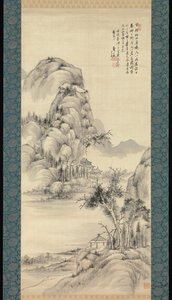
Hidaka Tetsuo: A Bridge Between Tosa and Nanga
Born in Himeji, Japan in 1791 – though often associated with the region of Osaka due to his early life – Hidaka Tetsuo (日高鉄翁) was a profoundly influential figure within the Bunjinga circles of 18th and 19th century Japan. His journey through Kyoto, Osaka, and Edo reflects not just geographical movement, but a deep immersion into the evolving landscape of Japanese art. More than simply a painter, Tetsuo embodied a synthesis of artistic approaches, skillfully blending the traditions of Tosa (Southern School) and Nanga (Northern School) painting – a rare and highly valued combination that speaks volumes about his artistic understanding.
Tetsuo’s early life in Hine village near Osaka provided him with an intimate connection to the natural world, a foundational element for both Tosa and Nanga styles. The Tosa school, known for its elegant brushwork, vibrant colors, and focus on capturing the beauty of nature, instilled in him a deep appreciation for landscape. Simultaneously, his exposure to Nanga painting – which drew inspiration from Chinese ink wash traditions – introduced him to the concept of *mokusatsu* (silent contemplation) and the use of monochrome techniques to convey profound philosophical ideas. This duality is strikingly evident throughout his oeuvre.
The Influence of Yasuda Rōzan and Artistic Collaboration
A pivotal moment in Tetsuo’s artistic development occurred during his travels, specifically around 1840-1850. He befriended Yasuda Rōzan (薬師良山), a renowned Bunjinga artist himself, and this relationship proved to be extraordinarily fruitful. While the precise nature of their collaboration remains somewhat shrouded in historical detail, it’s widely believed that Tetsuo greatly benefited from Rōzan's guidance and experience. The influence of Rōzan is particularly noticeable in Tetsuo’s later works, where a greater emphasis on atmospheric perspective and a more subdued color palette can be observed – characteristics often associated with the Nanga tradition.
However, it’s crucial to recognize that Tetsuo was not merely a follower. He retained his own distinct artistic voice, skillfully integrating elements from both schools while forging a unique style characterized by a remarkable sense of tranquility and understated beauty. His landscapes are rarely overtly dramatic; instead, they evoke a feeling of quiet contemplation, inviting the viewer to lose themselves in the scene.
Technique and Style: A Harmonious Blend
Tetsuo’s technical mastery lies in his ability to seamlessly blend the techniques of Tosa and Nanga. He employed the delicate brushwork and vibrant colors favored by the Tosa school, particularly when depicting natural elements like trees, mountains, and water. Yet, he also embraced the monochrome approach of Nanga, utilizing subtle gradations of ink to create a sense of depth and atmosphere. His compositions often feature expansive landscapes framed by simple, elegant structures – temples, pavilions, or solitary figures – creating a harmonious balance between nature and human presence.
The use of *sumi-e* (ink wash painting) is particularly noteworthy. Tetsuo’s control over the ink was exceptional, allowing him to create textures that ranged from delicate washes to bold, expressive strokes. He frequently incorporated calligraphy into his paintings, not merely as decorative elements but as integral components of the overall composition, further enhancing the sense of harmony and balance.
Legacy and Historical Significance
Hidaka Tetsuo’s contribution to Japanese art is significant for several reasons. Firstly, he exemplified the successful integration of Tosa and Nanga styles – a rare achievement that demonstrated the potential for artistic synthesis. Secondly, his works offer valuable insights into the evolving aesthetic sensibilities of 18th and 19th century Japan, reflecting both Western influences (particularly in terms of landscape painting) and deeply rooted traditional values.
His paintings are now highly prized by collectors and scholars alike, representing a crucial link between artistic traditions. They stand as testaments to the enduring power of observation, contemplation, and the skillful manipulation of ink and brush – qualities that continue to resonate with viewers today. His work can be found in numerous museums and private collections, ensuring his place as a pivotal figure in Japanese art history.



 Pregledaj u stvarnoj veličini
 Prebacite na print
 Pošalji
 Podijeli
 Detalji o umjetničkom djelu

 Preuzmi
 Slični predmeti
 Rentgenska snimka
 Automatska prezentacija
 Statistika

 Prikaži više