Donna Dorminante: A Dreamscape of Classical Echoes
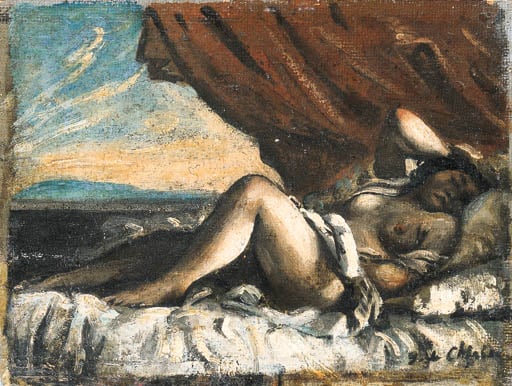
Giorgio de Chirico’s “Donna dorminante,” painted circa 1950, stands as a cornerstone of Metaphysical Art—a movement that irrevocably altered the course of twentieth-century painting and profoundly influenced Surrealism. More than just a depiction of a woman asleep in bed; it's an immersive experience into a realm where rationality yields to subconscious suggestion, mirroring the philosophical currents of Nietzsche and Schopenhauer that captivated de Chirico’s formative years.
- Subject Matter: The painting centers on a solitary female figure reclining horizontally on a bed draped in crimson. Alongside her are two pillows—one positioned at the upper right corner, another resting at the lower left—creating a subtly unsettling compositional balance.
- Style & Technique: De Chirico’s masterful use of monochrome lends an air of austere grandeur to the scene. The stark black and white palette amplifies the painting's dreamlike quality, emphasizing textures and contours with remarkable precision. His technique prioritizes meticulous detail—particularly in rendering the woman’s face and hair—reflecting a return to classical artistic conventions after years experimenting with abstraction.
- Historical Context: Emerging from the crucible of pre-war Europe, “Donna dorminante” embodies the anxieties and intellectual ferment of its time. De Chirico's fascination with Nietzsche’s concept of will to power—expressed through the depiction of a woman seemingly untouched by external forces—underscores the painting’s philosophical depth.
- Symbolism: The inclusion of an open umbrella above the woman’s head introduces an element of incongruity, disrupting the perceived stillness of the bedchamber and hinting at hidden anxieties. Furthermore, two birds perched in the background – one on the left side of the bed and another towards the top right—serve as emblems of freedom and vigilance, juxtaposed against the vulnerability implied by the sleeping woman’s posture.
- Emotional Impact: “Donna dorminante” evokes a palpable sense of melancholy and contemplation. The painting's stillness is punctuated by subtle visual cues that invite viewers to delve into their own subconscious—a hallmark of Metaphysical Art’s aim to capture the elusive essence of human experience beyond mere representation.
Exploring Giorgio de Chirico’s Vision
Giorgio de Chirico (1888-1978), born in Volos, Greece, possessed an artistic spirit nurtured by both classical heritage and a burgeoning awareness of modern alienation. His early education at Athens Polytechnic instilled him with foundational techniques, yet it was his subsequent studies in Munich that truly ignited his creative fervor. Amidst the intellectual dynamism of prewar Europe, he encountered artists like Böcklin and Klinger—whose symbolic landscapes and haunting imagery profoundly resonated with his developing aesthetic.
These influences extended beyond visual art; De Chirico wrestled with existentialist ideas championed by Nietzsche, Schopenhauer, and Weininger. These philosophers questioned the nature of reality and explored themes of irrationality and desire – concepts that directly informed his artistic worldview. He sought to portray not just what he saw but what he *felt*, channeling these philosophical inquiries into a visual language characterized by unsettling juxtapositions and dreamlike distortions.
The Influence of Metaphysical Art
De Chirico’s groundbreaking Metaphysical Art movement—launched alongside Carlo Carrà—challenged the prevailing artistic conventions of its era. Rejecting Impressionism's focus on fleeting impressions, he embraced a style rooted in classical tradition while simultaneously incorporating elements of Surrealism. His distinctive approach involved meticulously rendering objects with painstaking detail—often employing a technique reminiscent of Renaissance fresco painting—creating images that seemed to exist outside of conventional space and time.
As exemplified by “Donna dorminante,” De Chirico’s paintings are imbued with an atmosphere of profound mystery, prompting viewers to confront unsettling questions about perception and consciousness. His enduring legacy lies in his ability to capture the intangible realm of dreams—a feat achieved through masterful composition and a deliberate manipulation of perspective.


 Pregledaj u stvarnoj veličini
 Prebacite na prodaju printova
 Podijeli
 Podijeli
 Detalji
 Vodič
Vodič

 Preuzmi datoteku
 Slični predmeti
 Rentgenska snimka
 Slide show
 Statistika
 Pročitajte više






































 Opcija stakla dostupna je samo za dimenzije manje od 110 cm


