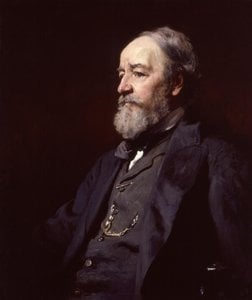
The Soul of the Victorian Canvas: The Life and Legacy of Francis Montague Holl
In the heart of the nineteenth century, amidst the rapid industrialization and shifting social tides of London, there lived an artist whose brush captured the quiet, often overlooked pulses of human existence. Francis Montague Holl, born in 1845 to a lineage of esteemed engravers, possessed an innate ability to find profound narrative within a single, frozen moment. While his contemporaries often chased the grandiosity of historical epics or the theatricality of high drama, Holl turned his gaze toward the intimate. His work became a bridge between the meticulous realism of his training and a deeply felt social realism that spoke to the triumphs and tribulations of the Victorian era.
Holl’s artistic DNA was woven from the threads of great masters and rigorous academic discipline. Growing up in a family of noted engravers, including his father Francis Holl, he was immersed in the technical precision required for fine line work from his earliest years. His formal education at the Slade School of Fine Art placed him under the profound influence of John Ruskin, whose philosophy of observing nature with unyielding honesty became a cornerstone of Holl’s practice. This commitment to truth—to capturing the spiritual essence of a landscape or the weary dignity of a laborer—allowed his paintings to transcend mere decoration, turning them into poignant windows onto the Victorian soul.
A Master of Narrative and Social Commentary
The evolution of Holl’s style is a fascinating study in the balance between sentiment and substance. In his earlier years, he gained recognition for his ability to depict problem pictures—works that presented a moral or social dilemma to the viewer, inviting contemplation on the human condition. One of his most enduring contributions to the art world is 'The Song of the Shirt', a masterful piece of social commentary that utilized a realistic technique to highlight the struggles of female labor. Through his use of light and shadow, Holl could transform a domestic scene into a powerful statement on class and resilience.
As his career progressed, particularly in his later years, Holl’s focus expanded. While he remained a master of the evocative landscape and the serene watercolor, he also ascended to the heights of portraiture. His skill in capturing the character of distinguished figures led him to become a sought-after portrait painter for official types, even earning commissions that brought him into contact with members of the royal family. This duality—the ability to move from the humble, misty rural scenes of 'Resting By The Way'* to the formal dignity of an aristocratic portrait—demonstrates a versatility that few of his peers could claim.
Technical Brilliance and Enduring Significance
The technical repertoire of Francis Montague Holl was as diverse as his subject matter. He moved with grace between the delicate, translucent layers of watercolor and the rich, textured depth of oil on canvas. His landscapes often utilized a muted, harmonious palette that evoked a sense of timelessness and peace, yet even within these serene settings, there is always an underlying tension or a narrative hint—a quiet observation of life unfolding. His ability to manipulate light was not merely a feat of skill but a tool for emotional resonance, guiding the viewer's eye toward the heart of his stories.
Though his life was tragically short, ending in 1888 at the age of only forty-three, the impact of his work remained. While his reputation faced a period of decline following his untimely death—a consequence many attribute to the sheer intensity of his prolific output—the rediscovery of his works in recent decades has restored his rightful place in the canon of British art. Today, we recognize Holl not just as a painter of scenes, but as a chronicler of an era. His legacy lives on through:
- The mastery of Social Realism: Bringing the struggles and quiet joys of everyday people to the forefront of fine art.
- Technical Versatility: The seamless transition between the delicate nuances of watercolor and the commanding presence of oil portraiture.
- Atmospheric Depth: A unique ability to imbue landscapes with a sense of spiritual and emotional weight.
- Historical Documentation: Providing a visual record of the social textures and class dynamics of Victorian England.
In every brushstroke, from the softest morning mist in a rural meadow to the resolute gaze of a working woman, Francis Montague Holl remains a quiet observer whose voice continues to resonate with clarity and compassion.



 Pregledaj u stvarnoj veličini
 Prebacite na print
 Pošalji
 Podijeli
 Detalji o umjetničkom djelu

 Preuzmi
 Slični predmeti
 Rentgenska snimka
 Automatska prezentacija
 Statistika
 Prikaži više






































 Opcija stakla dostupna je samo za dimenzije manje od 110 cm