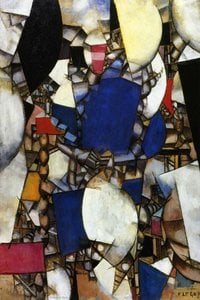
A Symphony of Flight and Form: Deconstructing Léger’s ‘The Album “Circus”’ (41)
Fernand Léger's “The album ''Circus'' (41)”, created in 1950, is not a depiction *of* a circus, but rather an exhilarating distillation of its very essence. It’s a visual poem capturing the energy, dynamism, and perhaps even the underlying mechanical rhythm that Léger perceived within this iconic form of entertainment. The work stands as a powerful example of his distinctive post-Cubist style – often referred to as “Tubism” – where forms are simplified into bold, cylindrical shapes and planes of color, hinting at both organic life and the burgeoning machine age. This wasn’t merely an aesthetic choice for Léger; it was a reflection of his belief in finding beauty and harmony within modernity, a celebration of the industrial world that many artists of his time viewed with skepticism.
The Language of Tubism: A Visual Vocabulary
Léger's approach to form is immediately striking. He moves beyond the fractured planes of early Cubism towards a more synthetic and accessible language. In “The album ''Circus'' (41)”, abstracted birds dominate the upper register, their curved lines providing a counterpoint to the angular black rectangles and triangles that suggest architectural structures or perhaps even mechanical components. These aren’t delicate renderings of avian creatures; they are stylized emblems of flight, rendered with a robust simplicity. The composition is deliberately asymmetrical, creating a sense of controlled chaos and perpetual motion. The loose brushwork, likely achieved using acrylic or gouache on watercolor paper, adds texture and depth, inviting the eye to explore the interplay between color and form. While specific details regarding the palette remain elusive, it’s clear that bold hues contribute significantly to the work's energetic feel – a vibrancy that speaks to Léger’s optimistic outlook in the post-war era.
Post-War Optimism and the Machine Aesthetic
Created just five years after the end of World War II, “The album ''Circus'' (41)” embodies a renewed sense of hope and a fascination with progress. Léger, having witnessed the devastation of war firsthand, turned towards celebrating the vitality of everyday life and the beauty inherent in industrial forms. He saw the machine not as a symbol of destruction, but as a source of aesthetic inspiration – a testament to human ingenuity and potential. This perspective is deeply embedded within his work from this period, which often incorporates themes of labor, leisure, and technological advancement. The abstracted birds can be interpreted as symbols of freedom and aspiration, soaring above the geometric structures that represent the constraints or frameworks of modern existence—the urban landscape, industrial society, or simply the boundaries of human perception. The artwork isn’t just a visual statement; it's a philosophical one, reflecting Léger’s belief in the possibility of a harmonious future.
A Dynamic Presence for Modern Interiors
The emotional impact of “The album ''Circus'' (41)” is undeniably uplifting. It evokes a feeling of energetic movement and playful surrealism, making it a captivating focal point for any space. Its bold colors and striking composition lend themselves particularly well to modern interiors. Imagine this piece adorning a minimalist living room, adding a vibrant splash of color and visual interest against clean lines and neutral tones. Alternatively, in an office or study, the artwork’s dynamic energy could inspire creativity and focus. Its abstract nature allows for versatile placement – above a sofa, as part of a gallery wall, or even as a statement piece in a hallway. More than just a decorative element, this work is a testament to Léger's innovative vision and his enduring contribution to 20th-century art—a valuable addition that offers both aesthetic pleasure and intellectual stimulation.



 Pregledaj u stvarnoj veličini
 Prebacite na print
 Pošalji
 Podijeli
 Detalji o umjetničkom djelu

 Preuzmi
 Slični predmeti
 Rentgenska snimka
 Automatska prezentacija
 Statistika

 Prikaži više






































 Opcija stakla dostupna je samo za dimenzije manje od 110 cm