

Giclée tisak muzejske kvalitete ili otisak na platnu uz brzu izradu i raznolike opcije završne obrade. ( Kupi ručno oslikano djelo Prebacite na digitalnu sliku)





























Odaberite jednu od naših unaprijed definiranih veličina koje odgovaraju izvornim proporcijama umjetničkog djela.

Unesite potrebnu širinu i visinu kako bi odgovarali vašem okviru ili zidu. Print se može samo izrezati, nikada ne može biti veći od slike, stoga format s drugačijim omjerom stranica uzrokuje gubitak dijela slike. Prije bilo kakve štampe šaljemo vam digitalni prikaz (mockup) na odobrenje. Slika prikazana na ovoj stranici ne prikazuje stvarni rez — to prikazuje isključivo digitalni prikaz.
Dostava širom svijeta () u roku od 2 tjedna umjesto standardnih 4/5 tjedana. (8 Studeni)
untitled (2624)
Veličina reprodukcije
In the hauntingly beautiful realm of Austrian Expressionism, few works command the viewer's attention with such visceral intensity as Egon Schiele’s Untitled (2624). This arresting portrait captures a moment suspended in time, where palpable intimacy meets an underlying sense of profound unease. The composition presents a striking duality: a man seated upon the floor, anchored by gravity and perhaps a heavy psychological weight, while a woman stands above him, her presence both commanding and tender. It is a scene that transcends mere depiction, inviting us into a private theater of vulnerability, desire, and the fraught, often turbulent dynamics inherent in human connection.
The eye is immediately ensnared by the painting's dramatic color palette. A dominant, vibrant crimson saturates the background, acting as a powerful visual pulse that beats behind the figures. This choice of hue is far from accidental; historically, such deep reds evoke a complex spectrum of human experience, ranging from the heat of passion to the starkness of violence and impending doom. Against this fiery backdrop, the muted tones of the figures emerge with a startling clarity, creating a dramatic counterpoint that heightens the emotional stakes of their silent confrontation.
Schiele’s mastery lies in his ability to use the very anatomy of his brushwork to communicate the unutterable. His signature technique—characterized by expressive, agitated lines—rejects the polished smoothness of academic tradition in favor of a raw, nervous energy. These thick, often jagged strokes do not merely outline the human form; they seem to vibrate with the internal tremors of the subjects' souls. Through distorted perspectives and exaggerated contours, Schiele bypasses the surface of the skin to explore the musculature of emotion itself.
For the discerning collector or interior designer, this piece offers a profound sense of movement and psychological texture. The artist’s meticulous attention to the rendering of skin textures and the tension in the limbs serves as a vehicle for emotional expression, making the artwork feel alive within a space. Whether placed in a contemporary gallery setting or a sophisticated private study, the painting acts as a window into the inner psyche, offering a depth that invites long periods of contemplation and discovery.
To truly appreciate the gravity of this work, one must consider the turbulent historical landscape from which it emerged. Painted circa 1915, the piece was birthed during the height of World War I, a period that cast a long, somber shadow over Europe. Schiele’s personal life was equally marked by upheaval; his recent marriage to Edith Harms and his subsequent draft into military service infused his work with an inescapable preoccupation with mortality and the fragility of existence. The tension between the two figures in Untitled (2624) can be seen as a microcosm of this larger, global anxiety—a struggle for connection amidst a world on the brink of collapse.
This masterpiece is more than a historical artifact; it is an enduring exploration of the human condition. It speaks to the universal experience of longing and the fear of loss, making it a timeless addition to any collection. For those seeking to infuse their environment with art that possesses both intellectual rigor and emotional resonance, Schiele’s work stands as a monumental testament to the power of the human spirit to find beauty within the most turbulent of shadows.
Ostala imena zabilježena za Egon Schiele, autora djela "untitled (2624)", uključuju Leo Adolf Ludwig Schiele.
"untitled (2624)" dostupan je kao preuzimanje digitalne slike visoke rezolucije, uz izravnu kupnju na njegovoj Digitalna umjetnina stranici.
Status autorskih prava za "untitled (2624)" autora Egon Schiele: djelo je u javnom vlasništvu – autorska prava su istekla. To određuje smiju li se slobodno izrađivati reprodukcije slike.

Born in Tulln an der Donau, Austria, on June 12, 1890, Egon Schiele’s life was a turbulent journey marked by both extraordinary artistic vision and profound personal hardship. His early years were shadowed by illness and loss; his father succumbed to syphilis when Egon was just fourteen, a tragedy that would deeply resonate within his work, fueling an obsession with mortality and the fragility of existence. Raised initially by his mother and then under the somewhat controlling guardianship of his uncle Leopold Czihaczek, Schiele’s childhood lacked conventional stability but fostered a fiercely independent spirit. Even as a boy, he displayed an intense fascination with trains—a motif that subtly reappeared in later paintings—and a burgeoning talent for drawing, though this was initially met with disapproval from his father who saw it as a distraction from more practical pursuits. The early death of his sister Elvira also cast a long shadow over the young artist’s psyche. These formative experiences instilled within him a sensitivity and an emotional rawness that would become hallmarks of his artistic expression, a constant grappling with themes of life, death, and the human condition.
Schiele's formal artistic training began at the Kunstgewerbeschule in Vienna, but he quickly found itself stifled by its conservative approach. He transferred to the Akademie der bildenden Künste (Academy of Fine Arts), only to become further disillusioned with its rigid academic traditions. This dissatisfaction led him to abandon formal training altogether, choosing instead to forge his own path—a testament to his unwavering artistic conviction. The influence of Gustav Klimt was pivotal during these early years; Schiele admired Klimt’s decorative style and exploration of symbolism, even receiving mentorship from the established artist. Klimt's bold use of color and stylized forms captivated Schiele, shaping his aesthetic sensibilities and inspiring him to experiment with innovative techniques. However, Schiele soon diverged from Klimt's path, developing a distinctive artistic voice characterized by its stark honesty and psychological intensity.
Schiele joined the Viennese Secession in 1909 alongside fellow artists Anton Faistauer, Rudolf Kalvach, Franz Wiegele, Hans Ehrlich, and Löwenstein—a group that championed avant-garde artistic ideals and challenged the prevailing aesthetic conventions. This affiliation marked a crucial turning point in Schiele’s career, exposing him to new ideas and fostering collaborations with influential figures within Vienna's art world. The Secession’s exhibitions showcased groundbreaking works by artists like Klimt and Oskar Kokoschka, introducing Schiele to a wider audience and establishing him as a prominent voice in the burgeoning Expressionist movement.
Schiele’s artistic style is immediately recognizable for its raw honesty and psychological depth. He fearlessly confronted themes often considered taboo – sexuality, death, anxiety, isolation – with an unflinching gaze. His distinctive style features elongated figures, contorted poses, and expressive lines that convey a sense of unease and emotional intensity. The human form, particularly the nude, became his primary subject, not as an object of idealized beauty but as a vessel for exploring the complexities of human experience. Self-portraits constitute a significant portion of his oeuvre, offering intimate glimpses into his inner world—a world often marked by loneliness and self-doubt. He didn’t shy away from depicting himself in unflattering or vulnerable poses, revealing a profound level of self-awareness and introspection. Recurring motifs like the *Physalis plant* – symbolizing death and transience with its delicate, papery husk – further underscore this preoccupation with mortality.
Despite facing censorship and legal challenges—including a brief imprisonment for allegedly corrupting minors with his art—Schiele gained recognition within Vienna’s avant-garde circles. His work challenged the conventions of the time, provoking both admiration and outrage. By the time of his untimely death during the Spanish flu pandemic in 1918 at the age of twenty-eight, he had established himself as a leading figure in Austrian Expressionism. Significant works such as Self-Portrait with Physalis, Couple Embracing, and Field Landscape (Kreuzberg near Krumau) stand as testaments to his artistic genius. Schiele’s influence on subsequent generations of artists is undeniable—particularly those interested in exploring psychological themes and challenging conventional artistic norms. His bold approach to form and subject matter continues to resonate with audiences today, making him one of the most important and influential figures in early 20th-century art. He left behind a body of work that is not merely aesthetically compelling but profoundly human—a testament to the power of art to confront the complexities of existence with honesty, courage, and unwavering vision.

1890 - 1918 , Австрија
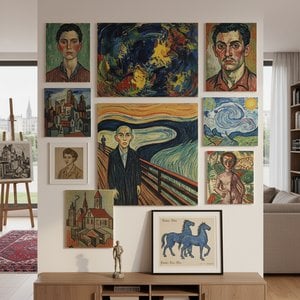
Otkrijte 10 remek-djela ekspresionizma koja su obilježila umjetnički svijet! Uronite u priče Muncha, Kirchnera i drugih majstora. Inspirirajte se bojama i emocijama – pronađite savršenu reprodukciju za svoj dom na WahooArt.com!

Explore the emotionally charged world of Egon Schiele (1890-1918). Discover his Expressionist masterpieces, psychological themes, and lasting impact on modern art. A comprehensive guide for collectors & enthusiasts.

Istražite 25 najpoznatijih djela Egona Schielea! Otkrijte ekspresionističke portrete, autoportrete i simbolizam u austrijskoj umjetnosti. Kvalitetne reprodukcije slika za vaš dom na WahooArt.com.

Explore 10 Expressionist paintings that revolutionized art! Discover Munch, Kirchner & Kandinsky's iconic works. Find museum-quality reproductions and vibrant canvas prints to elevate your home decor on WahooArt.com.

Explore 10 defining German Expressionism masterpieces – from Munch's 'The Scream' to Kandinsky’s abstracts. Discover the artists, stories & bold colors behind this powerful art movement. Find museum-quality reproductions at WahooArt.com.
 Pregledaj u realnoj veličini
 Pošalji
 Podijeli
 Detalji o umjetničkom djelu
 Vodič
Vodič

 Preuzmi umjetničko djelo
 Slični predmeti
 Rentgenska snimka
 Slide show
 Pitanja i odgovori
 Statistika

 Prikaži više









 Opcija stakla dostupna je samo za dimenzije manje od 110 cm


