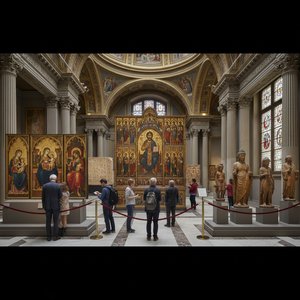
Stanislao Campana: A Parma Painter’s Legacy
Stanislao Campana (1794 – 1864) stands as a prominent figure in Italian Romantic painting, particularly celebrated for his monumental frescoes adorning the Biblioteca Palatina and St Michael's Church in Parma. Born in Pannocchia, Emilia-Romagna, Campana’s artistic journey began with formal training at the Istituto Toschi in Parma under Biagio Martini, establishing him firmly within the burgeoning artistic landscape of his time.
- Early Influences: Martini instilled a rigorous academic approach, grounding Campana's technique in classical principles while simultaneously fostering an appreciation for dramatic narrative and emotive expression—characteristics that would define his oeuvre.
- Rome and Artistic Awakening: A stipend secured through his depiction of Meleagro propelled Campana to Rome, where he encountered the vibrant intellectual currents of the Romantic era. This exposure broadened his artistic horizons and solidified his commitment to portraying mythological and biblical themes with unparalleled grandeur.
The Biblioteca Palatina Frescoes: Mythological Drama
Campana’s magnum opus resides within the Biblioteca Palatina, where he undertook a monumental commission to decorate the main hall with frescoes depicting episodes from Torquato Tasso's *Jerusalem Delivered*. These canvases exemplify Campana’s mastery of color and composition, capturing the epic sweep of biblical history with meticulous detail. The central panel portrays Pirithoos, king of Troy, engaging in a dramatic confrontation with Helena—a scene imbued with psychological complexity and rendered in luminous hues that convey both terror and nobility.
- Technique: Campana employed a grisaille technique – using shades of grey – to create depth and realism within the monumental fresco. This method allowed him to achieve remarkable tonal gradation, enhancing the emotional impact of the narrative.
- Symbolism: The frescoes are laden with symbolic references to Christian morality and heroic virtue, reflecting Campana’s deep engagement with philosophical ideas prevalent during his era.
Religious Commissions and Artistic Flourishing
Beyond the Biblioteca Palatina, Campana garnered acclaim for his altar piece depicting Madonna and Child alongside St Michael and the Devil disputing the souls of purgatory at St Michael’s Church. This evocative composition demonstrates Campana's ability to convey spiritual fervor through masterful brushwork and expressive coloration.
- Style: Campana’s style evolved throughout his career, embracing Romantic ideals while retaining a grounding in academic tradition. His works are characterized by dramatic lighting, dynamic poses, and meticulous attention to anatomical accuracy.
- Notable Works: Alongside the St Michael's altar piece, Campana produced “The Deposition,” commissioned by Duchess Maria Luisa of Parma—a poignant portrayal of Mary Magdalene weeping over Jesus’s corpse—which remains a testament to his artistic sensitivity and skill.
Academic Recognition and Legacy
Campana ascended to the professorship at the Academy of Fine Arts in Parma, cementing his position as a leading educator and shaping the artistic sensibilities of subsequent generations. He served as superintendent of the Ducal Galleries from 1847 onward, safeguarding Parma’s artistic heritage and furthering his own scholarly pursuits.
- Influence: Campana's work profoundly impacted the artistic landscape of Italy during the Romantic period, inspiring artists to explore grand narratives and imbue their paintings with emotional intensity.
- Historical Significance: Stanislao Campana’s frescoes continue to captivate audiences today, serving as enduring symbols of artistic excellence and embodying the spirit of Romantic idealism—a legacy that secures his place among Italy's most celebrated painters.
Further Exploration
For a deeper understanding of Stanislao Campana’s life and art, consult resources such as Wikipedia () and WahooArt ().