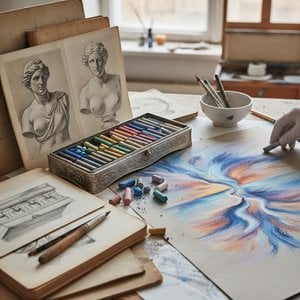
Omar Galliani, born in Montecchio Emilia, Italy, in 1954, embarked on a journey of artistic exploration that would firmly establish him as a leading figure in contemporary Italian hyperrealism. His formative years were steeped in the rich tradition of Renaissance drawing—a fascination ignited during his studies at the Academy of Fine Arts in Bologna, where he earned his diploma in 1977. This early immersion wasn’t merely academic; it was a deeply personal resonance with masters like Leonardo da Vinci, Raphael, and Correggio, whose meticulous techniques and profound understanding of anatomy would become cornerstones of Galliani's own artistic language. Even as the art world shifted towards abstraction and conceptualism, Galliani felt an undeniable pull toward figuration, a commitment that defined his early career and set him apart from many of his contemporaries. He quickly gained recognition, winning the first prize at the International Triennial Design Exhibition in Nuremberg in 1978, signaling the emergence of a unique voice within the Italian art landscape.
The Rise of Hyperrealism and Anachronistic Tendencies
Galliani’s artistic trajectory took shape during a period of dynamic change in Italy, marked by movements like Citazionismo and his involvement with groups such as Magico Primario and the Anachronists. These affiliations weren't about stylistic conformity but rather a shared desire to re-evaluate the role of figuration—to reclaim representational art after decades dominated by avant-garde experimentation. His work began to explore monumental drawings executed in graphite or charcoal, often on white or light materials, sometimes enriched with subtle touches of red. The hallmark of his technique was an extraordinary chiaroscuro achieved through delicate lines and, at times, the pouncing method—a painstaking process that allowed for incredible precision and depth. This dedication to detail wasn’t simply about technical virtuosity; it was a means of imbuing his subjects with a palpable sense of presence and psychological weight. His participation in the Venice Biennale in 1982, 1984, and 1986—a pivotal moment for any Italian artist—solidified his reputation on both national and international stages.
Anatomical Studies and the 'Nuove Anamnesi' Series
Throughout the 1990s, Galliani increasingly focused on the human form, embarking on a series of anatomical studies that would become known as ‘Nuove Anamnesi’ (New Histories). These weren’t clinical dissections but rather poetic explorations of the body—a meditation on beauty, spirituality, and vulnerability. The artist's meticulous renderings revealed not just physical structure but also an underlying emotional landscape. He often employed a special technique using pencil or pastel, ink, and gold leaf on poplar panels—a material traditionally used in Renaissance altarpieces, further connecting his work to the artistic heritage he so admired. This choice of medium wasn’t accidental; it allowed for a level of refinement and luminosity that perfectly suited his subject matter. The combination of precise drawing and ethereal imagery created a unique tension within his works—a balance between earthly realism and celestial dreaminess.
International Recognition and Cultural Exchange
Galliani's artistic vision extended beyond the borders of Italy, leading to numerous international exhibitions in cities like Paris, New York, Tokyo, Prague, Lisbon, and Mexico City. He became a cultural ambassador for Italian art, representing his country at events such as the São Paulo Biennial and the Venice Biennale’s Italian Pavilion. A particularly significant chapter in his career involved collaborations with China, Hong Kong, and Russia—projects that reflected his growing interest in Eastern cultures and philosophies. These experiences informed his work, introducing new symbols and motifs—constellations, flowers, Buddhist imagery—that added layers of meaning to his already complex compositions. In 2006, the Italian Ministry of Foreign Affairs selected Galliani as the sole representative of Italian art in China, a testament to his international standing and artistic influence.
Legacy and Continued Exploration
Omar Galliani’s work stands as a powerful affirmation of the enduring relevance of drawing—a medium often overlooked in the age of digital reproduction. His hyperrealistic style isn't merely about imitation; it’s about capturing the essence of human experience, exploring the delicate interplay between body and soul. He continues to teach painting at the Brera Academy of Fine Arts in Milan, nurturing a new generation of artists while pursuing his own artistic vision. In 2018, he generously donated a self-portrait to the Uffizi Gallery in Florence—a gesture that underscores his connection to the Renaissance tradition and his place within the pantheon of Italian masters. His legacy is one of unwavering dedication to craft, profound anatomical understanding, and a poetic sensibility that resonates deeply with viewers around the world. Galliani’s art invites us to contemplate the beauty and fragility of life—to look beyond the surface and discover the hidden depths within.
WahooArt.com संपादकीय टीम द्वारा
कला प्रश्नोत्तरी
प्रत्येक प्रश्न का केवल एक ही सही उत्तर है।
प्रश्न 1:
Where was Omar Galliani born?
प्रश्न 2:
Which academy did Omar Galliani graduate from?
प्रश्न 3:
In what year did Omar Galliani first exhibit at the Venice Biennale?
प्रश्न 4:
What technique is Omar Galliani particularly known for using?
Explore the ethereal beauty of pastel art. Discover how Impressionist masters used soft hues and velvety textures to capture light. A professional guide for art enthusiasts seeking to understand, collect, and appreciate the delicate magic of this timeless medium.
Explore the profound artistry of graphite drawing. Discover professional techniques for mastering depth, texture, and detail through a lens of art history, from classical sketches to modern masterpieces. Elevate your understanding of the pencil medium with our expert guide.
Elevate your artistic practice with this expert guide to mastering the line. Discover advanced techniques in graphite, charcoal, and contour drawing designed for art students seeking technical precision and expressive depth in their fine art studies.