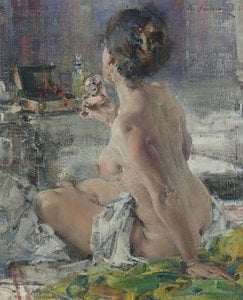
A Life Bridging Worlds: The Artistic Journey of Nicolai Fechin
Nicolai Ivanovich Fechin, often affectionately known as the “Tartar Painter,” was a figure whose life and art embodied a remarkable confluence of cultures. Born in Kazan, Russia, in 1881, his journey took him from the heart of Imperial Russia to the vibrant landscapes of the American Southwest, leaving behind a legacy marked by expressive portraits, innovative technique, and a profound sensitivity to the human spirit. Fechin’s early life was deeply rooted in craftsmanship; his father, Ivan Alexandrovich Fechin, was a skilled woodcarver and icon maker, instilling in young Nicolai an appreciation for tactile artistry and meticulous detail. This foundational exposure would profoundly shape his artistic development, fostering a hands-on approach to painting that became his signature. He received formal training at the Kazan Art School (1895-1901) before continuing his studies at the prestigious Imperial Academy of Arts in Saint Petersburg, where he benefited from the tutelage of prominent Russian masters like Ilya Repin and Filipp Malyavin—artists who championed realism and technical prowess. A pivotal moment arrived in 1908 with the award of the Prix de Rome scholarship, granting him the opportunity to immerse himself in the artistic traditions of Europe.From Siberian Landscapes to American Frontiers
Fechin’s early works reflected his Russian upbringing and travels, focusing on portraiture and scenes of rural life rendered with a keen eye for realism. However, it was a transformative journey to Siberia in 1904 that ignited a new artistic vision within him. The vastness of the Siberian landscape and the unique cultures of its native peoples left an indelible mark, inspiring a fascination with untamed beauty and diverse humanity. This influence would become increasingly apparent in his work as he began to experiment with bolder colors and more dynamic compositions. In 1923, driven by political upheaval and personal circumstances, Fechin immigrated to the United States with his family. Initially settling in New York, he quickly gained recognition for his portraits, but a diagnosis of tuberculosis prompted a move west in search of a healthier climate. This relocation led him to Taos, New Mexico, a burgeoning art colony that would become central to his artistic life. It was here, amidst the dramatic landscapes and vibrant Native American communities, that Fechin found his most enduring inspiration. He became captivated by the spirit and dignity of the indigenous peoples, portraying them with an empathy and respect rarely seen in contemporary representations.A Master of Texture: The Palette Knife Technique
Nicolai Fechin’s artistic style is instantly recognizable for its distinctive texture and expressive energy. He pioneered a unique palette knife technique, applying paint thickly and directly to the canvas—a method that allowed him to build up layers of color and create surfaces that seemed to vibrate with life. This wasn't merely a technical choice; it was integral to his artistic vision. The impasto created by the palette knife emphasized gesture, capturing the fleeting moments of emotion and personality in his subjects. His brushwork, or rather, lack thereof in favor of the knife, became a hallmark of his style, lending a sculptural quality to his paintings. This technique allowed him to blend realism with impressionistic elements, resulting in works that were both grounded in observation and infused with emotional intensity. He wasn’t simply *painting* portraits; he was constructing them, building form and character through the very physicality of the paint itself.Legacy and Lasting Influence
Throughout his career, Nicolai Fechin received numerous accolades, including a gold medal at the Munich Annual International Exhibition in 1910 and first prize at the National Academy of Design in 1924. He painted portraits of prominent figures like Lenin, Karl Marx, Frieda Lawrence, and Lillian Gish, solidifying his reputation as a sought-after artist. Beyond his paintings, Fechin’s creative spirit extended to architecture; he designed and built his own unique home in Taos, New Mexico—a testament to his artistic vision and craftsmanship. This house, now the Nicolai Fechin House Museum and home to the Taos Art Museum, stands as a lasting monument to his life and work. Fechin’s historical significance lies not only in his technical innovations but also in his ability to bridge cultures. He seamlessly integrated Russian artistic traditions with American themes, creating a body of work that is both uniquely personal and universally resonant. His sensitive depictions of Native Americans challenged prevailing stereotypes and offered a nuanced portrayal of indigenous life. Even after moving to Southern California in 1933 due to declining health, he continued to paint until his death in 1955, leaving behind a rich artistic legacy that continues to inspire artists and captivate audiences today. His pioneering use of the palette knife, coupled with his expressive portraits and vibrant landscapes, ensures his place as a significant figure in both Russian and American art history.Final Years & Remembrance
The move to Southern California in 1933 was prompted by Fechin’s battle with tuberculosis, but it did not diminish his artistic drive. Despite his failing health, he continued to paint prolifically, though his later works often reflected a more introspective and contemplative mood. This period also saw him explore sculpture, creating impressionistic pieces primarily from wood—a return to the craft of his father and a demonstration of his versatility as an artist. Fechin’s final resting place is at Santa Monica Cemetery in California, where he was laid to rest in 1955. His legacy lives on through exhibitions, publications, and the ongoing preservation efforts at the Taos Art Museum, ensuring that future generations can experience the power and beauty of his art. His work remains a testament to the enduring human spirit and the transformative power of artistic expression.- Notable Works: “Tea in Santa Monica (Portrait of Mrs. Krag),” “Autumn Trees, Twinning,” “Portrait of Varya Adoratskaya.”
- Key Influences: Ilya Repin, Filipp Malyavin, Siberian landscapes, Native American cultures.
- Artistic Style: Expressive portraiture, vibrant colors, dynamic compositions, palette knife technique, blend of realism and impressionism.
प्रश्न और उत्तर
क्या मैं कला आंदोलन के आधार पर Nicolai Fechin की कृतियों को देख सकता हूँ?
Nicolai Fechin द्वारा अपनाए गए कला आंदोलनों को कलाकार के सभी कला आंदोलन पेज पर देखा जा सकता है, जहाँ कलाकृतियों को उनके आंदोलन के आधार पर वर्गीकृत किया गया है।
Nicolai Fechin की कलाकृतियाँ कलर पैलेट के अनुसार कहाँ देखी जा सकती हैं?
रंगों के आधार पर पेज पर Nicolai Fechin की कलाकृतियों को उनके रंग पैलेट के आधार पर व्यवस्थित किया गया है।
क्या Nicolai Fechin की कलाकृतियों का कोई 3D वर्चुअल टूर उपलब्ध है?
Nicolai Fechin की कलाकृतियों को कलाकार के 3D गैलरी पेज पर एक 3D गैलरी में देखा जा सकता है।