Laurence Housman: Life & Legacy
Early Life and Education
- Born: 18th July 1865 in Bromsgrove, Worcestershire, United Kingdom.
- Laurence Housman came from a literary family; his older brother was the renowned poet A.E. Housman, and his sister Clemence Housman was also a writer and illustrator.
- He received his early education alongside his siblings, fostering a creative environment with poetry competitions and theatrical performances.
- Housman studied art in London at the Lambeth School of Art and the Royal College of Art, developing skills as an illustrator from 1883 onwards.
Artistic Development & Illustrative Work
- Initially focused on illustration, Housman’s early work blended traditional British styles with emerging modern influences.
- He illustrated numerous publications during the 1890s, including works by George Meredith, Jonas Lie, and Christina Rossetti. His illustrations for Goblin Market are particularly notable.
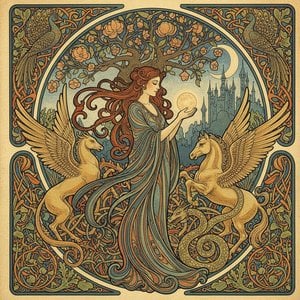
- His style is often characterized as belonging to the Art Nouveau movement, featuring intricate details and flowing lines.
- As his eyesight began to decline, Housman gradually shifted his focus from illustration towards writing.
Literary Career & Playwriting
- Housman’s literary career blossomed in the early 20th century. He published his first novel, An Englishwoman's Love-letters, anonymously in 1900.
- He became best known as a playwright, with works such as Bethlehem (1902), Angels and Ministers (1921), and Victoria Regina (1934).
- Victoria Regina, a play about Queen Victoria, faced censorship issues initially but became a success after restrictions were relaxed.
- He also wrote fairy tales, fantasy stories with Christian themes, and socialist/pacifist pamphlets.
Influences & Themes
- Key Influences: His brother A.E. Housman’s poetic sensibility, as well as the broader literary and artistic currents of his time.
- His work often explored themes of social justice, religious questioning, and human relationships.
- Housman's plays frequently challenged conventional norms, depicting biblical figures and members of the royal family on stage – a controversial act at the time.
Activism & Historical Significance
- Suffrage Movement: Housman was a committed feminist and actively supported the women’s suffrage movement, creating banners and propaganda for the cause.
- He participated in protests and rallies advocating for women's rights.
- Housman’s diverse body of work reflects his intellectual curiosity and social conscience.
- His legacy extends beyond his artistic achievements, as he contributed to important social and political movements of his era.
- Death: Laurence Housman died on 20th February 1959, leaving behind a rich and varied body of work that continues to be appreciated today.