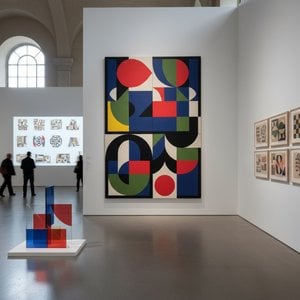
Joseph Schillinger: Bridging the Divide Between Music and Mathematics
Joseph Schillinger (1890 – 1974) stands as a singular figure in 20th-century art, recognized not merely for his striking visual compositions but also for his pioneering exploration of the intersection between music and mathematics. He wasn’t simply an artist; he was a philosopher attempting to articulate fundamental truths about existence through creative expression.
Born in Munich, Germany, Schillinger possessed an innate fascination with both disciplines from a young age. His father, a professor of physics, instilled in him a rigorous intellectual curiosity, while his mother nurtured his musical inclinations. This dual influence profoundly shaped his artistic vision – he believed that the universe itself operates according to mathematical principles and sought to translate these concepts into aesthetically compelling artworks.
Schillinger’s artistic journey began in earnest during the Bauhaus period (1919-1933), where he honed his skills under Walter Gropius, absorbing the revolutionary ideas of functionalism and geometric abstraction. However, it was after relocating to New York City in 1937 that Schillinger truly blossomed as an independent artist. He established a studio in Greenwich Village and embarked on a prolific creative output, producing canvases that captivated audiences with their mesmerizing color palettes and intricate geometric patterns.
His most celebrated work is arguably ‘Key Blue,’ created in 1934. This monumental painting—a vibrant expanse of ultramarine blue punctuated by subtle shades of violet and gray—became synonymous with Schillinger’s artistic philosophy. It exemplifies his belief that color itself possesses mathematical properties, reflecting the harmonic relationships inherent in musical scales.
Schillinger's theoretical framework, termed “Musical Geometry,” proposed a radical reimagining of artistic creation. He argued that artists should consciously utilize mathematical ratios and proportions to achieve visual harmony—a concept he elaborated extensively in his book ‘Musical Geometry’ (1948). This groundbreaking work garnered considerable attention from mathematicians and physicists alike, demonstrating the artist's ability to engage with complex scientific ideas.
Throughout his career, Schillinger continued to refine his artistic technique, experimenting with various mediums—primarily acrylic paint—to achieve unparalleled luminosity and textural depth. His canvases are characterized by a deliberate layering of colors and forms, creating an illusionistic effect that transcends mere representation. He sought not to depict reality but rather to evoke emotional resonance through the manipulation of visual elements.
Schillinger’s legacy extends beyond his artistic output; he championed the dialogue between art and science, fostering a collaborative spirit that challenged conventional boundaries. His work remains influential today, inspiring artists and thinkers alike to consider the profound connections between seemingly disparate fields of inquiry. Joseph Schillinger's contribution to both visual arts and intellectual discourse cemented his place as an extraordinary innovator—a true visionary who dared to explore the hidden harmonies of the cosmos.