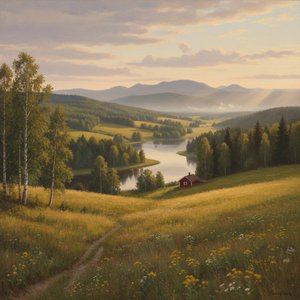
Johan Gustaf Thun (1798 – 1843): A Pioneer of Swedish Landscape Painting
Johan Gustaf Thun was a pivotal figure in the development of Swedish landscape painting during the Romantic era, establishing himself as one of the foremost artists of his time. Born in Vänersborg, Sweden, in 1798, Thun’s artistic journey began with an early fascination for drawing and sketching, nurtured by his father, who instilled in him a love for observation and meticulous detail—qualities that would define his distinctive style. His formative years were marked by exposure to the burgeoning intellectual currents of the period, including discussions on Classical art and philosophy, which profoundly shaped his artistic sensibilities.
- Early Influences: Thun’s initial training encompassed both academic instruction and independent study, allowing him to absorb diverse artistic traditions. Notably, he traveled extensively throughout Europe during his youth, immersing himself in the landscapes of Italy and Germany—experiences that would fuel his passion for capturing the sublime beauty of nature with unprecedented accuracy.
- The Vänersborg Landscape: Thun’s oeuvre is overwhelmingly dominated by depictions of Vänersborg Lake and its surrounding environs, a region he considered to be particularly receptive to artistic inspiration. He meticulously documented every nuance of light, color, and texture, employing techniques honed through years of painstaking observation—a hallmark of his approach that distinguishes him from many of his contemporaries.
- Technique & Style: Thun’s distinctive style can be characterized as a synthesis of Romantic idealism and Classical precision. He favored etching and watercolor, skillfully blending tonal gradations to convey atmospheric depth and luminosity. His etchings, particularly those depicting Vänersborg landscapes, are renowned for their remarkable detail and expressive quality—a testament to his mastery of printmaking techniques.
Major Achievements & Recognition
Thun’s artistic reputation soared during the 1830s, culminating in widespread acclaim for his monumental landscape paintings. His magnum opus, *The Vänersborg Landscape*, completed in 1831, remains a cornerstone of Swedish Romantic art history—a breathtaking panorama that captures the grandeur and serenity of Lake Vänersborg with unparalleled artistry. The painting’s meticulous rendering of geological formations, vegetation, and atmospheric conditions cemented Thun's place as one of Sweden’s most celebrated landscape painters. Furthermore, he was elected into the Royal Swedish Academy of Arts in 1832—a prestigious honor that underscored his artistic stature and ensured his legacy would endure for generations to come.
- Notable Paintings: Beyond *The Vänersborg Landscape*, Thun produced numerous other significant works exploring diverse aspects of the Swedish countryside, including scenes from Sävar Churchyard and landscapes around Stockholm.
- Influence on Contemporary Artists: Thun’s artistic vision exerted considerable influence on younger painters emerging during his lifetime—inspiring them to adopt similar observational methods and stylistic conventions.
Historical Significance & Legacy
Johan Gustaf Thun stands as a symbol of Swedish Romantic idealism—a champion of artistic integrity and unwavering devotion to the pursuit of beauty. His meticulous rendering of Vänersborg landscapes not only documented the visual splendor of his region but also served as an emblem of Sweden’s connection to nature—a theme that resonated deeply with audiences across Europe during the 1830s. Thun's work continues to inspire artists and scholars alike, cementing his position as one of the most important figures in Swedish art history—a testament to the enduring power of observation and artistic excellence. His legacy persists today through reproductions of his paintings and etchings, ensuring that his vision of Sweden’s landscape remains vividly alive for future generations.
Further Exploration
For more information about Johan Gustaf Thun's life and work, consult scholarly publications on Swedish Romanticism and Landscape Painting. Explore online resources dedicated to art history and biographical studies to gain a deeper understanding of his artistic contributions and their lasting impact on the cultural landscape of Sweden.