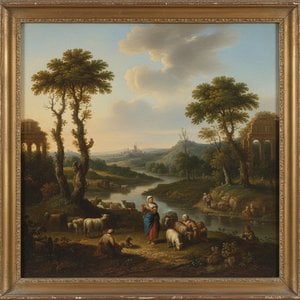
A Fleeting Glimpse: The Life and Art of Johan Daniel Koelman
Johan Daniël Koelman, a name that whispers through the annals of 19th-century Dutch painting, represents a poignant intersection of realism, landscape artistry, and a tragically short life. Born in The Hague on December 30, 1831, Koelman emerged during a period of burgeoning artistic exploration within the Netherlands. His untimely death at just twenty-five years old, on March 16, 1857—also in The Hague—left behind a modest but compelling body of work that continues to resonate with its quiet beauty and skillful execution. While his career was cut short, Koelman managed to establish himself as a promising talent, deeply connected to the emerging Hague School aesthetic, known for its naturalistic depictions of Dutch life and landscapes.
Early Training and Artistic Development
Koelman’s artistic journey began with formal training at the prestigious Royal Academy of Art in The Hague. This foundational education provided him with the technical skills necessary to pursue his passion for both figurative painting and landscape work. He quickly demonstrated an aptitude for capturing light and atmosphere, qualities that would become hallmarks of his style. In 1855, a significant milestone arrived when Koelman was awarded the prestigious Prix de Rome—a highly coveted prize that offered young Dutch artists the opportunity to study in Rome. This award speaks volumes about the early recognition of his talent and potential within the established art community. Although details surrounding his time in Rome remain scarce, it is reasonable to assume this experience broadened his artistic horizons and exposed him to a wider range of influences, though he ultimately remained deeply rooted in Dutch subject matter upon his return.
The Hague School Influence and Koelman’s Style
Koelman's work is inextricably linked to the Hague School, a group of artists who rejected the highly polished academic style prevalent at the time, opting instead for a more direct and realistic portrayal of everyday life and the natural world. Artists like Johan Marinus Fontanus and Hendrik Willem Mesdag were key figures in this movement, and their influence can be seen in Koelman’s paintings. He shared their commitment to *plein air* painting—working outdoors directly from nature—and a muted palette that accurately reflected the often-overcast skies and subtle tones of the Dutch landscape. His figurative works, while less numerous than his landscapes, exhibit a similar sensitivity to light and character. Koelman’s paintings aren't grand historical narratives or idealized portraits; they are intimate glimpses into the lives of ordinary people and the quiet beauty of the Dutch countryside. He excelled at capturing the transient effects of weather and the emotional resonance of specific locations.
Themes and Notable Works
The core themes within Koelman’s oeuvre revolve around the interplay between humanity and nature, often depicting scenes of coastal life, rural landscapes, and everyday moments. While a comprehensive catalogue raisonné of his work is lacking, several paintings offer insight into his artistic concerns. Works like “Inscheping van marmer op het strand van Carrara” (Embarkation of Marble on the Beach of Carrara), housed in the Dordrechts Museum, exemplifies his ability to render complex scenes with meticulous detail and atmospheric depth. The painting captures a bustling harbor scene, focusing not just on the physical labor but also on the interplay of light and shadow across the water and stone. His landscapes frequently feature expansive skies, evocative cloud formations, and subtle gradations of color that convey a sense of mood and atmosphere.
Legacy and Historical Significance
Despite his brief career, Johan Daniel Koelman left an indelible mark on Dutch art. His paintings are held in esteemed museum collections such as the Rijksmuseum in Amsterdam and the Musée d'Orsay in Paris—testament to their enduring quality and artistic merit. Koelman’s work serves as a valuable example of Hague School realism, capturing the essence of 19th-century Dutch life with sensitivity and skill. He represents a generation of artists who sought to break away from academic conventions and embrace a more direct and honest portrayal of the world around them. While his output was limited by his untimely death, the paintings he did create continue to offer viewers a fleeting glimpse into a bygone era—a testament to the power of observation, atmosphere, and the enduring beauty of the Dutch landscape. His art reminds us that even a short life can leave behind a lasting legacy.