Han Shuli: A Journey Through Tibetan Landscapes and Artistic Exploration
Han Shuli (韩书力), born in Beijing in 1948, stands as a prominent figure in contemporary Chinese art, distinguished by his unwavering dedication to capturing the ethereal beauty of Tibet and its profound cultural heritage. His artistic journey began with formal training at the Central Academy of Fine Arts, establishing him firmly within the tradition of realist painting while simultaneously fostering an innovative approach rooted in observation and emotional resonance.
Shuli’s formative years coincided with the tumultuous era of Mao Zedong's Cultural Revolution, a period that profoundly impacted Tibetan society. Witnessing firsthand the upheaval and displacement experienced by his homeland instilled within him a deep empathy for Tibetan culture and spirituality—themes that would permeate throughout his oeuvre. Notably, he embarked on an extended expedition to Tibet in 1973, immersing himself in the landscape and traditions of the region, which served as an enduring source of inspiration.
His artistic breakthrough arrived with “The Drawing of the Golden Ballot Box,” a collaborative project undertaken alongside Yu Xiaodong and Ngawang Dragpa. This artwork powerfully conveyed the essence of Tibetan democracy—the election of the Panchen Lama—highlighting Shuli’s commitment to documenting significant cultural events and promoting understanding between Tibetans and the wider world.
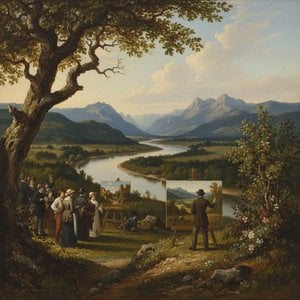
A retrospective exhibition organized by the National Museum of China in 2013 showcased a remarkable collection of ninety works spanning his entire artistic career. These paintings, predominantly landscapes imbued with Tibetan symbolism—mountains, glaciers, monasteries—demonstrate Shuli’s masterful technique and unwavering focus on conveying emotion through color and form. His distinctive style, characterized by meticulous detail and subtle tonal variations, reflects the influence of masters like Hans Baldung Grien and Holbein the Younger.
Further cementing his reputation as a respected artist was his participation in the International Art Exhibition held in Louvre Paris in 2013, where he presented “The Melting Glacier,” a captivating canvas that exemplifies Shuli’s ability to capture the sublime grandeur of Tibetan nature. His continued artistic exploration and dedication to portraying the spirit of Tibet solidify Han Shuli's place as one of China’s most significant contemporary painters.
- Awards: Gold Medal - National Art Exhibition (1980); Silver Medal - International Art Exhibition – Louvre Paris France (2015)
- Exhibitions: Han Shulin Retrospective - Solo exhibition - National Art Museum of China China (2013); 04.12 15.12 Ode au Tibet – collective exhibition – Times Art Museum Beijing China (2013); International Art Exhibition – Louvre 2013 – Paris France (2013); Han Shuli - *The Melting Glacier* - Solo exhibition - Macao Museum Macao (2017)
His work continues to resonate with audiences worldwide, serving as a testament to the transformative power of artistic observation and the enduring beauty of Tibetan landscapes.