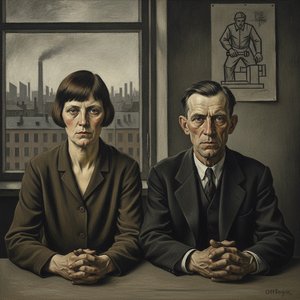
A turbulent childhood: Pflug’s early life was deeply affected by the turmoil of World War II. To avoid bombings, she lived with various family members and friends outside of Berlin.
Introverted nature: This instability fostered an introverted personality, leading her to find solace in books, paper, and crayons.
Early artistic spark: Regular visits to the Städel Museum in Frankfurt sparked a lifelong interest in framed landscapes; she began making ink drawings of views from her apartment window.
Artistic Journey and Development
Parisian Studies: In 1953, Pflug moved to Paris to study fashion design. This is where she met her future husband, Michael Pflug.
Husband’s Influence: Michael Pflug encouraged and supported her artistic pursuits, playing a crucial role in her development as an artist.
Early Themes: Her early work focused on landscapes and still lifes while living in Tunis, Africa during her husband's medical internship.
Relocation to Canada: The Pflugs moved to Toronto, Canada in 1959, where Christiane began painting her most recognizable series.
Style and Characterization
Magic Realism: Pflug’s work is characterized by the use of magic realism, emphasizing fantastical and mysterious elements within realistic depictions.
Distinctive Approach: She developed a unique approach to this style, creating a body of work that continues to intrigue art enthusiasts.
Recurring Motifs: Her paintings often feature city landscapes from her window, interiors with dolls, and portraits – particularly of her daughter and art dealer Avrom Isaacs.
Containment & Reflection: Many works utilize windows and reflections to create a sense of containment and explore the interplay between interior and exterior worlds. *Kitchen Door with Ursula* is a prime example.
Major Achievements and Recognition
Teaching Position: Pflug held a teaching position at the Ontario Art College (now OCAD) in Toronto during the 1960s.
Gallery Exhibitions: Her work was exhibited in several galleries, including retrospectives at the Winnipeg Art Gallery (1966), Justina M. Barnicke Gallery (1969), and the Alix Art Gallery (1971).
Public Collections: Paintings by Christiane Pflug are now held in the collections of the National Gallery of Canada and the Art Gallery of Ontario.
Historical Significance and Legacy
A Unique Voice: Despite a tragically short life, Christiane Pflug established herself as a significant figure in Canadian art.
Exploration of Inner Worlds: Her work offers poignant reflections on life and the human condition through her distinctive magic realist style.
Posthumous Recognition: A play based on her life, *Christiane: Stations in a Painter’s Life*, was produced in 1996, further cementing her legacy.
Tragic End: Pflug died by suicide in 1972 at the age of 36, leaving behind a compelling and enduring body of work.
WahooArt.com संपादकीय टीम द्वारा
कला प्रश्नोत्तरी
प्रत्येक प्रश्न का केवल एक ही सही उत्तर है।
प्रश्न 1:
Christiane Pflug's early life was significantly impacted by what major historical event?
प्रश्न 2:
Pflug is primarily associated with which artistic movement?
प्रश्न 3:
Before dedicating herself to painting, Pflug initially studied what in Paris?
प्रश्न 4:
A recurring theme in Pflug's work is the depiction of…
प्रश्न 5:
Where did Christiane Pflug ultimately settle after living in Tunis and Munich?