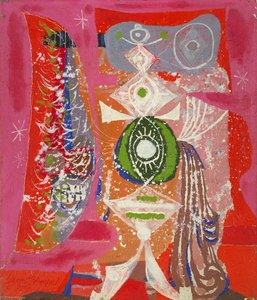
Byron Browne (1907 – 1961) stands as a cornerstone figure in the burgeoning field of American Abstract Expressionism, recognized primarily for his contributions to mural commissions and collaborations with Hans Hofmann. Born in London, England, Browne’s artistic journey began amidst the vibrant Pre-Raphaelite movement, profoundly shaping his aesthetic sensibilities before he embraced the radical experimentation of postwar abstraction. His formative years were marked by exposure to influential artists like Ford Madox Brown, whose visionary approach to Victorian social commentary instilled a deep appreciation for conveying complex ideas through visual language.
Early Influences: Browne’s initial artistic explorations centered around landscapes and portraits, reflecting the stylistic conventions of his time. However, he quickly gravitated toward Hofmann's teachings at Provincetown Art Colony, where he honed his skills in color theory and compositional techniques – principles that would become integral to his distinctive style.
Provincetown Collaboration: Browne’s partnership with Hofmann proved pivotal in establishing him as a leader within the American Abstract Artists Group (AAA). Together, they tackled ambitious mural projects for public spaces across the United States, notably the “Massachusetts State House Mural” and “The Metropolitan Opera House Mural,” demonstrating a commitment to large-scale artistic endeavors that pushed boundaries of expression.
Distinctive Style: Browne’s paintings are characterized by layered textures, bold color palettes—often dominated by rosy hues reminiscent of Hofmann's favored shades—and dynamic brushstrokes. He skillfully blended elements of Surrealism and Cubism, creating compositions that evoke emotional resonance while simultaneously engaging with geometric forms.
Notable Works: Among his celebrated paintings are “Jester,” a captivating depiction of expressive gesture and color harmony; “Abstract Collage,” showcasing meticulous layering and textural interplay; and “Rosy Brown Hues,” which exemplifies Browne’s masterful manipulation of chromatic hues to convey mood and atmosphere. These pieces continue to inspire admiration for their artistic innovation and enduring beauty.
The Impact of Hofmann's Influence
Hans Hofmann’s mentorship undeniably catalyzed Byron Browne’s artistic evolution, propelling him toward the forefront of Abstract Expressionism. Hofmann championed a revolutionary approach—the “push-pull” technique—which encouraged artists to confront color and form directly, bypassing representational conventions altogether. This method resonated deeply with Browne, who adopted it as his core compositional strategy, resulting in canvases that pulsate with energy and convey profound emotional depth. The AAA group’s collective pursuit of artistic freedom mirrored Hofmann's ethos, fostering a dialogue about the role of art in addressing societal concerns—a legacy that extends far beyond Browne’s own oeuvre.
Legacy & Historical Significance
Byron Browne’s contribution to American Art History is undeniable. He wasn’t merely an artist; he was a catalyst for change, embodying the spirit of experimentation and innovation that defined the postwar era. His murals served as powerful statements about civic responsibility and artistic vision—testaments to the transformative potential of art in shaping public discourse. Browne's enduring influence can be seen in subsequent generations of artists who embraced abstraction and sought to communicate complex ideas through visual mediums, cementing his place as a pivotal figure in the history of modern American Art.
Explore the life & work of Jacob Kainen, a pivotal figure in American Abstract Expressionism and Color Field painting. Discover his journey from Social Realism to vibrant abstraction and lasting influence on 20th-century art.
होटल डिजाइनरों के लिए नवीनतम भित्तिचित्र रुझानों का मार्गदर्शन। जंगल दृश्यों से लेकर सोने की पत्ती तक, अपनी जगह को अद्वितीय बनाएं। विशेषज्ञ सलाह और प्रेरणा पाएं।
अमूर्त अभिव्यंजनावाद की 10 उत्कृष्ट कृतियाँ जानें! पोलक, रोथको जैसे कलाकारों के अनूठे रंगों और भावनाओं का अनुभव करें। WahooArt.com पर कला इतिहास की गहराई में जाएँ और अपने घर के लिए अद्वितीय सजावट खोजें। ऑनलाइन संग्रह देखें!